Activity
Mon
Wed
Fri
Sun
Oct
Nov
Dec
Jan
Feb
Mar
Apr
May
Jun
Jul
Aug
Sep
What is this?
Less
More
Ruth Performance Lab
358 members • Free
6 contributions to Ruth Performance Lab

Apr 3 •
Post QF Focus?
I’m curious about what everyone’s focus is post QF? Athletes: if you’re not moving on to semifinals - what is your plan for the “off season”? Will you compete this year in some in-person events? Dabble in Hyrox? ATHX? Xenom?! (The name 😂) Coaches: what are you preparing your athletes for? What is the primary training focus for your clients as you shift into the off season?

0 likes • Apr 5
No athletes I program for, but biggest thing for me is getting into classes more this year and working on my weaknesses outside of class. Lots of skill work and lifting for this guy, plus some running!
Mar 24 •
2026 Quarterfinals Strategy Guide
This is a big one - spent a lot of time getting my thoughts in place here. I'm sure as people test workouts and we've had a chance to get a feel for some of these today / tomorrow that some of this will change... but this is a good snapshot of my initial thoughts.
1 like • Mar 26
Hit the strict hspu workout and went 17:58! Holding the 5k pace or a little slower was a great pacing strategy. Held 5’s every :30 and i was super proud of that!
0 likes • Mar 26
Held 5k pace pretty strong on the first set, did grace in 5 minutes, then was a little slower than my 5k pace which i think helped a ton
0 likes • Mar 8
@Kyle Ruth assuming i redo Monday, how do you think somebody should approach it with 7-9 unbroken ring muscle ups? (Yes this is for me) lol
1 like • Mar 9
@Kyle Ruth forgot to respond to this, but redo went down and got 2 more reps! Decided to speed up the lunges a tad (I did not lunge faster but didn’t rest over the dumbbell as much), broke up the db snatches, went 8 and 4’s on both pull-ups and chest to bar. Got to the rings and held 2 every :35ish seconds with a set of 3 and 2 to close it out. 15 ring muscle ups!
Mar 5 •
26.2 Strategy Guide
Here is this week's strategy guide - this is basically just a test of RMU as you clearly saw in the demo. I've tried to give some strategy and points of performance around preserving the RMU by the end. GOOD LUCK AND LET US KNOW HOW IT GOES!
1 like • Mar 5
I was just about to ask about this! Fired up for this one!
Mar 4 •
Density Progressions: The Missing Programming Variable
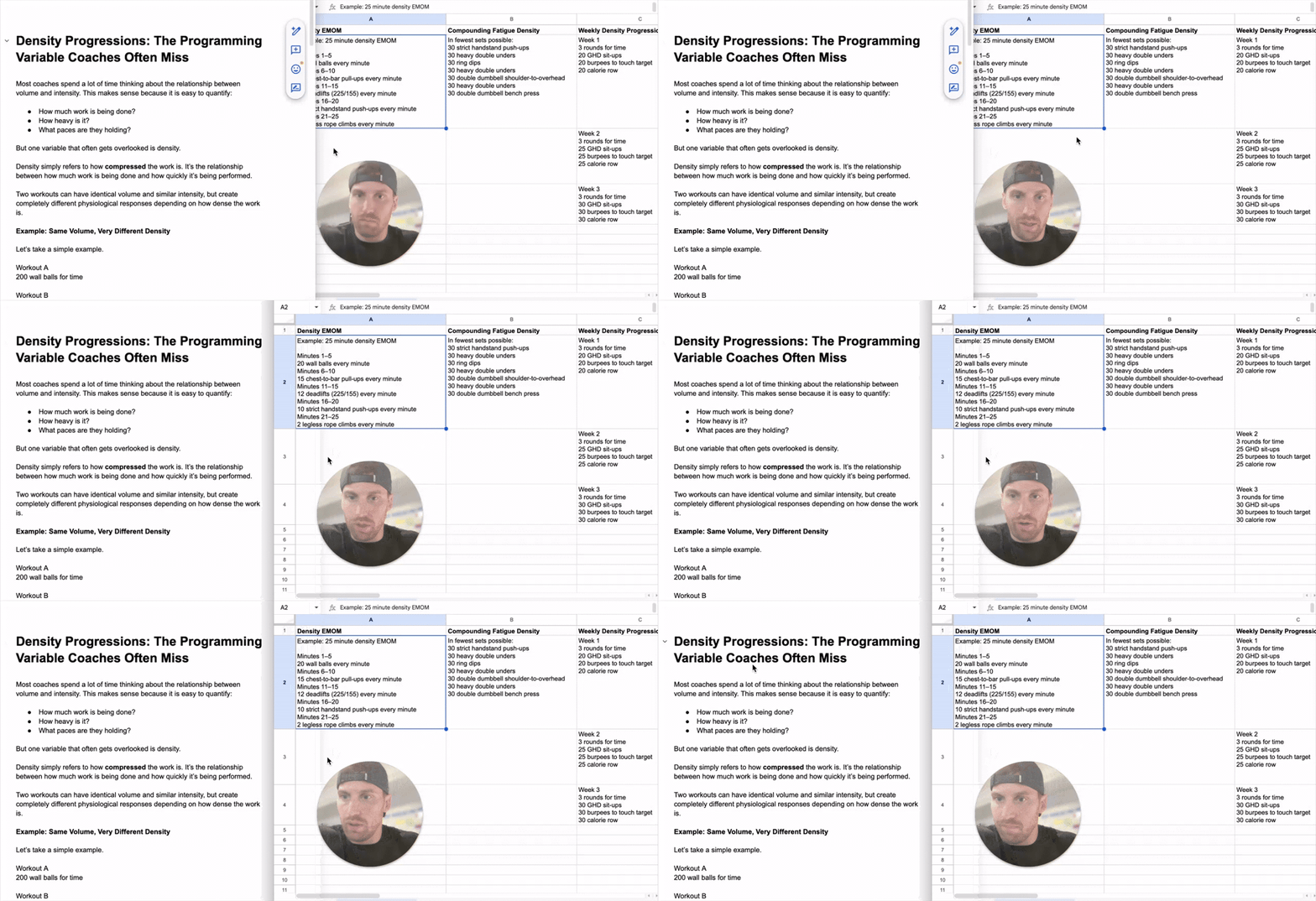
Density Progressions: The Programming Variable Coaches Often Miss Most coaches spend a lot of time thinking about the relationship between volume and intensity. This makes sense because it is easy to quantify: - How much work is being done? - How heavy is it? - What paces are they holding? But one variable that often gets overlooked is density. Density simply refers to how compressed the work is. It’s the relationship between how much work is being done and how quickly it’s being performed. Two workouts can have identical volume and similar intensity, but create completely different physiological responses depending on how dense the work is. Example: Same Volume, Very Different Density Let’s take a simple example. Workout A 200 wall balls for time Workout B 10 wall balls every minute on the minute for 20 minutes In both cases, the athlete is doing 200 wall balls. But the experience and the physiological response are completely different. In the “for time” version, the work is much more dense. Fatigue accumulates continuously. Metabolites build up. Intramuscular pressure increases. Perfusion drops. Tension under fatigue increases as the athlete tries to maintain movement speed. All of this creates a much more stressful internal physiological environment. You get: • More accumulated fatigue • Less metabolite clearance • More ischemia inside the working muscles • More tension being produced while the muscle is already fatigued That combination dramatically increases the amount of muscular damage and soreness that athletes experience. In the EMOM version, every minute includes a built-in rest period. That rest allows partial clearance of metabolites, restoration of blood flow, and recovery of force production. The volume is the same, but the density is much lower, so the physiological cost is very different. Why Density Matters in CrossFit Density becomes even more important when we consider the nature of the sport. CrossFit workouts tend to be very dense especially formats like:
0 likes • Mar 5
Question, in the 25 minute emom, how are you considering wallballs, chest to bar, deadlifts, HSPU’s and rope climbs the same movements? Or are you generalizing the similar muscles being used when picking those movements?
1-6 of 6
Active 14d ago
Joined Feb 27, 2026
Powered by