Activity
Mon
Wed
Fri
Sun
Aug
Sep
Oct
Nov
Dec
Jan
Feb
Mar
Apr
May
Jun
Jul
What is this?
Less
More
Memberships
Human AI Alliance
526 members • Free
Art of Birding
17 members • $2/month
3 contributions to Art of Birding
24d •
Where goes the Henslow's?
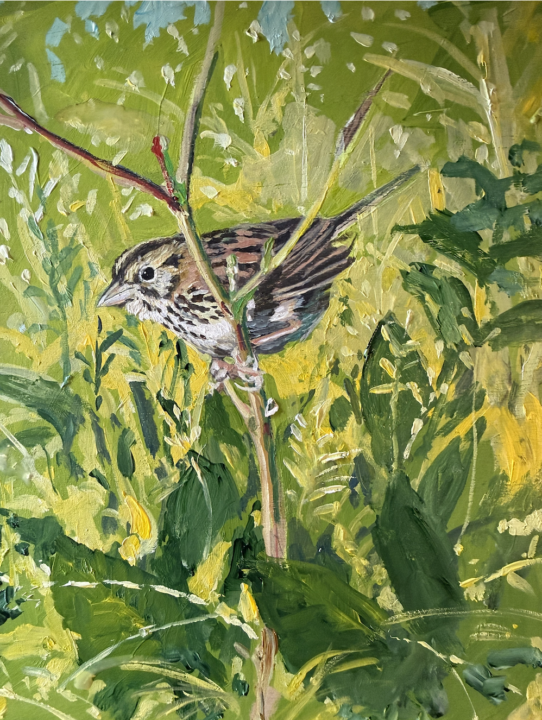
I have a concern. During many years of bird counting at Dick Young Forest Preserve's restored prairie west of Nelson Lake, there were healthy numbers of Henslow's sparrows singing on breeding territories. So far this year? Nothing. Not a single "tsi-lick!" to be heard. Nor are there sedge wrens, whose "chapp-chapp-chapperrr" calls were common too. For the last three years, I've not heard Savannah sparrows or grasshopper sparrows either. They disappeared a few years ago too. Climate change? I am instead concerned that the mid-June mowing practices of the Kane County Forest Preserve District to remove purple clover have eclipsed the breeding prospects of these grassland bird species. If I'd heard even one Henslow's, I might be able to imagine there are more just waiting to be heard on a less windy day. I began this painting a few years ago and finished it today. A Henslow's sparrow in the scrubby restored prairie habits they frequent. Where goes the Henslow's? So far, nobody knows. I'm not the greatest scientist in the world. I finally caught up (almost) on sighting and listening records on eBird. Attention deficit on my part equaled delays in entering data. Fortunately, I've taken photos of Henslow's and other species along the way. Today the list included bobolink (many male and females), dickcissel (dozens) Eastern and Western meadowlark, song and field sparrows, goldfinch, barn and rough-winged swallow, red-winged blackbird, killdeer, Caspian tern (flyover), dozens of yellowthroats, pied-billed grebe in the wetland, Eastern kingbird, phoebe, Eastern bluebird, starling, house finch, and robins. For the record, here's a montage of Henslow's photos

1 like • 23d
per your quote: "concerned that the mid-June mowing practices of the Kane County Forest Preserve District to remove purple clover" Who do we talk to about this?
Jan 24 •
Owls teach us how to camouflage
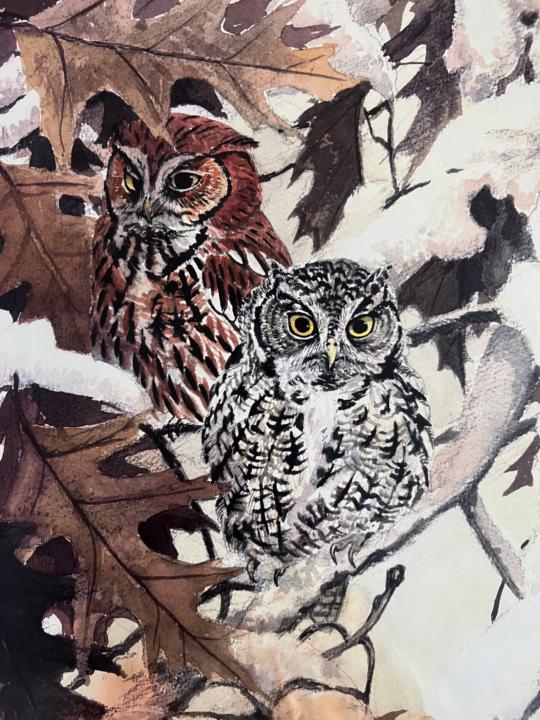
I produced this #watercolor painting of screech owls in their gray and red phases. The divided composition positions their relative cryptic coloration in context with reddish-ochre oak leaves on one side and bare branches with snow on the other. #Genetics drives these variations as part of #evolution and #naturalselection. These birds are hard to see in #nature, as cryptic coloration does its job of camouflage. Human enterprise copies these principles in #military #gear, including uniforms for use in diverse #habitats from woodland to desert to snowy landscapes. Even oceangoing vessels and aircraft employ visual tricks to avoid detection. Owls evolved softened feather edges to enable nearly silent flight while hunting. Stealth aircraft manipulate radar waves using unique shapes, specially textured materials, and other signatures to evade sensors. But if you really want to know how to hide, ask an owl. #artist #art #birding #education #nature
1 like • Feb 28
Chris and I go way back... I have a painting of a barn owl he painted while we were dorm neighbors at Luther College. It hangs in my office, I'll share a photo of it at some point.
0 likes • Mar 7
Barn Owl by Cudworth 1978

Jan 13 •
The American River in Central California
I live alongside the American River in central California where the nature preserve of the American River Parkway provides wonderful access to tranquility and wildlife in an urban area. https://arpf.org/visit/int-map-wpp/
0 likes • Feb 28
I've floated the American River on a trip to Folsom about 30 years ago, fun to see it mentioned.
1-3 of 3
@bob-snodgrass-5027
I guess I need to add a bio; outdoors, gardening, and Drupal
Active 23d ago
Joined Jan 13, 2026
INTJ
St Charles IL