Activity
Mon
Wed
Fri
Sun
May
Jun
Jul
Aug
Sep
Oct
Nov
Dec
Jan
Feb
Mar
Apr
What is this?
Less
More
Memberships
What Do You Want? Library
77 members • Free
5 contributions to What Do You Want? Library

Oct '25 •
Episode of the Week (11/3-11/10)
🔥THIS WEEK'S EPISODE TO STUDY AND REVIEW 🔥- #255 Sam Zemurray (Banana King). If you really like that one, there's also the first time David went through that book, Episode #37, and another time he went through it, not labeled as an episode number, just titled "Sam Zemurray (The Fish That Ate the Whale)! There will be an episode posted to study for updated here each week so we can discuss the principles from it and how to implement them in our businesses and lives on the live calls, and at any time during the week here when we learn or realize something we want to share!


1 like • Nov '25
@Max Baldauf Sam Zemurray seemed like a lovely chat! I could picture him in a meeting, skipping over pleasantries, and cracking right down to business. I'll do the same in his honor: What impacted me most: Sam spotted opportunity where others saw nothing. He bought Honduras land for pennies while everyone else ignored it. By the time they realized its value, game over. That's grounding flooring right now ($385B flooring industry) with ZERO wellness innovation. Wellness Amenities will become the new premium benchmark, as traditional amenities (no matter the high-end appeal) will become a requirement from occupants/residents/customers/clients/guests - all the way from Motel 6, up to the Four Seasons. Seeing this writing on the wall at the end of 2024, I started to strategically file a series of patents/trademarks together forming an impenetrable IP mote around this entire category, before anyone sees this becomes a multi-billion dollar category. Here's what Sam did differently: Sam built physical infrastructure (ships, ports, railroads). We're building IP infrastructure (patents, certifications). Both create toll booth economics, but are IP moats actually stronger or weaker than physical infrastructure in 2025? My thoughts: You can build competing ships. You can't build around overlapping patent claims without massive legal exposure. Sam's advantage was capital + speed. Mine is IP + speed. The lesson I'm taking: When "certain cards sit unclaimed," you have maybe 18-24 months before that window closes forever. My Advice to my fellow Fanatics of Founders: If you are passionate about something enough, and you can see the change happening all around you (subtly), the best practice is to keep your ego out of it (it's bigger than you anyways)...Do not shout your idea from the mountaintops, but secure the idea first. When the value hits on your idea, no one will be able to compete. Come at these monumental moments in your life with "Quiet Strength" - as Tony Dungy (Former NFL Coach/Hall of Famer) said best.
Nov '25 •
Building a Patent Monopoly One Habit at a Time (Nov 6 Deadline)
What's up Habit Engineers! Ryan Bowne here, Founder/CEO of Terra Grounding Floors. Quick intro: I'm building the category-defining company in bioelectrical wellness infrastructure. We own the patent fortress (US 63/894,583) that controls who can and cannot create grounding flooring technology - basically the 'toll booth' model for the entire $875B wellness real estate market. Why I'm here: Building Terra requires me to compound 1% improvements daily just like Max teaches. Current habit stack: 4:30am wake → grounding meditation → morning prayer → patent strategy → family breakfast at 7 → partner negotiations → 6pm family dinner (non-negotiable) → kids' bedtime prayers → evening strategy for next day's agenda → repeat. The Triple S Method keeps me locked in while juggling IP law, manufacturing partnerships, and a November 6 deadline that determines market control. Favorite Podcast: How I Built This Episode: Stewart Butterfield - Slack Why this hits different: Everyone knows Slack's $27B exit, but this episode reveals something deeper - Stewart failed TWICE building games (Game "Neverending" and "Glitch") before accidentally creating Slack from internal tools. Key insight that changed how I'm building Terra: Stewart says 'We didn't build Slack to be a business. We built it to solve our own problem, then realized everyone had that problem.' This mirrors Terra exactly. I started trying to solve my own cortisol issues through grounding. Built the solution and immediately started filing patents/trademarks to lock down this entire category. Three key takeaways that compound: 1. Category creation > Competition - Slack didn't compete with email, they created 'work messaging' 2. Infrastructure becomes invisible but essential - Nobody thinks about Slack anymore, they just use it 3. Patents + Network effects = Monopoly - Stewart's biggest regret? Not filing more IP early Currently applying this to Terra: We're not competing in flooring, we're creating 'bioelectrical wellness infrastructure' as a category. By November 6, one manufacturer gets exclusive rights. By 2030, grounding floors will be as expected as WiFi.
1 like • Nov '25
@Max Baldauf Thanks a million! I try to keep it classy/honest, and if I can share knowledge/insight/strategy which worked for me, maybe it will help someone else in the same way. Here's to building tomorrow into what we need today! One micro-step forward (1% better) each day.
1 like • Nov '25
@Max Baldauf You're absolutely right, and I needed to hear this. The 1% compounded focus has gotten Terra from zero to 10 patents and $10B company negotiations in weeks - but I can already feel the cost. I haven't played hockey in 3 weeks and my physical state is sub-prime. Here's what I'm realizing: There's a difference between sprint seasons and marathon mindsets. Right now I'm in a sprint (Nov 6 deadline, active negotiations, patent prosecution, etc.). The 1% single-focus approach is necessary to win this immediate battle. But your 5-category framework is the only way to win the war without burning out. The synthesis: Use James Clear's method during critical execution windows (product launches, fundraising sprints, major deals). Use your holistic 0.2% x 5 method as the default operating system between sprints. Your point about cross-pollination is gold - some of my best business insights have come from completely unrelated areas (theology, fitness, family dynamics). When I'm only optimizing for business, I become a narrower thinker. Practical question: How do you recognize when you've been in "sprint mode" too long and need to shift back to holistic optimization? What's your forcing function to prevent the sprint from becoming your lifestyle? How do you "ground" yourself back to baseline for longevity purposes?
Nov '25 •
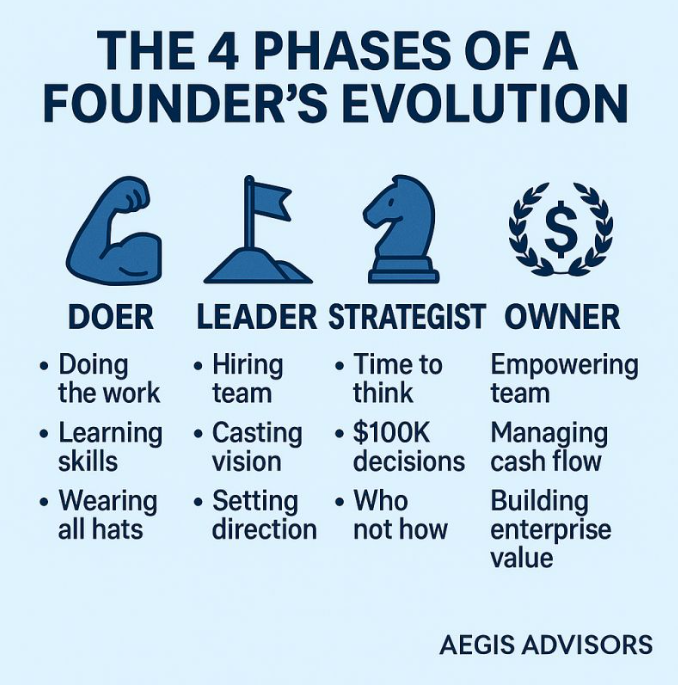
Saw this and thought it was cool
I should've announced this before, I'm sorry - Sundays are my day of rest, so I will not be active in the community those days. Eventually we'll grow this community where we'll have more than one admin to help solve problems or anything when we've got hundreds or thousands of people in here, but for now it's just me haha. I saw this this morning and thought it was a good visual aid! Let's make this week amazing!!
1 like • Nov '25
Max, this framework is spot-on. I'm living between DOER and LEADER right now and feeling the friction. Just filed 10 patent applications myself (including one at 2am this week because I couldn't sleep until it was done), but I'm also negotiating with $10B+ companies and just hired my first CFO. The cognitive dissonance is real. Here's what nobody told me: The hardest part isn't learning to delegate - it's recognizing that the habits that got you here are now holding you back. I'm literally addicted to "wearing all hats" because it feels productive, even though I know casting vision is higher leverage. The STRATEGIST phase - "Who not how" - is calling me hard. I just completed 4 patent filings that absolutely should've been delegated. But when you're the only one who truly understands the vision, letting go feels like losing control. Real question for the group: How did you know when it was time to stop being the best executor and start being the best architect? What forced your hand? (Also, shoutout to whoever invented coffee. You're the real MVP of the DOER phase.)

Nov '25 •
Traits of Founders?
The key is how do you model their actual behaviors— some are geniuses, us mere mortals have no chance of being that smart. So, here is my first take at these behaviors; this is open to discussion. I am sure I missed some. The idea is how we change ourselves to be more like the Founders? Curious to get everyone’s feedback. Once you have a clear set of traits, you can build out training, testing, and feedback loops to make the habits stick. I. Direction — How They Choose What to Work On 1. Focus They lock onto one mission and remove everything that dilutes it. Practice: Run a weekly audit: What directly advanced my mission? What distracted me? Eliminate the latter. 2. Information Arbitrage They don’t chase novelty; they exploit unnoticed value. They steal brilliance from unrelated fields and apply it faster. Practice: Study one “irrelevant” domain weekly and extract a working idea. 3. Avoid Stupidity They prevent failure more reliably than others chase genius. Practice: List the five dumbest mistakes people in your position make. Build guardrails against them. II. Thinking — How They See the World 4. First-Principles Reasoning They rebuild understanding from fundamentals, physics, math, psychology, not tradition. Practice: Write down each assumption and test it through data, not opinion. 5. Causal Mapping They think in systems, not stories. Everything is a chain of cause and effect. Practice: Diagram problems until you can trace how each link produces the next. 6. Ruthless Cognitive Clarity They strip emotion from decisions and see incentives as the true map of behavior. Practice: Replace “why” with “what caused this?” and chart it visually. III. Execution — How They Move 7. Iteration Discipline They prototype fast, fail cheap, and learn faster than anyone else. Practice: End every project by scheduling the next version. Nothing is ever final. 8. The Art of No They master subtraction. Saying no keeps velocity clean. Practice: Track how many hours you spent on what didn’t move the mission forward. Then stop doing them.
2 likes • Nov '25
@Max Baldauf 93% success rate is exceptional. Most habit interventions hover around 20-30%. Your Triple S framework (Specific, Simple, Sealed) mirrors how we approached Terra's IP strategy. Instead of trying to patent everything off rip, we got specific about the core innovation, simplified it to essential claims, and sealed it with continuation patents covering every workaround. Think of it as getting your foot through the hotel door, then bringing all the luggage in to the point that it fills the lobby entirely. The neuroscience angle strikes a chord. When I discovered grounding ("earthing") reduces cortisol by 31%, and inflammation by 71% (clinically backed) it clicked - we're not just changing flooring, we're changing the neurochemistry of indoor spaces. The habit isn't what people walk on, it's how their bodies respond to what they walk on. Integrity point hits hard. In IP licensing, your word IS your product. One broken promise and the entire partnership model collapses. I've been applying a similar framework: Say what you'll deliver, deliver what you said, document what you delivered. Curious about your Triple S Method - is the 'Sealed' component about commitment devices or something deeper? Because getting Fortune 500's to change their habits might be my next constraint to come, after my November 6 "line in the sand", as @Kendall Doble mentioned. Would love to understand how you'd approach institutional habit change vs. individual. Different beast entirely!
0 likes • Nov '25
@Kendall Doble Your mirror line is brutal truth. After reading your QR Capital journey (700 employees, $350M in development), then 2008 - that's the kind of scar tissue most founders never acquire. Your breakdown of the phases is exactly why we're keeping Terra lean through this inflection point ("Lean Startup" by Eric Ries provided me with knowledge on which expenses are important/necessary, and which ones to avoid, through the startup process). In applying what I learned from Eric, the good news is, I have no outside equity deals or partnerships to please). We could very easily chase every interested party right now, but my thoughts are - bad partnerships are like bad hires at 10x the damage. They don't just consume resources, they lock up territories and could potentially poison the entire category (not the impact we are going for with Terra). The November 6 deadline isn't about fear - it's about forcing clarity. These Fortune 500s have committees for their committees. Without a forcing function, Interface and Shaw will "explore synergies" until someone else owns the category. You clearly get this from your "changing tires while driving" comment. Love the analogy and I can visually see myself getting each lug nut on the tire while going 80mph on I-4 (left lane). It's exciting, and the feeling of being behind the 8-ball to me, is fuel and validation of being onto something major! Good enough reason to wake up at 4:30AM every day, I'd say. What resonates most is your point about founders becoming their own roadblock. The temptation at Terra right now is to over-engineer the perfect licensing structure instead of getting our first installation live and letting market feedback drive iteration. Since you've lived through all four phases: what's your take on bringing in operators early (pre-revenue) versus waiting until post-product-market fit? The conventional wisdom available says wait, but I'm wondering if the right operator DNA could accelerate us through Phase 1 without the Phase 3 politics.
Dec '24 •
Request for help in improving the community -
I know this community is already a valuable resource, but I also know there’s a TON of things that can and need to be better, or are currently missing. If there’s anything you feel like this community should have that would be valuable to you, please comment on this thread below. And if you’re looking through ideas and you see a comment you agree with that we haven’t already included, give it a thumbs up. That’ll help us prioritize which value-adds to include next for y’all :)
3 likes • Nov '25
This is exactly what the community needs. I’m in to help. Kendall’s #3 (FounderBot) is genius, but while you’re building that, here’s a bridge: Start a weekly ‘Pattern Matching’ thread where we manually do what the bot would do - someone posts a challenge, we collectively find the relevant Founders episodes and extract the pattern. For implementation, pick ONE to nail first. I’d suggest #5 (Case Studies) because it’s simplest and creates immediate value. I’ll commit to posting the first case study this week about navigating enterprise sales cycles with Fortune 500s - currently living it. Max, what specific help do you need? Technical build-out? Content curation? Beta testing? Tell us the blockers and let’s divide and conquer. Small note on #1 (Curated Paths): Add ‘Best for Intellectual Property & Licensing’ - massive blind spot for most founders that costs them millions. **This transforms the community from passive consumption to active application. That’s the difference between inspiration and transformation. Ready to pilot whenever you are.
1-5 of 5
@ryan-bowne-9741
Turning buildings into biology. Patent owner. Terra Grounding Floors. Deadline Nov 6. #GroundedLiving™ #WellnessROI™
Active 162d ago
Joined Nov 1, 2025