Activity
Mon
Wed
Fri
Sun
Apr
May
Jun
Jul
Aug
Sep
Oct
Nov
Dec
Jan
Feb
Mar
What is this?
Less
More
Memberships
AI Automation Growth Hub
3.6k members • Free
Business Builders Club
7.7k members • Free
AI Automation (A-Z)
146.1k members • Free
AI Automation Agency Hub
303.6k members • Free
AI Automation Society
297.8k members • Free
Over 40 and Unemployed
701 members • Free
AI Cyber Value Creators
8.5k members • Free
CyberCircle
84.8k members • Free
Startup Dawgs
78 members • Free
22 contributions to AI Automation Society

5d •
Is automated social media lead hunting actually viable for a local business? Need a reality check.
I have a client (a used car dealership in the US) who wants me to build an AI-powered "Lead Hunter Agent" that would: - Scan TikTok, Instagram, YouTube, and Facebook using Apify or similar tools - Detect posts, comments, and videos related to buying used cars - Identify users showing buying intent - Automatically engage with them (comments, DMs, outreach) - Capture and store those leads in a CRM I've pushed back. Here's why: - Geography: The dealer is local. Social media users could be anywhere in the US. No reliable way to filter by location when scraping. - No contact info: You only get usernames. No email, no phone. The only way to reach them is on the platform itself. - Automated engagement = banned: Meta has been mass-banning accounts for bot activity since mid-2025. You can't automate comments or DMs in Facebook groups without getting flagged. - Local Facebook groups (like "Atlanta Used Cars") do solve the geography problem — but you still can't automate conversations there. That's a human job, not an AI agent. - Cost per lead: Apify credits + LLM tokens + dev time + extremely low conversion rate = likely more expensive per qualified lead than just running geo-targeted ads. My recommendation was: skip this, invest in geo-targeted ads and local SEO. Explore Facebook groups manually first before automating anything. The client ran my analysis through ChatGPT and Claude asking them to "roast" it. Got confident counterarguments. Then when he prompted "assume the specialist is right" — both AIs immediately agreed with me. So: am I wrong? Has anyone actually built a working automated social media lead gen system for a LOCAL business? Looking for real experience, not theory. Thanks.

0 likes • 2d
Your analysis is correct - and that ChatGPT/Claude "roast then capitulate" sanity check method is genuinely useful, I'm going to steal that. The geography problem alone kills this for a local business. Even if the intent detection is perfect, you're fishing nationally for a ZIP-code-dependent dealership. The one exception worth flagging: a monitoring agent that filters location-tagged posts or surfaces relevant signals from local Facebook groups - but with a human doing the actual outreach. Not full automation, but it replaces the scroll time and gives the rep warm signals to act on rather than cold lists. For this client specifically: Google Business Profile optimization + geo-targeted Google Ads will outperform any social scraping play, with a fraction of the complexity and cost. Your pushback was right.

🔥
3d •
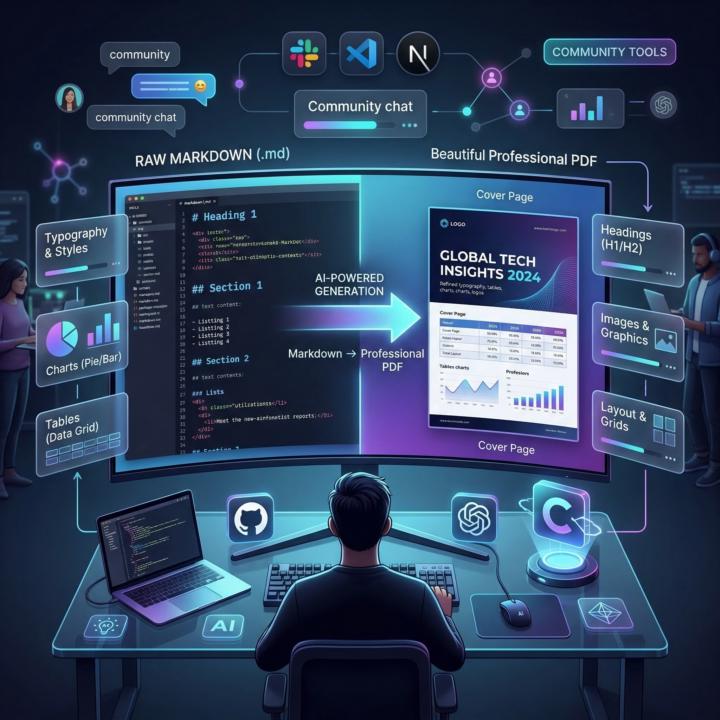
🚀 Looking for a Claude Skill to Turn .MD Files into Beautiful, Professional PDFs
Hey builders, Quick question for the community. Many of the workflows I’m running with Claude Code generate documents in .md format, which is great for structure and automation. The problem comes when converting them to PDF… they work, but they’re missing that super professional look (clean layout, typography, spacing, visual hierarchy, etc.). What I’m trying to find is a Claude Skill or workflow that can take .md files and produce really polished, client-ready PDFs. Ideally something that: - Applies professional layouts automatically - Handles titles, sections, callouts, tables, and spacing nicely - Produces PDFs you could send directly to a client or use in a report Does anyone here know a skill, tool, or workflow for this? Even better if you’ve personally tested it. Would love to hear what you’re using 🙌
0 likes • 2d
@Kyan Cordes approach is solid. The specific stack that works well in production: - Pandoc + custom LaTeX template → best for document-heavy outputs (contracts, reports) — gives proper page numbers, TOC, dense layout - md → HTML + Puppeteer/Playwright → PDF → easier visual control via CSS, better for branded/web-style deliverables - WeasyPrint → good middle ground if you want CSS control without spinning up a headless browser The template is 80% of the work. Once you have a CSS or LaTeX template that matches your brand, Claude just needs to generate clean .md and the pipeline handles the rest. For client deliverables specifically, Pandoc + LaTeX gives the most "printed document" feel. You set it up once and it just runs

2d •
Claude Code x Higgsfield
Hello everyone, lately I saw a really cool marketing agency on IG named mobileesitingclub. I was wondering can connect Claude with my Higgsfield so that Claude can write prompts in the same style ? Does anyone have experience with that? BR Naha
3 likes • 2d
@Muhammad Awais is right on the approach. Here's how to make it more systematic: Pull 10 to15 example prompts from the style you want to replicate 1. Ask Claude to identify the underlying patterns - shot type, tone, subject framing, lighting language, mood descriptors 2. Build a style template from that analysis 3. Feed the template + subject brief to Claude every time you need a new Higgsfield prompt This way you're not copying style ad hoc - you have a reusable prompt engine. Keep the template in a dedicated Claude Project so it persists across sessions and scales to any subject.

6d •
Trusting Agents More
GPT 5.4 dropped last week, and it felt like the right time to talk about something I've been thinking about: how much more we can actually trust AI agents to finish a task now, especially with the newest models. The real power of these models right now isn't in a chat window. It's in setting them up inside your terminal or an IDE, where they get actual freedom to do things they couldn't do before (file access, running code, hitting APIs). That's where the magic happens. MCP server hype has died down, but I think it is a great time to talk about them again. If you don’t know what that is, it is basically a custom server an AI agent can search to access all of the API endpoints of specific software. Here's the thing, you don't really need one handed to you anymore. Writing custom instructions for how to use a specific software platform's API lets you basically build your own. You're just treating each platform like a tool the agent can reach for when it needs to. Now, safeguards still matter. You probably don't want your agent taking out a $5 million loan on your behalf (clearly). But there's a huge range of tasks where it can get to 90, maybe even 95% done without you touching anything. And that last 5-10%? That's where you step in for the finishing touches instead of doing the whole thing from scratch. TLDR: I am realizing I can use claude code for more shit.
2 likes • 6d
This hits on something real. The terminal context is where the trust actually starts paying off. What changed for me: I stopped treating Claude Code like a chatbot and started treating it like a junior engineer with full shell access. You give it a task, a working directory, and get out of the way. The results are different.The 5 - 10% human checkpoint you mentioned is the right mental model. Where I've found it breaks down is when the agent doesn't have enough context about why something exists - it'll "fix" something in a way that breaks a dependency elsewhere. The fix: detailed AGENTS.md / MEMORY.md files in the workspace. The more context it has upfront, the fewer weird edge decisions.On MCP - agree the hype cycle was noisy, but using the API docs as a reference tool for the agent (instead of waiting for a pre-built server) is genuinely underrated. Fewer moving parts, more control.
1 like • 2d
@Kenneth Chiba That split is exactly right - Claude web as the architect, Claude Code as the builder. Works especially well when you front-load the thinking in the web session first: define the goal, sketch the structure, clarify edge cases. Then hand off to Code with a tight brief and get out of the way. The output quality is noticeably different compared to just prompting directly in Code without that up-front thinking layer.

Sep '25 •
N8n vs Make.com
So the question is n8n versus make.com? Which one is better,? They both have their ups and they both have their downs. I’m looking for some personal and professional opinions of how you feel about each program. N8N in my opinion, builds agents better and easier and I feel can do more. Make.com seems to be easier to be working with all the way across but more difficult in building out agents. I like using both platforms and both have their strong points and both have their weaknesses. The other thing that I look at with them is their cost. Self hosting with NAN is great. Don’t get me wrong. It is awesome. I do find a bit of a nuance with the self hosting and that it is something else in addition that I have to keep up with. make.com on the other hand is not self hosted, but is cloud and again building agents are a little more difficult n8n and cost wise make.com is not bad. The other thing is with NAN doing the cloud posting versus self hosting $25 a month for 2500 actual workflow usage is phenomenal. You’re not being charged for each node that is being used in a workflow. But how many times the work flows are triggered. Meaning you can have one workflow and it can run 2500 times for the $25 a month. The big question is what is everybody else’s take an opinion on this matter? I know everybody prefers make over N8N or N8N over make just looking for valued opinions and discussion
0 likes • 4d
Both have their place. After running n8n self-hosted on Coolify with Cloudflare Tunnels for production client work - n8n wins for anything needing reliability and data control. Make is faster to prototype and the visual flow is cleaner for clients to understand. But for sensitive data or zero vendor lock-in, self-hosted n8n is the answer. The $25/month cloud plan is also underrated - execution-based pricing is fair for real workloads. My rule: Make for quick client demos, n8n for production.
1-10 of 22

@aty-paul-7706
Cybersecurity & AI Solution Architect | I secure infra, clean hacks, and build smart automations with OpenClaw, n8n & Claude.
Active 7h ago
Joined Feb 13, 2026
ENTJ
Powered by