Activity
Mon
Wed
Fri
Sun
Sep
Oct
Nov
Dec
Jan
Feb
Mar
Apr
May
Jun
Jul
What is this?
Less
More
Memberships
Digital Builders
91 members • Free
Miami Real Estate
372 members • Free
Built into Mason
58 members • Free
Construction Contractors Hub
4.3k members • Free
1 on 1 Coaching
8.2k members • Free
Sophron Acquisition Systems
643 members • Free
Startup Empire
699 members • $2,999/y
14 contributions to Construction Contractors Hub

🚀
Jun 24 •
Getting better answers and more out of your Claude usage
Burning through usage always sucks and not getting high quality answers suck too. They often go hand in hand and here is a quick video on how to get more out of your usage while also increasing the accuracy of answers on a Cowork project. Grab the skills in https://www.skool.com/contractor-os/about

0 likes • Jun 25
@Tim Fairley @Josh Turner how you guys find OCRs with Claude? Is it accurate enough or make some really dumb mistakes
0 likes • Jun 25
I am not that much of user of it but looking into it for something and found Mistral is saying they are best, so was just curious https://mistral.ai/news/ocr-4/
Jun 10 •
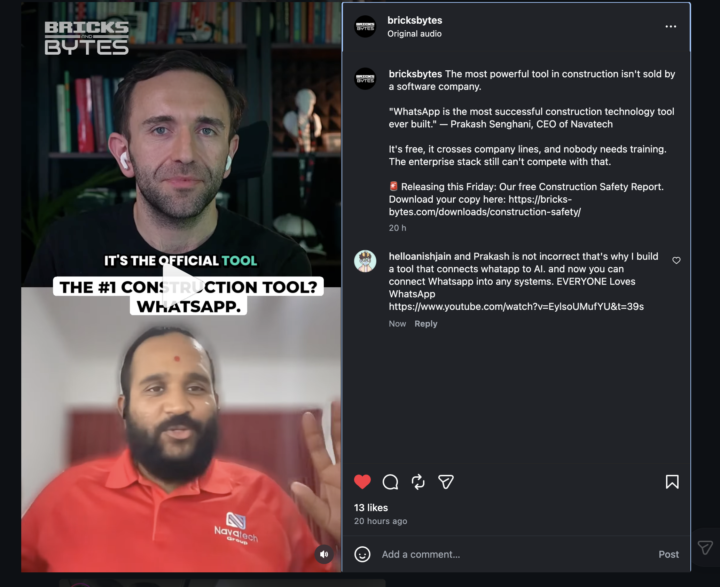
Is he is right about Whatsapp?
"WhatsApp is the most successful construction technology tool ever built." — Prakash Senghani, CEO of Navatech https://www.instagram.com/p/DZXQ8rLFaij/
0 likes • Jun 23
haha, I am biased
0 likes • Jun 23
@Tim Fairley Thanks man, means a lot

Jan 24 •
Introduce Yourself
I'm keen to hear who everybody is, and what their goals are I assume you already know who I am. But if you don't I'm Tim. I worked for 8 years for big contractors on road, rail, renewable energy projects. I've always worked for head-contractors. I recently worked for some smaller contractors as a consultant when I left my job doing estimating and contract management. It was good, but I found it hard to see a path to scale (other than just starting a contracting business myself) So I instead decided to build software, and found that that's 100x harder than I thought and a very easy way to lose money

1 like • Jun 15
yoo @Tim Fairley What happened here would love to know more if you are interested in sharing your stroy "So I instead decided to build software, and found that that's 100x harder than I thought and a very easy way to lose money" How did you lose money here? ads/Dev Agency?
0 likes • Jun 17
@Tim Fairley Aha! I wish you worked with me.
Jun 10 •
Construction Site Diary Architecture
I've been experimenting with some different architectures for a construction site diary. If you aren't familiar with the concept, the site diary is one of the most important construction tools. You basically document everything that happens on site: who did what and how much work you got done each day. Then you use the data to feed your project control system. It also makes incredibly powerful evidence for any construction claims In this video I outlined a simple architecture using Airtable as the database, Claude and Claude dispatch for updating the diary, and WhatsApp for tracking project correspondence and tasks
0 likes • Jun 13
haha and now they cut off fable too, that was good trick though before IPO
0 likes • Jun 14
@Tim Fairley Yup agreed 100%

Jun 11 •
What automations are you building?
Been heads down building out our full back-office automation stack at Ferguson Brothers and figured I'd share what's actually running (and what's still in progress). The three streams I'm working on: Stream 1 — Field time cards → productivity metrics Crew submits time cards in the field → routes into Notion → mapped against our cost code unit table → surfaces productivity rates by trade/task. Goal is to know our actual labour productivity so I can estimate from real numbers, not guesswork. Stream 2 — Billable receipts → job costing Any receipt that belongs on a job goes through a shared Google Drive folder structure (one folder per job) → automatically routed into JobTread as a cost → tagged and coded → shows up in the budget instantly. No more manual entry at end of week. Stream 3 — Overhead receipts → QBO direct Company expenses (materials, tools, subs that aren't job-specific) bypass JobTread and go straight to QuickBooks. Keeps the books clean without cluttering job records. The backbone of all three is Claude + JobTread MCP — Claude has live read/write access to JobTread so I can query job data, build estimates, review budgets, and push records without switching screens. Still building but the architecture is pretty much locked. Happy to go deeper on any of it. What are you building? (written with the help, guidance and tutelage of Claude).
0 likes • Jun 11
haha yeah those arrows make it's pretty clear that use Claude. btw for Stream 1, so your crew Submits time cards in time or you need to force them on timely basis?
1-10 of 14