Activity
Mon
Wed
Fri
Sun
Mar
Apr
May
Jun
Jul
Aug
Sep
Oct
Nov
Dec
Jan
What is this?
Less
More
Memberships
Peptide Price
8.7k members • Free
Dr. Bhatti's Research Academy
1.1k members • $20/m
HemepathIsEasy Community
50 members • Free
4 contributions to Peptide Price

1h •
Educational post about delayed gratification
I have a Bachelor’s in Clinical Psychology and I’m working toward my Master’s. I’m deeply interested in how lifestyle + physical training + brain function work together because we aren’t “bodies” OR “brains” we’re unified human systems. This post is educational only. It’s not about attacking individuals or generations, but about understanding how reward systems, habits, and gratification affect our goals especially in weight loss and life. Delayed Gratification vs. Instant Gratification What Research Says At the core of self-discipline and long-term success is the ability to delay gratification to choose a larger, later reward over a smaller, immediate one. The classic research on this “The Marshmallow Test showed that kids who waited for the larger reward later in life had better outcomes in academic achievement, emotional regulation, health, and life satisfaction. (Mischel, 2011) More recent studies continue to show that the capacity to delay gratification is linked with better stress tolerance, planning ability, and executive functioning which supports long-term goals like fitness, career, and well-being. (Duckworth & Steinberg, 2015) Today’s environments especially for younger generations are full of hyper-available rewards: - Social media notifications - Streaming entertainment - Video game loops - Constant novelty - Fast feedback loops These deliver rapid dopamine hits the brain’s “reward chemical.” And when rewards are instant and abundant, the baseline for satisfaction rises making delayed rewards feel harder to stick with. Emerging research in behavioral neuroscience shows that frequent, rapid rewards can weaken impulse control circuits in the prefrontal cortex the part of your brain that helps you plan, persist, and delay gratification. (Hofmann et al., 2012; Kanfer & Schefft, 2015) That doesn’t mean one generation is “better”; it means the environment shapes reward tendencies. Millennials and older gens grew up with slower, less immediate feedback loops giving more embedded practice in waiting, planning, and enduring discomfort for greater gains.

1 like • 43m
This explains why religious belief works well for some people. The anticipation of reward in an afterlife pushing that reward gratification into the beyond

🔥
Oct '25 •
🔵 Methylene Blue for Focus & Brain Health
Daily Deep Dives: Methylene Blue (MB) has been around for over 100 years, but recently it’s been gaining attention in the performance and longevity world. Why? Because at low doses it seems to have powerful effects on the brain. 🔹 What It Does - Boosts energy in cells → MB can act as an electron carrier, helping mitochondria produce ATP more efficiently. More ATP = more energy for neurons. - Protects the brain → reduces oxidative stress and helps shield neurons from damage. - Improves blood flow & oxygen use → supports sharper thinking and focus. - Enhances memory → studies suggest MB helps with memory formation and recall. - Supports mood & motivation → mild effects on dopamine, serotonin, and norepinephrine can support attention and drive. 🔹 Why It’s Different Unlike stimulants (like caffeine), MB doesn’t just “push” the brain harder. Instead, it helps the brain run more efficiently at the cellular level. 🔹 Things to Keep in Mind - Dosage matters → Low doses = beneficial, high doses = counterproductive. - Research low around 5-10mg a 3-4 times per week - Purity matters → Only pharmaceutical-grade MB is safe for human use. Aquarium or lab-grade MB can contain heavy metals. - Medical caution → MB interacts with SSRIs and some other meds (serotonin syndrome risk). Also not recommended for people with G6PD deficiency. ✅ Bottom Line Methylene Blue may enhance focus, energy, and memory by helping the brain’s power plants (mitochondria) work more efficiently. But it’s only effective and safe when used in the right dose and quality.

1 like • 11d
Absolutely do not take this if you have G6PD deficiency
🔥
13d •
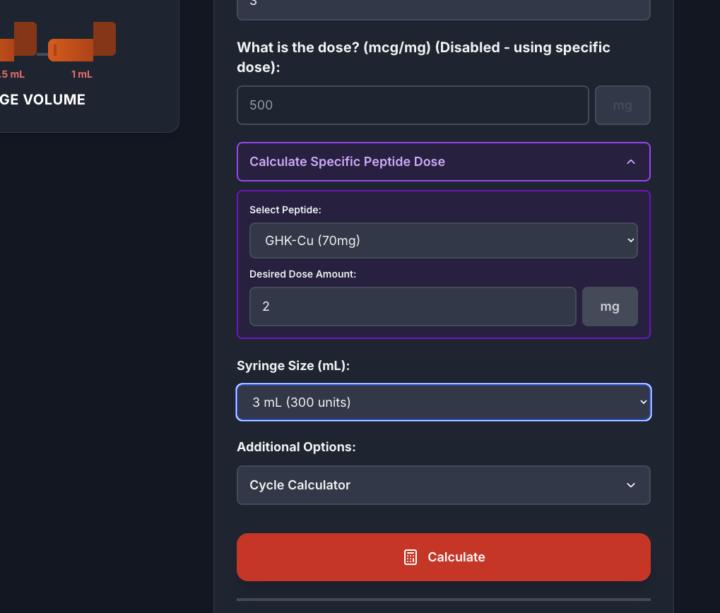
🖊️ Peptide Calculator Updated for Pen Cartridges
Really quick update for the reconstitution calculator on peptideprice.store I got asked if I could add a 3ml syringe size to the reconstitution calculator to account for people researching with pens. This is now live so you can use it for 3ml pen cartridges. Same easy process as always. 👉 https://peptideprice.store/calculator Hope this helps!
1 like • 12d
@Based Man GKKC-U 🥳I see what you did there. Code for “beauty” peptides. Bashful Man
🔥
20d •
Peptide Q&A Time (Keep It Research Based)
If there's anything you've been wanting answered or have any peptide-related questions, drop them in this thread 👇 Remember, Research Use Only Use RS for phrasing!

2 likes • 19d
@Monica San has to be PBS according to its patent : https://patentimages.storage.googleapis.com/8a/34/95/f2349b16698e9a/EP2245056B1.pdf
1 like • 19d
@Carlos Vasquez SQ is fine. The only difference is the rate of absorption with IM being faster. There is no loss in efficacy. The other differences between the different routes is truly the dose that is able to be administered. SQ is capped at around 200-400mg/dose as volumes approaching 1mL can become uncomfortable. IM can tolerate higher volumes = higher doses. IV can administer even higher doses.
1-4 of 4

Active 38m ago
Joined Nov 17, 2025
Uk