Activity
Mon
Wed
Fri
Sun
Feb
Mar
Apr
May
Jun
Jul
Aug
Sep
Oct
Nov
Dec
Jan
What is this?
Less
More
Memberships
54 contributions to Front End Now Community

18h •
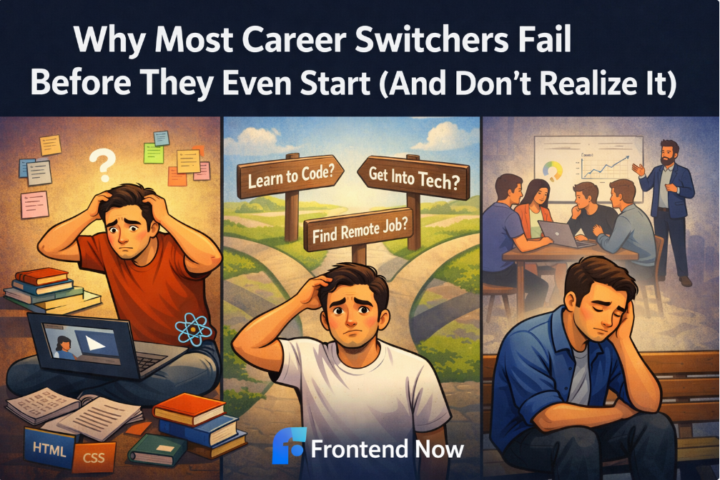
Why Most Career Switchers Fail Before They Even Start (And Don’t Realize It)
I’ve talked to hundreds of people trying to make a career switch into tech. Most don’t fail because they’re “not smart enough.” Most fail before they even start and they don’t realize it. Here’s what actually happens 👇 The real reason tech career changes fail Most career switchers start with the wrong goal. They say: - “I want to learn to code” - “I want to get into tech” - “I want a remote job” Those aren’t goals. They’re intentions. Strong career switchers start with: - A specific role - A specific outcome - A clear timeline Without that, everything feels overwhelming and it kills momentum. The silent killer: treating tech like school Most people subconsciously believe: “If I just learn enough, I’ll be ready.” So they: - Watch random tutorials - Jump between courses - Learn bits of HTML, CSS, JavaScript, React… with no direction It feels productive. But it’s not career-focused. A tech career change isn’t about learning everything. It's about learning the right things, in the right order, for the right outcome. Another mistake no one talks about Career switchers massively underestimate identity shift. You’re not just learning skills. You're becoming: - Someone who thinks in systems - Someone who solves problems publicly - Someone who applies before they feel “ready” That discomfort makes people quit quietly. They don’t say “I quit.” They just stop showing up. What actually works instead People who successfully change careers into tech do this: - Pick one clear path (not “tech”, a role) - Commit to a realistic weekly schedule - Optimize for outcomes, not comfort - Get feedback early instead of hiding It’s less exciting. It's far more effective. Important reality check If you’re thinking about a tech career change and it already feels confusing or heavy, that’s not a red flag. It just means you don’t have a clear system yet. And no one wins without one. What do you think would stop you from starting or sticking with a career switch into tech?
0
0
3d •
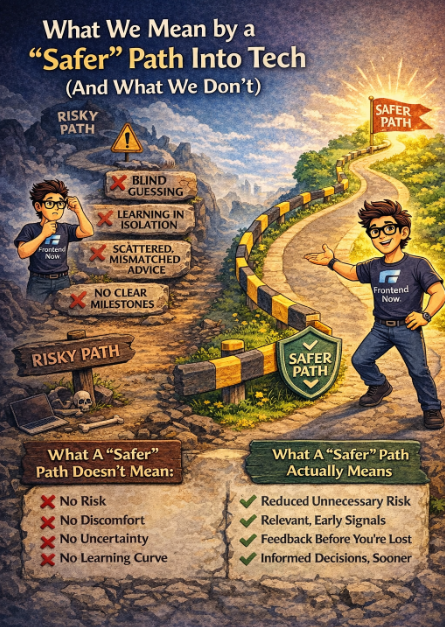
What We Mean by a ‘Safer’ Path Into Tech (And What We Don’t)
When we talk about a “safer” path into tech, it’s important to clarify what we actually mean and what we don’t. Because “safe” gets misunderstood a lot in career-switch conversations. A safer path into tech does not mean: - No risk - No discomfort - No uncertainty - No learning curve Any real career change involves risk. Anyone telling you otherwise is oversimplifying. What we do mean by a safer tech career path is reduced unnecessary risk. Risk that comes from guessing. Risk that comes from misinformation. Risk that comes from following paths that don’t match your life or goals. Most career switchers don’t fail because they took a risk.They fail because they took the wrong kind of risk. An unsafe path into tech usually looks like this: - Learning without knowing what hiring actually looks for - Spending months on skills that don’t compound - Following advice meant for full-time students, not working adults - Measuring progress by effort instead of outcomes - Finding out you’re off-track far too late That kind of risk doesn’t feel dramatic, it feels slow. And by the time people realize it, they’ve lost confidence, time, and momentum. A safer path into tech looks different. It doesn’t eliminate fear, but it gives you guardrails. Guardrails like: - Clear milestones instead of vague progress - Early signals about what matters and what doesn’t - Feedback before confusion compounds - A path designed around employability, not just learning It’s not about guarantees. It's about probability. Increasing the odds that your effort actually turns into results. This is especially important for career switchers. If you have a job, responsibilities, and limited time, the biggest risk isn’t trying tech. The biggest risk is wandering without direction and calling it “playing it safe.” A safer path respects your constraints. It shortens feedback loops. It reduces guesswork. And it helps you make informed decisions earlier, not later. If you’re evaluating your own path right now, ask yourself this honestly:
0
0
4d •
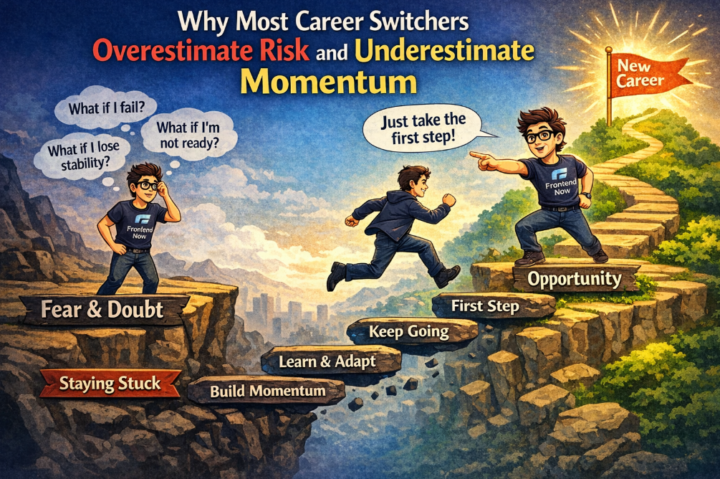
Why Most Career Switchers Overestimate Risk and Underestimate Momentum
If you’re thinking about switching careers into tech but feel stuck, it’s usually not because the move is impossible. It’s because the risk feels bigger than it actually is. Most career switchers dramatically overestimate the risk of changing paths and underestimate the power of momentum once they start moving. That imbalance keeps people frozen far longer than they need to be. When people think about a career change, especially into tech, their mind jumps straight to worst-case scenarios: - “What if I fail and waste time?” - “What if I’m not cut out for this?” - “What if I leave stability and can’t replace it?” - “What if I start and realize I’m behind everyone else?” Those fears feel logical, but they’re usually based on imagination, not evidence. What rarely gets equal attention is the cost of staying still. Staying in a role that feels capped. Staying in a job that drains energy. Staying in a situation where growth feels slow or nonexistent. That risk compounds quietly, year after year. The other thing career switchers underestimate is how momentum works. Most people imagine progress as one big leap: “I’ll know when I’m ready.” “I’ll feel confident before I act.” “I’ll commit once everything makes sense.” In reality, momentum builds through small, imperfect steps: - Trying something consistently instead of waiting - Getting early feedback instead of guessing - Making decisions that create information, not certainty Once momentum starts, fear loses its grip. Not because the fear disappears, but because it stops controlling every decision. The people who successfully switch careers into tech don’t have less fear. They just don’t let fear delay the first few steps long enough to kill momentum. They realize something important early: Risk feels highest before you start. Momentum feels strongest after you begin. If you’re honest with yourself, the question isn’t: “Is switching into tech risky?” It’s: “Is staying where I am any less risky over the next five years?”
0
0
5d •
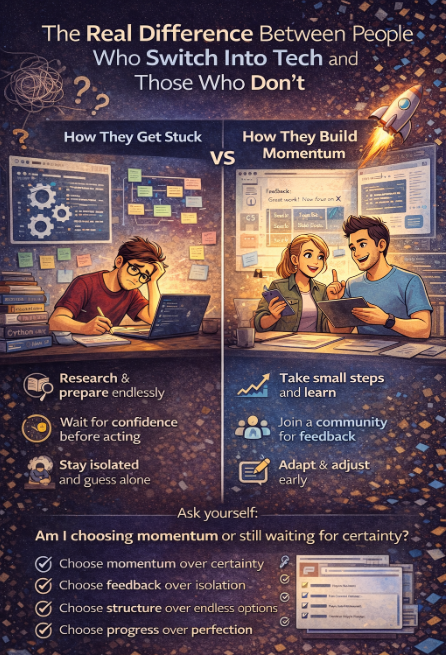
The Real Difference Between People Who Switch Into Tech and Those Who Don’t
If you spend enough time around people trying to break into tech, a pattern becomes impossible to ignore. Some people switch careers successfully. Others want it just as badly… but never quite make the jump. The difference usually isn’t intelligence. It’s not background. It’s not even effort. It’s how they approach the process. Most people assume the ones who succeed are more disciplined or more “technical.” In reality, the biggest difference shows up much earlier before skills even compound. The people who successfully switch into tech stop trying to prove they belong and start trying to build momentum. They don’t wait until they feel confident to take action. They don’t treat confusion as a signal they’re failing. They don’t expect the path to feel smooth. They expect friction and plan around it. On the other hand, the people who don’t make the switch often get stuck trying to eliminate uncertainty before moving forward. They research longer. They prepare more. They wait for clarity to arrive on its own. That feels responsible, but it quietly delays progress. Another difference is how they relate to guidance. Successful career switchers don’t look for the “perfect” roadmap. They look for feedback early. They want to know what matters, what doesn’t, and where they’re off-track now, not six months later. The ones who struggle tend to stay isolated longer. They try to solve everything internally. They don’t realize how much time is lost guessing instead of calibrating. And maybe the most important difference is how they define readiness. People who make it don’t wait to feel ready. They move forward once they’re directionally ready. They accept that confidence comes from action, not before it. People who don’t make it often keep raising the bar on themselves. Every milestone becomes a prerequisite for the next one. Progress feels endless, even when they’re capable. This isn’t about talent. It’s about approach. Career switch success in tech usually comes down to a few quiet choices:
0
0
6d •
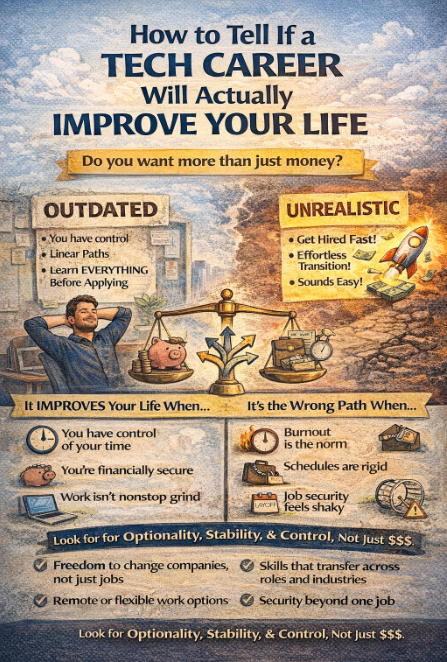
How to Tell If a Tech Career Will Actually Improve Your Life
If you’re considering a tech career change, the most important question usually isn’t the one people ask first. It’s not: “How much does tech pay?” The better question is: “Will a tech career actually improve my life?” Because higher income alone doesn’t automatically mean better. A tech career is worth it when it improves more than one dimension of your life. Money matters, yes. But it’s only one part of the equation. What most people are really looking for is: - More control over their time - Less financial anxiety - Work that doesn’t exhaust them physically or emotionally - Skills that create options instead of trapping them That’s the real appeal of tech. Here’s where people get it wrong. They assume tech will improve their life simply because it pays more. But if a role: - Requires constant burnout - Locks you into rigid schedules - Creates fear of layoffs without transferable skills - Or depends on nonstop grinding to stay relevant Then the income alone won’t compensate for the stress. A tech career improves your life when it gives you optionality. Optionality looks like: - The ability to change companies without changing careers - Skills that transfer across roles and industries - Remote or flexible work being a realistic option - Stability that comes from being employable, not just employed That’s why so many people stay in tech even when individual jobs change. The leverage stays. Another overlooked factor is how tech work fits your personality. Tech rewards: - Problem-solving over constant performance - Process over urgency - Thinking over reacting For people who value autonomy and steady growth, that’s a major quality-of-life upgrade. For people who need constant external validation or fast emotional rewards, it can feel draining. Neither is right or wrong but the difference matters. If you’re evaluating whether tech is worth it for you, try reframing the decision. Instead of asking: “Can I make more money in tech?”
0
0
1-10 of 54
@alex-p-8947
I help beginners land remote jobs in tech without a degree or previous experience 🚀 https://learnfrontendnow.com 💻
Online now
Joined Feb 4, 2025
Powered by