Activity
Mon
Wed
Fri
Sun
Aug
Sep
Oct
Nov
Dec
Jan
Feb
Mar
Apr
May
Jun
Jul
What is this?
Less
More
Memberships
AC
AI Contnet Creation 101
337 members • Free
AI Workshop Lite
35.1k members • Free
Agency Flywheel Hub
4.7k members • Free
AI Business Guild
1.8k members • Free
Chase AI Community
71.3k members • Free
AI Automation Society Plus
3.8k members • $99/month
AI Freedom Agency
10.8k members • $26/month
AI Automation Society
420.8k members • Free
Amir Discovers AI
137 members • $57/m
14 contributions to AI Automation Society

🔥
4d •
🏆 Weekly Wins Recap | June 27 – July 3
From $40K AI projects and first clients to custom CRMs, AI operating systems, and production-ready automations, another week inside AIS+ proved that consistent building keeps creating opportunities. 🚀 Standout Wins of the Week inside AIS+ 👉 @Kobe Shemesh closed a $40K upfront AI project after refining his Claude Code workflow, proving that small improvements in execution can create massive business results. 👉 @Galyn Fergerson landed her first client just 6 days into AIS+, turning a discovery call into a $750 AI OS project before even finishing the automation course. 👉 @Girish Mohan built an AI Scrum Master that now prioritizes his calendar, tasks, and deals automatically—helping him execute every day with more focus. 👉 William Rendall was promoted to AI Workstream Strategy Lead less than three months after joining AIS+, crediting the community for accelerating his growth. 👉 Diane McCracken celebrated her 100th Claude Code session at 68 years old, showing that curiosity and consistency matter far more than experience. ⸻ 🎥 Super Win Spotlight | @Ahmad Abd Alkarim Ahmad joined AIS+ with years of leadership experience but wanted a better way to turn ideas into action. Today, his custom AI Operating System helps him manage projects, analyze business problems, and support his team without slowing anyone down. His biggest lesson? Don't just watch. Build. Practice. Share what you learn. That's where the real return comes from. 🎥 Watch Ahmad's story 👇 ✨ Every week, members are turning ideas into systems, skills into businesses, and momentum into real opportunities. Step inside AI Automation Society Plus and start building assets, systems, and skills that compound 🚀

1 like • 9h
@Chris Hoffman waiting for your progress
1 like • 9h
@Kairo Jovian good luck in your journey
14d •
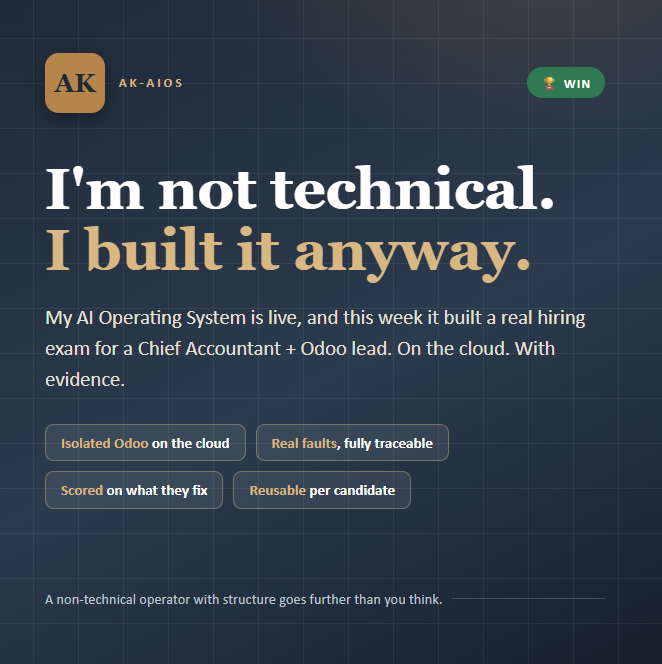
I'm not a developer. My AI Operating System just earned its keep.
A win I had to share here. 🏆 A few weeks ago I finished setting up my own AI Operating System, AK-AIOS. Not a chatbot I open now and then. A system I run my real work through, every day. Big thanks to @Nate Herk here. His 2-hour AIOS walkthrough and the onboarding repo he shared are what got me set up. I just built on top of it. This week it proved itself. My company needed to hire a Chief Accountant who could also lead our Odoo implementation, and fast. The problem: a CV can't tell you whether someone can take a broken accounting setup inside a live ERP, trace it to the root, and actually fix it by configuration. And our tech team was already fully loaded. I'm not a developer. A year ago I could spin up a droplet, but I couldn't have installed and configured a proper Odoo server on the cloud. So instead of waiting for the perfect resource, I worked with AK-AIOS as a thinking partner, not a button. We broke the problem down, weighed the options together, and I steered it to the approach I judged best, not just the first one it suggested. What came out the other side: - An isolated Odoo running in the cloud - Real accounting and inventory faults planted in it, fully traceable - A practical exam that scores each candidate on what they actually fix, with the logs and the evidence - Resettable and reusable for the next candidate (I shared the full story on LinkedIn this Last week.) And here's the part I'm proud of: this was one task out of many. I now run my consulting, my website, and my product work through the same system. It's set up, it's live, and I'm leaning on it hard. Biggest lesson: don't wait for the perfect resource. A non-technical operator with a bit of structure can go a lot further than they think. If you had a system like this behind you, what's the first thing you'd put it to work on?
1
0

💎
⭐
Apr 25 •
🚀New Video: Claude Code + Playwright Automates Literally Anything
When you connect Playwright CLI to Claude Code, you can automate almost anything in a browser. This video walks through 3 use cases: having Claude Code QA a web app and fix its own bugs, scraping contact info from search results, and automating actions inside logged-in sessions like Skool. I also show how I'm chaining these scripts into scheduled tasks so an agent runs them on its own.
2 likes • Apr 26
Really appreciate it @Nate Herk . I have tried it in a Claude project to customize odoo instant. It works well. But not forever. Also some modules like POS which depends on js and cookies does not work properly. But over all it s perfect and similar to selenium testing if you have tried it before. Actually i am not a developer but awar and have much curiosity about anything related to sw as i manage a teams of developers and product managers.
💎
⭐
Apr 14 •
🚀New Video: Claude Code Just Dropped Routines. It's So Good.
Claude Code just launched routines, which let you run prompts on a schedule from Anthropic's cloud without keeping your laptop open. In this video I walk through exactly how to set them up, the gotchas I ran into migrating my automations, and how to configure your API keys, cloud environments, and permissions so everything actually works on the first try.
2 likes • Apr 14
@Nate Herk really we need an agent to follow up.your updates and encapsulates them.into our mind😊 Thank you nate
🔥
Feb 27 •
🏆 Weekly Wins Recap | Feb 21 – Feb 27
SaaS builds. $16K contracts. First clients. Outbound systems going live. This week inside AIS+ was all about leverage turning into real results. Here are a few standout wins inside AIS+ 👇 👉 @Michael Elliott landed a $16.8K contract in just 10 hours of work using Claude Code. 👉 @Krishna A closed another $2,000 deal - now $4K+ this year building apps, agents, and SaaS. 👉 @Viktorio Halcu secured his first client on commission, building an AI outbound calling agent. 👉 @Ahmad Abd Alkarim built his first full vibe-coded SaaS with multi-tenant authentication and dashboard systems. 👉 @Mike Thomson launched Outreach Dashboard v2 - full cold email infrastructure stack live and ready to scale. 🎥 Super Win Spotlight: @Mike Thomson | Systems Before Scale Mike didn’t join looking for magic. He joined because he saw people actually building. After testing multiple systems, he rebuilt his entire cold outreach infrastructure using insights shared inside AIS+. Domains. Inboxes. Warmup. Follow-ups. Automation stack ready. Now he’s weeks away from launching outreach at scale. Mike’s journey is proof that you don’t need hype - you need systems, consistency, and the right room. 🎥 Watch Mike's story 👇 ✨ Want to see wins like this every week? Step inside AI Automation Society Plus and start building assets that compound 🚀

4 likes • Feb 27
@Enoch Adebisi thank you
1-10 of 14
@ahmad-abd-alkarim-8843
Product Director, SaaS & Odoo, 20+ yrs. Not a developer but I build anyway. Building my own AIOS and sharing automations that actually work. No hype.
Active 9h ago
Joined May 5, 2025
Powered by