Activity
Mon
Wed
Fri
Sun
Feb
Mar
Apr
May
Jun
Jul
Aug
Sep
Oct
Nov
Dec
Jan
What is this?
Less
More
Memberships
#TheTechHustle Community 🤝🏽
290 members • Free
Closers.io - Remote Sales Reps
13k members • Free
Front End Now Community
168 members • $47/month
118 contributions to Front End Now Community

23h •
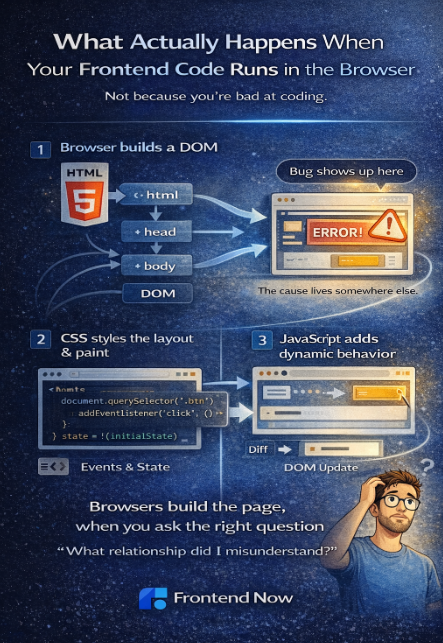
What Actually Happens When Your Frontend Code Runs in the Browser
A lot of frontend confusion comes from one simple thing: Most beginners write code without really knowing what the browser is doing with it. So things feel mysterious. Re-renders feel random. Bugs feel unpredictable. Let’s slow it down and walk through what actually happens, without going low-level or adding too much detail. Step 1: The browser builds a map of the page When your HTML loads, the browser doesn’t just “show a page.” It builds a structure called the DOM (Document Object Model). Think of this as the browser’s internal tree of: - elements - text - relationships This is what the browser uses to understand what exists on the page. Step 2: CSS tells the browser how things should look Next, the browser applies CSS. CSS doesn’t change structure, it answers questions like: - Where should this be positioned? - How big is it? - What color, font, and spacing should it use? The browser combines HTML + CSS to calculate layout and paint pixels on the screen. That’s why small CSS changes can cause big visual shifts. Step 3: JavaScript adds behavior JavaScript is where frontend becomes dynamic. When your JavaScript runs, it can: - Read data from the page - Listen for events (clicks, input, scroll) - Change state - Update the DOM Important point: JavaScript doesn’t magically “update the UI.” It changes data, and the browser reacts by updating what’s rendered. That’s the core idea behind how frontend code works. Step 4: Events trigger change When a user clicks a button or types into an input: - An event fires - Your code runs - State changes - The browser updates the UI This loop happens constantly. Frontend development is really about managing what changes, when it changes, and what depends on it. Step 5: Re-rendering isn’t magic In modern frameworks like React, the browser isn’t updating everything. Instead, React is: - Comparing what should be shown - Updating only what changed That’s why understanding browser rendering basics makes React feel less mysterious.
0
0
3d •
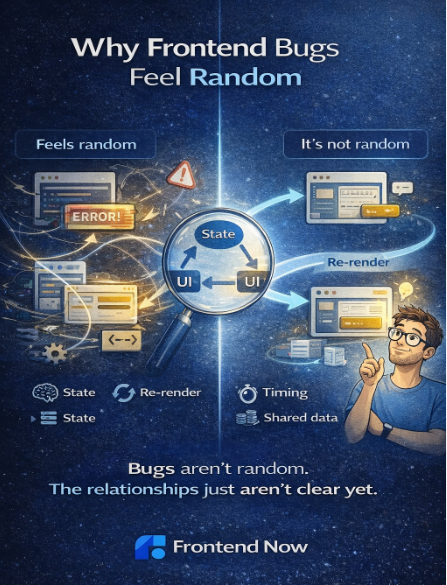
Why Frontend Bugs Feel Random
If frontend bugs ever feel random, you’re not alone. Most beginners tell me things like: “It was working… then I changed one small thing and everything broke.” That experience is incredibly common. And the important part is this: Frontend bugs usually aren’t random at all, they just feel that way when the mental model isn’t clear yet. Why frontend bugs feel unpredictable at first When something breaks, beginners often look straight at the line of code throwing the error. That makes sense. But frontend bugs rarely live in a single line. They usually come from: - State changing in a way you didn’t expect - Multiple pieces of UI depending on the same data - An assumption about timing or order - A component re-rendering when you didn’t think it would If you’re not tracking those relationships, the bug feels like it came out of nowhere. What experienced frontend engineers do differently Senior frontend developers don’t start by “fixing” the code. They start by asking a few calm questions: - What changed right before this broke? - What state was updated? - What parts of the UI depend on that state? - What assumption did I make that’s no longer true? That turns debugging from guesswork into pattern recognition. A simple example You update one piece of state… and suddenly a different part of the UI breaks. That’s not React being weird. It usually means: - Two components depended on the same state - Logic lived in the wrong place - Data changed shape unexpectedly The bug shows up here, but the cause lives somewhere else. Once you trace that path, the fix is usually obvious. Why guessing makes bugs worse When bugs feel random, people often: - Change multiple things at once - Add conditionals “just in case” - Copy fixes without understanding them That can make the app work again temporarily, while making future bugs harder to reason about. Experienced engineers do the opposite: They change one thing, then observe. How to make frontend debugging predictable
0
0
4d •
🎯 What Senior Frontend Developers Actually Look For (This Decides Who Gets Hired)
I just dropped a new YouTube video that I really want everyone in this community to watch, especially if you’re trying to break into frontend, level up from junior, or stop getting overlooked. 👉 Watch here: https://www.youtube.com/watch?v=3cw5Irc2uTU In this video, I break down what senior frontend developers and hiring teams ACTUALLY care about when they look at your work and it’s probably not what you think. This isn’t about: memorizing more frameworks adding another tutorial project or chasing every new tool It’s about the signals you’re sending. I cover things like: Why “clean code” matters more than fancy features What makes a project look real vs “tutorial energy” The frontend skills that separate juniors from mid-level devs How seniors evaluate problem-solving, not just syntax What instantly makes someone think: “I’d trust this person on my team” If you’ve ever wondered: “Why am I not getting interviews?” “What am I missing?” “How do I think more like a senior?” This video will give you clarity. 👇 After you watch, drop a comment here and answer this: What’s ONE thing from the video that you’re going to change about how you build projects? Let’s make sure the work you’re doing actually moves the needle.
0
0
4d •
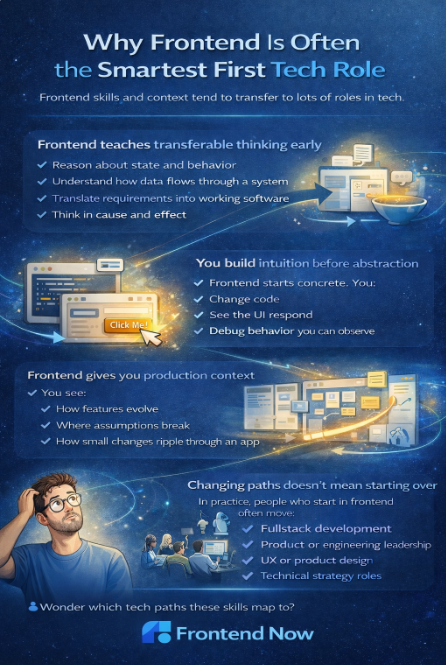
Why Frontend Is Often the Smartest First Tech Role (Even If You Change Paths Later)
One of the quiet fears I hear from people starting out is this: “What if I choose frontend and later realize I want something else?” That fear makes sense. No one wants to lock themselves into the wrong first tech job. The interesting part is that frontend development is rarely a trap, it’s often a launchpad. Frontend teaches transferable thinking early When you learn frontend development properly, you’re not just learning tools. You’re learning how to: - Reason about state and behavior - Understand how data flows through a system - Translate requirements into working software - Think in cause and effect Those skills show up everywhere in tech. That’s why frontend developer skills tend to transfer well into other roles. You build intuition before complexity Many tech roles start abstract and ask you to trust systems you can’t see yet. Frontend starts concrete. You: - Change code - See the UI respond - Debug behavior you can observe That visible feedback builds intuition early, and intuition makes later complexity easier, not harder. Frontend gives you production context As a frontend developer, you work close to real users and real products. You see: - How features evolve - Where assumptions break - How small changes ripple through an app That production context is valuable no matter where you go next, backend, full stack, product, or leadership. Changing paths doesn’t mean starting over One of the biggest misconceptions is that switching roles means resetting your progress. In practice, people who start in frontend often move into: - Full stack development - Product or engineering leadership - UX or product design - Technical strategy roles Because the mental models carry forward. You’re not relearning how software works, you’re applying it in a new area. Why this matters for beginners If you’re choosing your first tech job, the best question usually isn’t: “What will I do forever?” It’s: “What role will give me strong fundamentals and room to grow?”
0
0
5d •
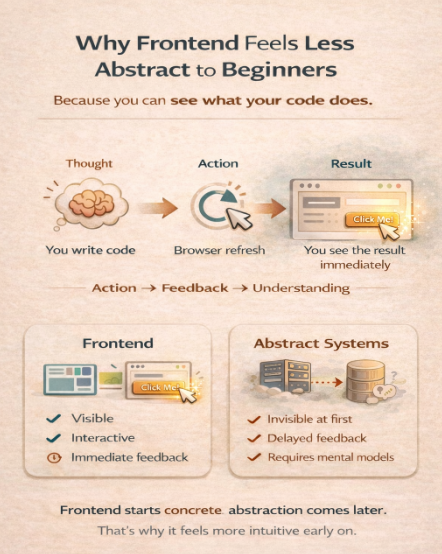
Why Frontend Development Is Less Abstract Than Most Tech Careers
One of the most common fears I hear from beginners is this: “I’m worried coding will feel too theoretical.” That fear makes sense. Many tech careers do start in abstraction. Frontend development is different and there’s a technical reason why. Frontend starts with behavior you can see In frontend development, most of what you build is visible. You work with: - Layout and spacing - Buttons and forms - User interactions - UI state and feedback When you change something, you immediately see the result in the browser. That visible cause-and-effect loop makes learning feel concrete instead of theoretical. Compare that to more abstract tech roles In many coding careers, especially early backend work, you’re dealing with things you can’t see yet: - Servers handling requests - Databases storing data - APIs passing information - Systems talking to other systems Those concepts matter, but they require mental models that take time to form. For beginners, that delay between action and feedback can make learning feel abstract and disconnected. Frontend lets you reason in real time With frontend development, you’re constantly asking: - “What happens when a user clicks this?” - “What changes when this state updates?” - “Why did the UI re-render?” You don’t need to imagine the result. You can observe it. That makes frontend development easier to reason about early on. You don’t need the whole system to make progress Another reason frontend feels less abstract is scope. As a beginner, you can: - Build one component - Fix one interaction - Improve one small piece of the UI You don’t need to understand the entire architecture to move forward. That keeps the learning process grounded. This doesn’t mean frontend stays simple Frontend development becomes complex as you grow: - State management - Performance - Accessibility - Architecture But the entry point is concrete. You start with visible behavior, build intuition, and then layer in complexity later, not the other way around.
0
0
1-10 of 118

@harry-ashton-2348
I help beginners land remote jobs in tech without a degree or previous experience 🚀
https://learnfrontendnow.com 💻
Active 19h ago
Joined Feb 4, 2025
Powered by