Activity
Mon
Wed
Fri
Sun
Mar
Apr
May
Jun
Jul
Aug
Sep
Oct
Nov
Dec
Jan
Feb
What is this?
Less
More
Owned by Georgiana
⭐Inspire.Empower.Live. Supportive skool where we are encouraged to increase our awareness, take action, and thrive through life's many challenges.💪💕
Memberships
Confident Introverts
102 members • Free
🇺🇸 Skool IRL: Detroit
13 members • Free
Personal Growth Skool
81 members • Free
30 Day Challengers
170 members • Free
ProSpirit
38 members • Free
Just Another Moment (JAM)
130 members • Free
DAfree Awareness Movement
289 members • Free
The Unstoppable Academy
39 members • Free
The Human Restoration Project
8 members • Free
47 contributions to Personal Growth Skool
1d •
Scientific Saturday / Sunday: the neuroscience of doing things you don’t want to do
Hey Everyone, Hope you’re all having a great weekend thus far! I’ve been a fan of neuroscience / biopsychology ever since taking a course on it in university, and am especially interested in how we can apply it to ourselves for our own benefit. Incidentally, a year or two ago I listened to an interesting podcast (see resources below) featuring Dr. Andrew Huberman and David Goggins (perhaps known more than anyone for being relentless in his training and doing things he really doesn’t want to do). They were discussing the role of the anterior mid cingulate cortex (let’s just be easy on ourselves and refer to it as the AMCC) in doing things you don’t want to do / tenacity / persistence / etc. Science seems to suggest that the size of this brain region correlates with one’s ability to do things they do not want to do / tenacity. Furthermore, forcing yourself to do things that you do not want to do, especially those that take you out of your comfort zone, increases the size of the AMCC, which leads to stronger will power over time! Furthermore, according to Dr. Huberman: “Leaning into challenges, whether physical or intellectual, promotes brain health and helps maintain cognitive function as you age. This kind of practice is associated with ‘super agers’, people who maintain their cognitive abilities well into later life by consistently engaging in challenging activities. Through consistent effort and facing challenges head-on, we can strengthen our minds without relying on shortcuts or hacks.” Who else wants to be a ‘super ager’? I am going to add that one to my list of long-term goals!😁 Of course, the path towards increased AMCC size and health is not easy. It takes a lot of consistent effort to grow this region, and the journey is unpleasant because, after all, we have to do things we don’t want to do on a consistent basis. The more we detest them, the better! Yet, I think it is worth trying. Here are two quotes from a research article (see below) on the AMCC and tenacity:
🔥
0 likes • 46m
@Bruno Militz hahah, no energy drinks! One thing that HAS helped (when I actually keep it in mind) is thinking about it in this way "This is a time to actually honor the time that I've spent with this person. Like taking a picture of a moment". When I think about it that way, as a noting of a memory, it feels a lot better".
🔥
0 likes • 10m
@Tyler Scott I really want to love my progress notes. It's the only way I get paid. LOL I suspect at the cold showers still have some kind of an impact. But we do end up getting acclimated to things both physically and mentally, so if the toughness increased maybe you got to make it even tougher. Ice bath?

🔥
2d •
🎨 Saturday Fun 🔥
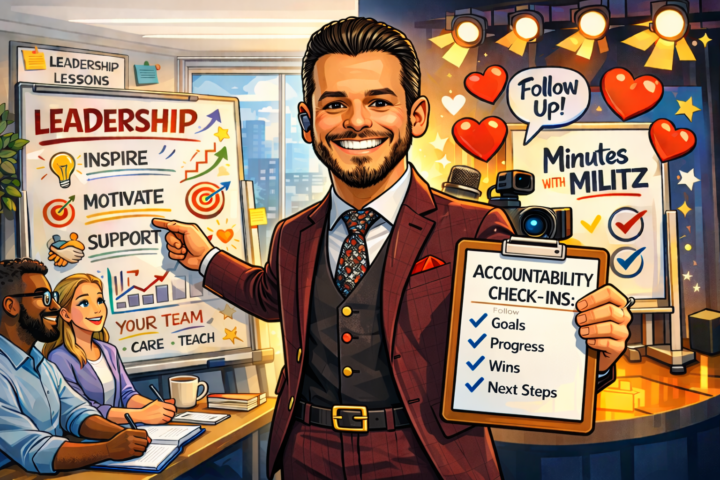
I saw this a few minutes ago and had to share with y'all. ↙️ Go on ChatGPT and ask: "Create a caricature of me and my job based on everything you know about me.” It might ask you to upload a few photos (mine did), and honestly… it nailed it 😂 You can also guide it if you don’t use ChatGPT much, just tell it about your job, career, or what you’re building. This kind of image is actually super useful: social media, skool profile or about page, website, print it and keep it at home, or just for fun 😅 I’m sharing mine here because this is a great example of how AI can be used in a creative, positive way, not just for work. 👇 Drop yours below if you try it Let’s hype each other up and have some fun with it. ⏰ Reminder: We’ve got our usual 10:30 AM call today (open for everyone). No agenda, just chatting, connecting, and getting to know each other like always. Open space for any questions, ideas, or topics you want to bring up. I do have to take my cat to the vet at 11:30 AM (yearly check-up 🐾), but I’ll be fully present with you all for that hour 😎 See you soon 🙌
🔥
3 likes • 2d
I shall return in 20 hours---I've already uploaded some images today for a project that I'm working on and now I'm out of my daily allotment, but I'm excited to try this. :) I LOVE yours!! It definitely fits!!! :) :) :)
🔥
1 like • 1d
@Bruno Militz thanks!!
3d •
Friday Fun: If you had a super power
Hey Everyone, Happy Friday! Or, depending on how you feel and what you're doing, perhaps more suitable is 'TGIF!'🙃 Anyways, here is some Friday fun for ya! If you had a super power, what would it be? Use a GIF to describe it! Let's try to guess each other's powers! Cheers! 😁

🔥
1 like • 2d
@Tyler Scott ooooh. But maybe that can be done with your power to teleport? Also.... I evidently didn't follow directions to actually add a gif 🫣
🔥
2 likes • 2d
@Matthias Schweiker for people to experience love?

6d •
I tracked every minute of my time in January, here’s what I learned
After going through Bruno’s Time Mastery course, I realized that I didn’t know my 4 quadrants as well as I thought. (check it out here if you haven’t gone through it yet. It’s worth it!) So in January I decided to take it a little more seriously. I used google calendar to track every single thing I did. Color coding each of the 5 categories made it super helpful to visualize. They were: - Health (exercise/sleeping) - Relationships (family/friends) - Growth/Business time - Chores - 9-5 Before I reveal the % breakout for each, the reason why I wanted to do this was because I had AN IDEA of the time I was spending in all the areas, but I wanted to ACTUALLY know. Knowledge is power It also helped me stay accountable by blocking ‘growth work’ and family time in advance so I could plan around those and stick to a schedule the best I could. I try to keep my days as similar as possible with the only changes coming on the weekends when my family time replaces the 9-5 time. Same wake up every day, same bedtime everyday (unless I get sleepy lol). Since I’m a numbers nerd, here is the breakdown of each of the categories by percentage for January: - Health 36% - Relationships 25% - Growth/Business 14% - Chores 5% - 9-5 20% How do you think yours would shake out? It makes sense to me that Health and Relationships is over half, I feel like I’m good there. The Growth/Business is frustrating looking at it from this perspective, but it still comes out to about 25 hours/week. I don’t think I can physically do more right now without disrupting the Health or Relationships. I don’t want to say the growth/business is the most important, but that’s the push I’ve been making recently. So I’m in a stage of finding better uses for this time, rather than more of it I’d love to ‘offload’ the chores and 9-5 lol. The chores would probably free up more family time and the 9-5 would definitely free up more Growth/Business time.

🔥
2 likes • 4d
@Chris Wendt that's a really good thought! I think that I would still feel the need to respond to things! I don't have too too many individual calls but I like your idea :-)
🔥
1 like • 2d
@Chris Wendt that's very true :-) trying the new thing is reversible :-)
🔥
4d •
WHAT A CALL. 🙏🏽🔥
Huge thank you to everyone who showed up, asked thoughtful questions, and truly engaged. This honestly went way beyond my expectations, and that’s 100% because of the people in this room. The energy, the honesty, the depth of the conversation… it was special. A massive thanks to Eric for generously sharing his experience, wisdom, and perspective. From building businesses to navigating relationships, family, and the long game of life, this was real, grounded, and incredibly valuable. For those who couldn’t make it live, I strongly recommend watching the recording. There’s so much value in there, and I guarantee different things will click for you depending on where you’re at in your journey right now. 😎 Feel free to send him a thank-you message and connect with him. 📱 904.314.2911 📸 Eric's Instagram Thank you all for showing up the way you did. Seriously. This is why this community exists. 🙏🏽 Feel free to share your feedback if you’d like.

🔥
2 likes • 2d
@Josie Ngoumou awe!!!! 🥰❤️😊 You too! I can be so expressive though 😂🙃
🔥
1 like • 2d
@Bruno Militz my bad. YET! Oh, since I'm going out of States tomorrow, maybe I can hit up a local karaoke bar or something and just do a random song.
1-10 of 47
🔥
@georgiana-desrosiers-8324
"A smooth sea never made a skilled sailor"
It's never over until it's over.
Skool: inspired-life-empowered-being
🌟Inspire.Empower.Live🌟
Online now
Joined Dec 7, 2025
INFJ
Powered by