Activity
Mon
Wed
Fri
Sun
Oct
Nov
Dec
Jan
Feb
Mar
Apr
May
Jun
Jul
Aug
Sep
What is this?
Less
More
InnerDevelopment@Work
518 members • Free
27 contributions to InnerDevelopment@Work

27d •
Two small "discoveries" inspired by today’s hangout
Hi everyone, Following the story @Maria do Céu Bastos shared during today’s hangout, I wanted to share two related discoveries that I did not get a chance to mention during the call. The first is iNaturalist, an online community that also contributes valuable biodiversity data for scientific research. Perhaps some of you already know it, but I joined only recently—and discovered that it makes Pokémon feel rather redundant when our world is already so full of real creatures to “catch.” 😊 You simply photograph a plant, animal, fungus, or other living creature with your phone. The app suggests what it might be, and members of the community can then confirm or refine the identification. I find it wonderfully engaging: I am finally learning the names of creatures I have seen throughout my life, while being surprised almost every day by how much I never noticed or knew. It makes me especially happy when I discover a species in my small garden that I had never noticed there before. And I get to keep a little photographic memory of each encounter. The image below shows part of my humble collection so far—caught only with my camera, of course, except perhaps for the obvious pests eating my tomatoes. 😄 The second discovery, also connected with regenerative agriculture and permaculture, is a film I have not yet watched but definitely intend to: Groundswell – Official Trailer (2026). The trailer gives me somewhat of a real-life Don’t Look Up feeling—but I will reserve judgment until I see the full film. Perhaps some of you will get a chance to watch it too and share your reflections!
0 likes • 25d
Interesting that you mentioned birds—in one part of the movie, they discuss how birds can serve as indicators of local environmental health. And I honestly had no idea about Canada’s involvement in the nuclear story. I read that footnote several times and then followed the link you shared. At first, it seemed almost like an oxymoron, but I realised that reaction came largely from my own stereotypical image of Canada. Once I moved beyond that, it became another sobering example of how deeply imperial and industrial histories are intertwined.
0 likes • 24d
@Maritza Roldan that is so cool. You must be enjoying wonderful coffee then 🙌

Jul 14 •
Bring some lightness into your changemaking work!
🌀 Notes from our ID@Work hangout just now: Some threads that stayed with me: 📋 @Morena Galesic Divic ran a union meeting at her faculty — went well, but exposed the exhausting tightrope of following procedure and staying human with people 🐌 Institutions move at the speed of trust 😤 So much bureaucracy isn't really about the work — it's ego and money wearing a process costume. 🤷Nobody actually knows what they're doing. Not doctors. Not world leaders. We're all closer to improvising than our titles suggest 💡 Less "get it right," more long-term investment in relationships. Less grip, more fun. 👉 What's one thing you could hold a little lighter this week? P.S. @Nadene Canning I hope you're having a lot of fun in Caux (despite the seriousness of the topic!)

3 likes • Jul 14
This should be an everyday morning reminder: “Don’t take it all so seriously, have fun!” 😊 Thank you @Sarah Santacroce, this hangout was exactly the kind of lightness-refill I needed.
Jul 1 •
IDGs and union work?
This is more of a question than a statement for the group. In some work environments, talking about inner development can still be met with resistance, to say the least. I have recently become a union representative at my institution, and I am beginning to see quite a lot of alignment between union work and the IDGs. Although unions are often perceived mainly as dealing with administrative and legal complexities, I feel there is also something much more tangible and outspokenly human in this space: dignity, dialogue, responsibility, courage, care, and the protection of meaningful work. Has anyone here had experience with implementing the IDGs, or other inner development pathways, through a union framework or similar structures?
1 like • Jul 9
Just to give some feedback I promised to @Nadene Canning and @Lars-Erik Einevik : I held my first larger union meeting as a local union representative at my faculty, and around 40 people came, including 12 non-members, which was much more than expected. I framed the union not only as a legal or administrative mechanism, but as a space for dignity, responsibility, listening, and humane dialogue. I used a simplified polarity map, translated into English here: when trust breaks down, we need formal mechanisms such as protection of dignity, designated persons, union support, and procedures; but before that, we need clearer information, safer conversations, earlier raising of problems, and more trust. The room started with some tension, but my own openness — saying that I am new, that I will make mistakes, I already did, and that I also had not known enough about some past issues — seemed to help people relax. Some people voiced criticism of the union and of past lack of transparency. One former member said the meeting gave her a “seed of hope” to return. One colleague from the cleaning staff spoke very movingly about missing humane conversations, gatherings, and mutual appreciation. We did not solve a lot, but we opened a door after a long period without regular meetings, and I announced that we will continue with another meeting within about six months (as defined by law). For me, this felt like a small but real movement from silence and defensiveness toward dialogue, recognition, and shared agency. I am also aware that there were tensions, few sour-ish faces and pockets of resistance — partly around concerns raised by members, and partly around my intention to look more carefully into missing or unclear protective measures. But I also understand that this road will be bumpy, and I am slowly coming to peace with that. Once again, Nadene and Lars-Erik, thank you so much for the conversation during what was originally meant to be our regular summer hangout, but ended up becoming a very helpful coaching session for me as I was preparing for this meeting. You helped me find the steadier state of mind I needed for this work. I am enormously grateful for this community and The Field.
1 like • Jul 10
@Nadene Canning Thank you! I do see the value, but I also see how this kind of space can be uncomfortable at the beginning, especially when people are used to the status quo or to a more “muddy” state of things. Like I said, there will be bumps, but I guess that is pretty normal and expected.

May 18 •
This week what are you up to?
Nudge nudge …Let us know what’s on your mind 🧐 How are you feeling? What’s your body telling you? Are there any skills you want to be experimenting with? What inspired you in the past days? Or is there something that is weighing heavy on your heart? If any of these questions resonate, step in and tell, ask, vent, process. Life is beautiful and tough No judgement We are all here together

2 likes • May 19
This is a more heavy one, but your question really met me where I am this week. I have been dealing with the terminal stage of my mother’s illness, and moving through waves of rage around unfairness, suffering, lack of meaning, and all the painful parts of human condition. In that rage, I found myself digging out and sifting my composter — something I had never fully done before. And then I was there with worms, half-decomposed leaves and food scraps, noticing how everything was slowly becoming soil — teeming with life within death itself. I kept thinking or maybe hoping about how decay, pain, and transition can somehow become nourishment. I am still deeply uneasy with the suffering I cannot alleviate, but I feel a little calmer imagining that her energy, too, may eventually transform into something soil-like — something that keeps nourishing life in another form. So, nudge nudge — my current condition is nudging me into the ever-present search for meaning, even in the weirdest places 🥴.
Apr 2 •
Reclaiming Human Agency
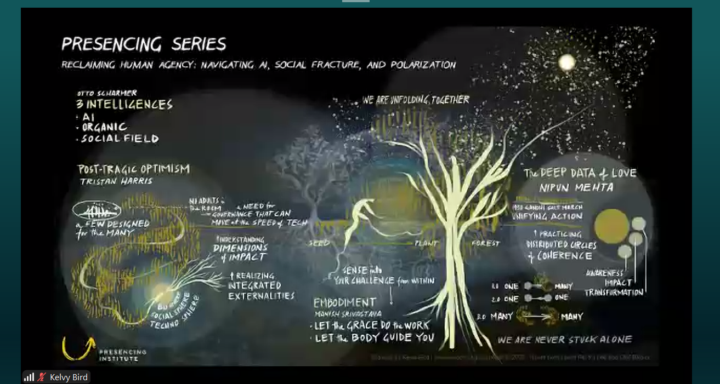
Just coming out of this session on navigating AI, Social Fracture, and Polarization it was SO dense and we were deep into reclaiming our capacity to sense, know, and act amid forces designed to fragment our attention and polarize our communities. This session brought together ethical AI innovators with Tristan Harris, Nepun Mehta, experts in embodiment Manis Srivastava and collective sense-making, and practitioners navigating the economies of attention. Hosted by Otto Scharmer and Antoinette Klatzky and social artist Kelvy Bird. I'll need some time to share my notes! Please, I invite any of you who attended to add your own takeaways from any of the speakers that would be fabulous for us all to read. In the meantime, here is the graphic recording that Kelvy put together. I'm still listening to this phrase from Nepun: Love is deep data, with it we trust that inner coherence will lead to social coherence.💖
2 likes • Apr 6
Wow, sounds like the session was so deep and relatable for this time we live in.Thank you all for sharing the insights, especially for us who missed it 🙏❤️
1-10 of 27

@morena-galesic-6393
Assistant professor working at civil engineering faculty. Wrapped up in challenge of balancing research, teaching and the rest of the life :)
Active 2d ago
Joined Oct 18, 2024
Split
Powered by