Activity
Mon
Wed
Fri
Sun
Aug
Sep
Oct
Nov
Dec
Jan
Feb
Mar
Apr
May
Jun
Jul
What is this?
Less
More
Memberships
Constellations
89 members • Free
175 contributions to Clief Notes

0 likes • 3d
Fable usage extended to July 12th? Thanks, Anthropic!
0 likes • 2d
@Scott Smith pretty decent of them to do this before API rates limit usage. any interesting output from Fable?
4d •
The missing layer behind better AI writing?
Everyone wants AI to “sound like me.” So they keep fixing outputs one prompt at a time. More warm. More direct. Less corporate. More founder voice. But the model is guessing because the real *source layer* is missing. A simple fix: Separate Identity from Voice. Your identity profile tells the systm who or what must not be distorted: principles, judgment patterns, boundaries, points of view, public-use limits. Your voice profile tells the system how that identity behaves in language: tone, pacing, examples, vocabulary, anti-patterns, channel shifts. - Identity is not copy... - Voice is not strategy... - One draft is not the source of truth. First dfine what must stay true, then define how it should sound. lastly, generate the post, email, page, script, or deliverable. If you define *identity* and *voice* separately, you stop prompting for tone every time and start building a reusable writing system. Curious how others in Clief Notes are handling this: Do you define identity and voice separately, or do you keep them in one brand/persona file?
1 like • 3d
@Alex Brown definitely continues building over time
1 like • 2d
@Mofedul Alam Joy killer application of the principles, thanks for sharing

2d •
Data Summarization, Prose Writing, Output Structure
This is probably well discussed given the rising popularity of ICM and Obsidian brains, like the one Jake recently discussed in this weeks High Tea. Do you guys have any prompts/skills to share to best dissect various types of media and parse it into your Obsidian library? I am currently not happy with the writing prose style, depth / how the information is structured as its being taken from input content. I am currently building the ICM input/output stages to adapt a parsing engine for finance/news/tech/software learning types of content into my "2nd brain". Perhaps I need to work on specific parsing logic for each. But its seemingly tedious and Im having trouble with getting a consistent output format that is satisfactory. Why? Because every case is unique...I mainly just want it to be as concise as possible, and have well structured themes.
2 likes • 2d
@Novus Vella I have a few different research decomposition methods, depending on source and end goal. are you trying to compare frameworks and methodologies or what is your use case?

4d •
How do I automate my mortgage business workflows?
I set up the ICM folder system, and I think I did it correctly. My main goal is to automate the admin work I hate doing. Some of the tools I use require brokerage compliance approval before I can get API access, so I’m working through that part now. That said, I’ve seen Codex/Claude open browsers, use apps, and complete real tasks without direct API access. I’m not sure if that is the right approach for my setup, because it seems like it burns through a lot of tokens. I also don’t know if that’s because of how I set up my ICM folder system or if that’s just expected. I’m trying to get clarity on how to actually start automating my admin work. Should I be creating skills, workflows, tasks, or something else? I don’t really understand the difference between them yet, and I want to make sure I’m building this the right way instead of wasting time in the wrong direction.
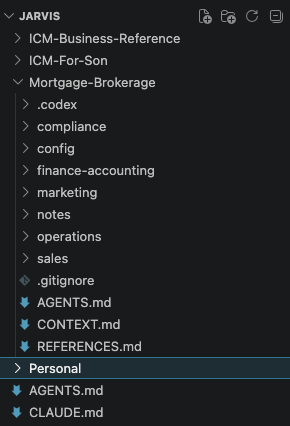
2 likes • 4d
@Erick Martinez break it down to ICM layers. You can structure workspaces however you like, and I have built custom OS for mortgage, real estate and insurance clients. - A task is one action. - A workflow is the repeatable path: trigger, inputs, stages, outputs, review, and done condition. - A skill/tool is something reusable that helps execute part of that workflow. - An automation is when the workflow has a trigger, runner, access, monitoring, and failure handling. - An agent is last: a scoped operator with judgment, permissions, escalation, and review. For your mortgage business, start by mapping the admin workflows you hate doing. Then rank them by friction, volume, compliance sensitivity, and access requirements. The best first candidates are usually high-friction, high-volume, lower-action-risk workflows where AI can draft, summarize, classify, or prepare without submitting anything. So, avoid starting with anything that sends disclosres, changes loan data, quotes rates, issues approvals, or submits externally. Those can come later after access, compliance, logging, and review gates are clear. Pick one low-risk workflow first. Document the steps. Run it manually with AI helping draft, summarize, classify, or prepare. Keep the human in the loop. Once the path is stable, decide whether it should become a checklist, prompt, skill/tool, API automation, browser-assisted workflow, or named agent. Browser control can work, but it is brittle and token-intensive, as you've seen. Treat it as temporary or supervised unless compliance, access, logging, and failure handling are clear. Especially in mortgage and real estate, approved systems and review boundaries matter more than clever automation. A key point I learned after building across multiple industries is: keep a governance and business layer, your overall rules, preferences and settings - identity, brand, voice etc.
1 like • 3d
@Erick Martinez glad it helped! there is not much in the course about repos/plugins/skills because folders and workspaces are the foundation, and really all you need. most youtubers stuff is trash, tbh. if I need a skill I would rather build my own, so I know what goes into it and what it does. You can always point Claude to a repo and ask questions about it, pull out what you like and discard the rest.

4d •
Your AI Content Might Be Fine. Maybe That's The Problem.
If you use AI to help write anything, whatever your niche is, you've probably had this moment: the draft looks fine, technically correct, nice sentences, but something about it feels a little off. Maybe a little too polished, a little too generic, but you can tell - or maybe just sense - that it's written by an AI bot. I ran into this when setting up my voice.md file, so I built something to fix it. The guide I created doesn't just describe the tone I want, it defines it with real examples. Here's the structure that actually worked: 1. Gold standard examples: 2 to 3 pieces of writing that are exactly the tone I'm going for, used as a reference before writing anything new. Each example is followed by a "Why it's good" explanation. 2. Bad examples with annotations: writing that looks fine on the surface but fails in a specific, named way. 3. A drift patterns table: short phrases that sound right but aren't, next to the actual reason they don't work. 4. Mechanical rules: specific, almost boring rules that are easy to forget but change everything once you write them down The biggest shift for me was realizing tone can't just be described, it has to be demonstrated. Telling an AI to "sound warm" or "sound authentic" doesn't work nearly as well (or at all) as showing one good example and one bad example side by side, then naming exactly what's different between them. More examples = better output. Explaining the failures is huge. If you're using AI for anything where tone actually matters, I'd genuinely recommend creating something like this before you let it write your first real piece. It saved me a ton of revision time and kept my content sounding like an actual person instead of a generic AI draft. Happy to answer questions if anyone wants to build their own version of this.
4 likes • 4d
@Carla Bosteder "tone can't just be described, it has to be demonstrated" also, I like your drift patterns, very helpful!
1 like • 3d
@Carla Bosteder @Alex Brown "trust, but verify" or as Jake talks about, "pull the thinking away from AI"
1-10 of 175

Active 9h ago
Joined May 31, 2026
Seattle
Powered by