
Write something

20d •
What's the difference between 빨간, 빨강 & 빨간색
@Samin 사민 All four words relate to the color red, but they differ in grammar type and nuance. - 빨간 -> adjective form (used before a noun) - 빨강 -> noun form (means “red color”) - 빨간색 -> standard noun for “the color red” - 빨강색 -> less natural or slightly redundant form (not commonly used) Examples - 빨간 꽃이 예뻐요.-> The red flower is pretty. (Using the adjective form) - 나는 빨강을 제일 좋아해요.-> I like red the most. (Using the noun form) - 그 치마는 빨간색이에요.-> That skirt is red. (Using the standard color noun) - 그 치마는 빨강색이에요. ❌-> (Sounds unnatural / not standard) I hope this helps!! 😊

21d •
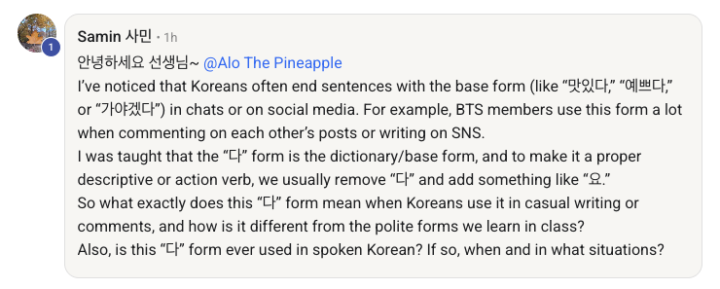
Great Question from Samin!
@Samin 사민 Koreans use the “-다” form in casual writing (SNS, comments, captions, diaries) as a neutral, narrative-style statement. It feels like you’re talking to yourself, making a comment, or writing a caption. It's not polite or formal, it’s just plain and simple. Explanation Why Koreans use it - gives a caption / monologue feeling - sounds direct and natural - common among friends online - slightly dramatic or humorous Examples: - 맛있다 = “It’s delicious.” (stated to yourself) - 예쁘다 = “It’s pretty.” - 가야겠다 = “Guess I should go.” How it compares - –다 = neutral narration - –요 = polite, friendly - –습니다 = formal speech Is it used in speaking? Yes, but mainly: - talking to yourself - quoting someone - lectures or announcements - Not for regular conversation. Examples - 오늘 날씨 좋다. → “The weather is nice.” - 아... 드디어 끝났다. → “Finally, it’s over.” (self-talk)
23d •
Different ways Koreans say “Good night”
There are so many different ways to say “good night” in Korean. As you can see below, there are a lot of options! 🔹 Casual & friendly - 잘자 — Good night - 잘자요 — Good night (soft/polite casual) - 굿나잇~ — Good night (Korean-style English) 🔹 Everyday polite - 잘 주무세요. — Please sleep well. - 편안한 밤 되세요. — Have a peaceful night. - 좋은 밤 보내세요. — Have a good night. 🔹 Warm & caring - 오늘도 고생했어요. 푹 쉬세요. — You worked hard today. Rest well. - 내일 또 봐요. 편히 주무세요. — See you tomorrow. Sleep well. - 몸 따뜻하게 하고 주무세요. — Keep yourself warm and sleep well. - 좋은 꿈 꾸세요. — Sweet dreams. - 편안한 밤 보내요. — Have a comfortable night. 🔹 More formal - 안녕히 주무세요. — Sleep well (very polite). - 평안한 밤 보내시길 바랍니다. — I hope you have a peaceful night. - 편히 쉬십시오. — Please rest well (formal & respectful). Among them, I think I use “잘자요,” “안녕히 주무세요,” and “편안한 밤 되세요!” the most. 잘자요, everyone~ 🌙✨

1-3 of 3
powered by

skool.com/10-minute-korean-daily-words-5235
A cozy space where Korean learners connect, share, and grow
Our mission: Bringing learners from all around the world together.
Suggested communities
Powered by