

9d •
🔐 Hot, Cold, and Bold: A Beginner’s Guide to Crypto Security
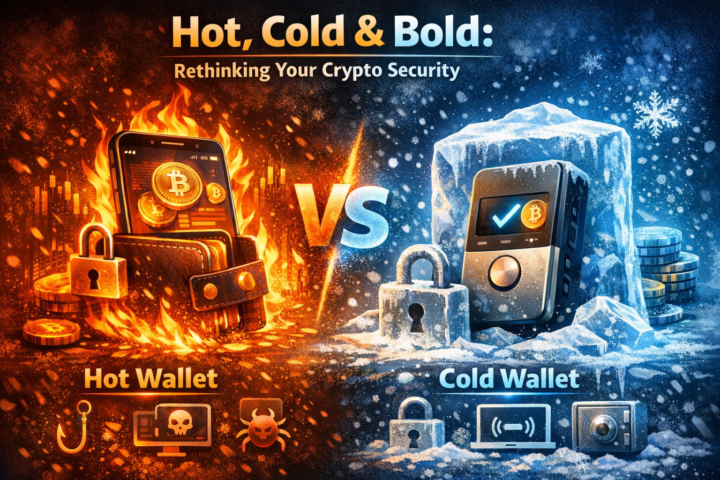
Introduction: Owning Your Crypto Means Securing It One of the most exciting parts of cryptocurrency is **true digital ownership**. You can send money anywhere in the world, interact with new financial tools, and control your own assets without banks. But with that power comes responsibility. Unlike a bank account, **there is no customer service line to recover lost funds**. If someone gains access to your wallet, your crypto can be gone forever. That’s why understanding **crypto wallet security** is one of the most important things a beginner can learn. A helpful way to think about security is through a simple concept: **Temperature.** Crypto wallets are generally described as **hot wallets** or **cold wallets**. --- 🔥 Hot Wallets vs ❄️ Cold Wallets Many beginners think these terms refer to brands or types of apps. They don’t. The difference is actually very simple: **Hot Wallet = Connected to the internet** **Cold Wallet = Not connected to the internet** That’s it. This difference creates a trade-off between **convenience and security**. Hot Wallet Connection: Online Best For: Daily use, trading, DeFi Cold Wallet Connection: Offline Best For: Long-term storage Hot wallets are easy to use, but cold wallets are far more secure. --- 🧠 A Common Myth: Your Hardware Wallet Does NOT Hold Your Crypto Many people believe that when they buy a hardware wallet, their crypto is stored inside the device. This isn’t actually true. Your crypto **always lives on the blockchain**. Your wallet only stores something called your **private keys**. Think of it like this: * The **blockchain** is the bank vault. * Your **private key** is the key to the vault. * Your **wallet** is the tool that holds the key. A hardware wallet simply keeps that key **offline and protected**. --- 🧰 What a Hardware Wallet Actually Does What It DOES ✔ Stores your **private keys offline** ✔ Lets you **approve transactions securely** ✔ Requires **physical confirmation (button press)**
1
0
12d •
Demystifying Crypto: The Beginner’s Guide to XRP
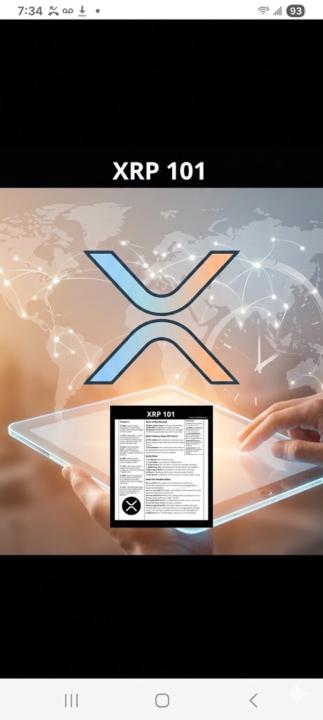
Introduction: Your Roadmap to Digital Finance If you’ve been dipping your toes into the world of cryptocurrency, you’ve almost certainly seen the name XRP. It frequently makes headlines, but with all the technical jargon out there, understanding what it actually does can feel overwhelming. Whether you’re looking to invest or just want to understand the technology, here is your straightforward, beginner-friendly guide to XRP. What is XRP? A Simple Explanation At its core, XRP is a digital asset designed specifically for fast and low-cost cross-border transactions. Think of it as specialized digital cash. It runs on the XRP Ledger (XRPL), which is an energy-efficient, open-source, and decentralized blockchain. While the ledger itself is decentralized, a technology company named Ripple Labs plays a key role in its development and uses XRP in its software solutions. What Problem Does It Actually Solve? To understand XRP, you have to understand the problem it was built to fix. - The Problem: Traditional international money transfers are notoriously slow, expensive, and highly dependent on a web of intermediary banking systems. - The Solution: XRP acts as a "bridge currency." It enables near-instant, incredibly cheap global transactions without the need for those traditional middlemen. Financial institutions can use XRP to streamline liquidity and move money across borders seamlessly. The Quick Stats: Why People Like It XRP stands out from other cryptocurrencies for a few very specific reasons: - Lightning Fast: While traditional bank wires can take days, an XRP transaction settles in just 3 to 5 seconds. - Incredibly Cheap: The average transaction fee is a microscopic $0.0002, making it significantly cheaper to move than Bitcoin or Ethereum. - Eco-Friendly: Unlike Bitcoin, XRP is not mined. This means it doesn't rely on massive, energy-intensive computer farms. - Fixed Supply & Burn Mechanism: There is a maximum supply of 100 billion XRP. It was entirely pre-mined, meaning no more can ever be created. Furthermore, every time a transaction occurs, a tiny fraction of XRP is "burned" (destroyed forever), slowly reducing the total supply over time. - Bank-Friendly: It’s built for enterprise use, with over 300 banks and institutions currently utilizing Ripple technology.
1
0
1-2 of 2
powered by
skool.com/xrp-cloud-live-2801
XRPCloud community for learning XRP, digital payment rails, and blockchain finance. Education, insights, and tools for the future.
Suggested communities
Powered by