5d •
Career & Entrepreneurship
Hi all. What careers/skillsets/businesses does everyone in this group possess? May be some good networking opportunities in assisting each other within similar industries to get us closer on the journey to financial freedom. Post which industries, careers, and or business models you are currently pursuing to generate extra cash flow. Mine is the Fire Protection & Essential Services Industry, however expanding to freelancing myself and becoming a consultant full time...

3d •
What Im offering
I have a classroom filled with resources. 12 folders with a wealth of information and real tools. I am offering Trading Bots, Indicators, settings and advice and support. I also offer expert consultation in various topics like Mindset, Leadership, Finance, Risk Management (physical, digital, financial) Of those who have tested the trading software there has been profits reported. Profits that exceed what they have previously got in trading and exceed any subscription to access these systems. And yet there is crickets in chat. Only 3 subscribers. If I offer all these profitable, life changing things up front without hesitation. What do I get in return ?? The results I receive mean I have failed you. If I offered buy/sell signals in various things like crypto, forex would that be something that you would pay for ? There is no point to offer a free service. Because you dont see value in it. So it must be paid, to show you are serious and to show your commitment up front. Write below what you want and how much you will pay monthly for it. Lets see if that makes a change to this community. I am open to any options and will reassess the direction of this group with the feedback. If I offer nothing anyone wants I will close the account. Its just wasting my time. 🙏
5d •
Squeaky wheel get attention
In nature and including Humans. Those who are noisy will get heard. Anyone who is quiet is considered to be 'OK'. If chat is quiet, I presume you are all 'OK'. If you are all ok you dont need me. 🤷♂️
11d •
First Cull and future plans
I just got rid of the dead weight. 25 non active members. And I will do it again when needed. This will make moving forward easier. Some of you were on the list but have been given an extension. From now. Any new members subscription (Standard $8 or Premium $44) will contribute towards a community project. (to be agreed upon) There are currently 3 paid Premium. And 1 possible Standard on 7 day free trial. This is going towards skool and running this community. As it stands there is 1 community trading acc ($25k) running on a 1 step challenge. 1/5 passed. 50% of profits made in this acc will go towards community projects. Project must be something that will return value (a product) or multiple in money (investment) Write below what business concepts you think might be worth looking into as a group If you know of anyone else who might be interested to join then awesome. But otherwise. Lets get back to work. Keep posting wins in chat. It keeps me accountable. And its contagious to see others winning. Post them in other groups as well (big or small. A Win is a Win). As many are not actually seeing real results so often. It will give you street cred and soon enough you can be the one everyone wants to network with. 💪
14d •
AI Decision Systems – Premium Tier Access
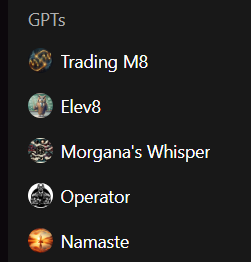
I’ve built a suite of pre-programmed AI systems, each designed for a specific domain. These aren’t generic chatbots. Each system is structured to: - Process information within its niche - Apply decision frameworks - Deliver focused, actionable responses Think of it as having specialised advisors on demand, not just AI generically answering questions. Systems Available 📊 Trading M8 AI trading decision assistant. Upload charts, outline your setup, and receive structured feedback on: - Trade logic - Risk exposure - Timing and execution 🎓 Elev8 AI learning and study system. Designed to: - Break down complex topics - Guide structured learning - Improve understanding, not just give answers 🔮 Morgana’s Whisper AI spiritual guidance system. Provides insight based on: - Astrology - Numerology - Personal interpretation frameworks ⚙️ Operator AI decision & risk management system. Built for business and real-world scenarios: - Situation analysis - Risk evaluation - Actionable decision support - Job promotion and recruitment. 🌌 Namaste AI astrology & numerology system. Focused on: - Natal chart insights - Personal readings - Deeper interpretive analysis Access These systems are available inside the Premium Tier. Requirements: - Active ChatGPT subscription - Premium membership access Once inside, you’ll get: - Direct access to all systems - Guidance on how to use them effectively - Ongoing updates and improvements What This Actually Gives You - Faster, more structured decisions - Reduced guesswork - Access to specialised AI systems across multiple domains Let me know in chat who might be interested 🙏
1-22 of 22