
Write something
Feb 6 •
Big feelings don’t mean fragile kids
We’ve started equating “regulated” with “calm.” That’s not accurate. A regulated nervous system can: - protest - cry - get frustrated - resist - recover Dysregulation isn’t about volume. It’s about whether a child can return to baseline with support. **WITH SUPPORT** A toddler who melts down but reconnects quickly? That’s development. A child who expresses big emotion but stays organized in their body? Also development. Silence isn’t always strength. Calm isn’t always capacity. Watch recovery Watch reengagement. Watch how the body reorganizes. That tells you far more than the size of the reaction.
Jan 20 •
What to watch instead of “what’s next”
When parents are told to “wait and see,” it usually sounds like: Do nothing and hope for the best. That’s not actually helpful. What is helpful is knowing what to watch while you’re waiting — because development doesn’t pause just because new skills aren’t showing up yet. Instead of asking: - What should they be doing next? - What milestone comes after this? - Are they behind? Try noticing: - how easily your child transitions between positions - whether movement looks smoother or less effortful - if they recover more quickly after frustration - how long they stay with play before moving on - whether their body looks more organized, even without new skills These are signs of integration, not performance. This is also why copying activities from the internet often backfires. If you’re chasing the next skill, you miss the information your child is already giving you. Development isn’t a checklist — it’s a pattern. And patterns show up in how a child moves, not just what they can do. If you’re watching closely, you’re not “doing nothing.” You’re doing one of the most important parts.
0
0
Jan 12 •
Developmental Ladder
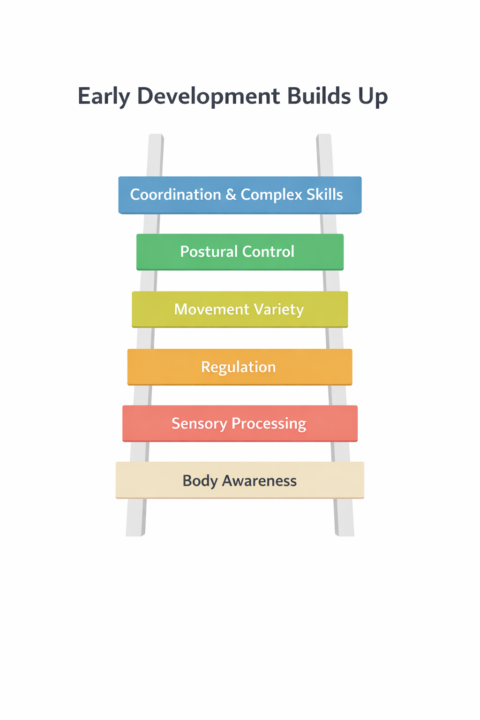
Early development rarely shows up in big, obvious jumps. More often, it looks like: - small changes in how a child moves - slightly longer attention during play - less effort getting into or out of positions - quicker recovery after frustration These shifts are easy to miss if you’re only watching for milestones. Development works more like a ladder than a checklist. Each rung is built on the one below it. Bigger, more visible skills depend on smaller, quieter ones happening first. A child can’t skip rungs and expect the top to feel stable. They might reach it, but it often takes more effort, more support, or more regulation to stay there. Foundations tend to show up quietly — before skills become obvious. When those lower rungs are solid, higher-level skills come more easily and with less strain. That’s why understanding how development unfolds matters just as much as what shows up, We’ll keep coming back to this idea and how it shows up across early development. Remember to celebrate the small things!!🤩
1
0
Jan 11 •
What I mean by "foundations"
When I talk about foundations, I’m not talking about skills a child can perform on command. I’m talking about things like: - how their nervous system processes input - how their body organizes movement - how regulation shows up before milestones - how early patterns support everything that comes later - Foundations aren’t flashy. They don’t always look like progress. They definitely are not a check box on the CDC milestones list. A child can learn a skill without strong foundations — but it often costs them more effort, energy, or regulation to do it. That’s why this space focuses on the why, not just the what.
1
0
1-4 of 4
powered by

skool.com/unfiltered-guide-to-parenting-6435
Early neurodevelopment, explained—because parenting comes with enough guesswork already.
Suggested communities
Powered by