
12d •
Death by a thousand well-meaning pats on the back…
Has anything like this ever happened to you? August 2020: I had a high level agent ask for the “rest of” my supernatural thriller after he read a single chapter I wrote. Crap, I thought. Now I gotta write the whole thing. I spent A YEAR AND A HALF on that sucker and I thought I had polished it to a brilliant shine. February 2022: I finally send it to the agent and he sends me the NICEST REJECTION LETTER IVE EVER HAD. GUSHING WITH PRAISE, but it was ultimately not right for him. It dawned on me: HE WAS BEING NICE BECAUSE HE KNEW I’D SPENT A YEAR AND A HALF ON IT! If it had been good enough, I’d have an agent by now. Lesson? We should push our writing far past what our abilities are. We should keep rewriting until NO ONE CAN IGNORE IT. We are only getting somewhere with our work when we are able to cast a cold eye on it; see it as others see it. See it as professionals see it.
May 29 •
A great reminder...
"Of all sad words of tongue and pen, the saddest are these: 'It might have been!'" ---John G. Whittier, 1854
May 27 •
The power of patience
My entire writing life has been one long drawn out lesson in patience. All of us have felt it. I'm here with Max at The Social, downtown Provo. Just before we continued writing our respective projects, he said, "yeah. Brick-by-brick." And that's really it. Writers are almost forced to play the long game, to feel the frustration of spending an entire day on the equivalent of carrying a few buckets of ready-mix to the place where you're trying to build an entire stadium (where ostensibly an eventual audience will someday sit). Yes, different opportunities may arise sooner for some than others, but there's no denying that having the discipline to simply do it every day or almost every day is essential. Finding joy in the doing, and not in the destination, is vital. And the one key to it all––I have had to learn again and again and again... ...is patience.
2
0
Apr 27 •
My latest Substack article about the movie I made years ago finally reaching theaters. hope u like it
https://open.substack.com/pub/drnatesmithjones/p/here-i-am-content-and-happy-in-my?r=5zozpf&utm_medium=ios
Apr 19 •
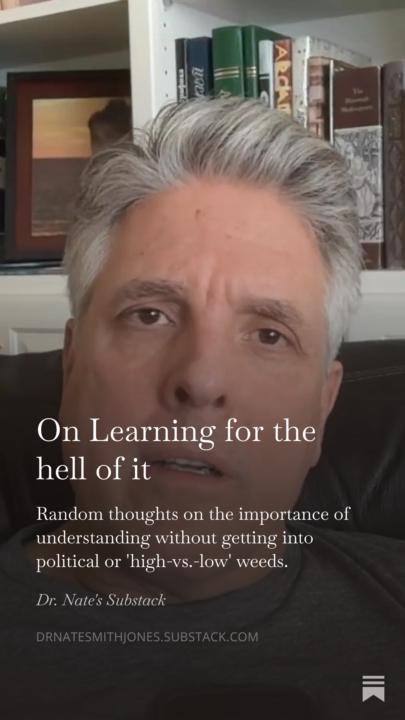
Here's my latest substack article----it's a short video this week, but perhaps you'll like it...
https://open.substack.com/pub/drnatesmithjones/p/on-learning-for-the-hell-of-it?r=5zozpf&utm_campaign=post&utm_medium=web&showWelcomeOnShare=true
1-20 of 20
powered by

Suggested communities
Powered by