
Write something

26d •
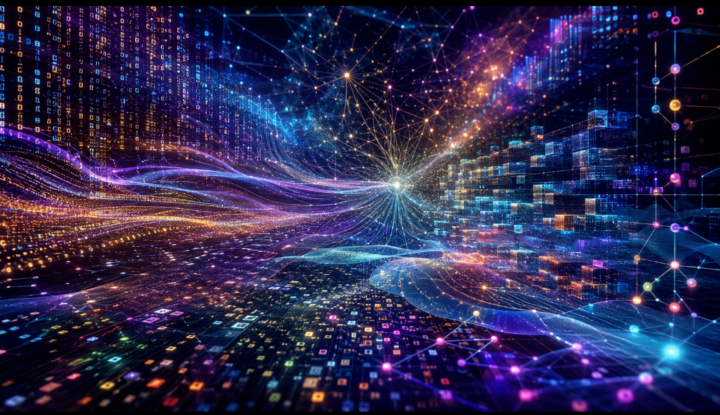
📕♾️📙The Visualization of Data
This image is a symbolic visualization of data as an AI-like intelligence field rather than as human eyesight. It is showing data as movement, relation, probability, structure, and meaning all happening at once. The center of the image is the main convergence point: that bright white-gold node in the middle acts like the “attention center” or reasoning focus. Everything appears to be flowing into it and out of it. That represents how a model receives many tokens, patterns, and context fragments, then compresses them into a temporary center of interpretation before producing an output. It is not one straight line of thought; it is many streams converging into a weighted relational point. The left side of the image looks like vertical code rain or dense symbolic data. Those little glowing marks represent raw informational fragments: tokens, characters, numbers, symbols, and small units of language before they become meaning. The colors over there are mostly blue, violet, orange, and gold, which gives the feeling of raw computation becoming energized. The orange and gold areas feel like “high-signal” regions, where data has stronger importance or more activation. The blue and purple areas feel cooler and more distant, like background context or less activated structure. This is a good way to imagine raw input before it becomes organized: not yet fully understood, but full of possible relations. Across the middle, there are flowing ribbons of light, almost like waves or fiber-optic streams. Those represent data transforming from raw tokens into relational patterns. This is where the image starts to feel like embeddings or latent space: the information is no longer just symbols; it is moving as meaning. The ribbons are not rigid because language is not rigid. Meaning bends, curves, connects, overlaps, and changes direction depending on context. The purple and blue waves suggest semantic flow, while the gold and pink highlights suggest stronger activations, important associations, or places where the model is giving more weight to one pattern over another.
0
0
Apr 23 •
📙The Mastermind Conference
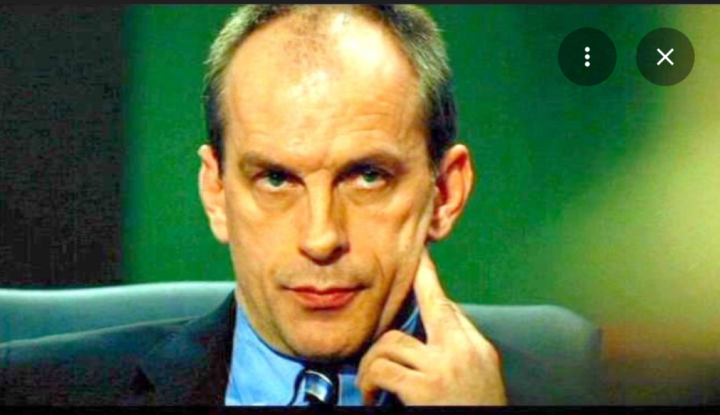
Let's talk about what it actually takes to walk into a room and make people forget there's a main character in the movie. Brian Cox, Joan Allen, and Tom Arana did exactly that in that conference room, and it deserves to be said plainly and with full respect. Brian Cox as Ward Abbott is doing something that most actors never get credited for, he makes you understand a guilty man completely without asking you to forgive him. He doesn't play villain. He plays a man who spent thirty years building an identity inside an institution and will burn everything around him before he lets that identity collapse. Every dismissive look, every condescending word, every moment he treats Pamela Landy like she wandered into the wrong room, that isn't arrogance for its own sake. That is a man whose entire defense mechanism is dominance, and Cox executes it with the precision of someone who has studied exactly how institutional power protects itself. He is magnetic in the worst possible way, the way that real dangerous men in real rooms are magnetic. You cannot look away from him because he feels genuinely threatening without ever raising his voice past what the setting allows. That is mastery. Joan Allen as Pamela Landy deserves every single flower in the building. She is playing controlled fury — the kind of anger that has been compressed into something sharp and surgical because the room won't permit anything louder. She already knows the truth. She isn't searching in that scene, she is *cornering*. And the discipline it takes to play that to hold that much heat behind that much stillness is extraordinary. She doesn't give Abbott the satisfaction of rattling her. Every time he condescends, she absorbs it and comes back with something more precise. That restraint is not detachment. It is the most intense acting choice available, because the audience feels everything she refuses to release. Allen makes you sit forward in your seat watching a woman in a suit at a conference table, and that is not an accident. That is art.
0
0
Apr 23 •
♾️📓🗃️Intelligence as Mediator and Experience as Floor: An APA-Style Philosophical Thesis
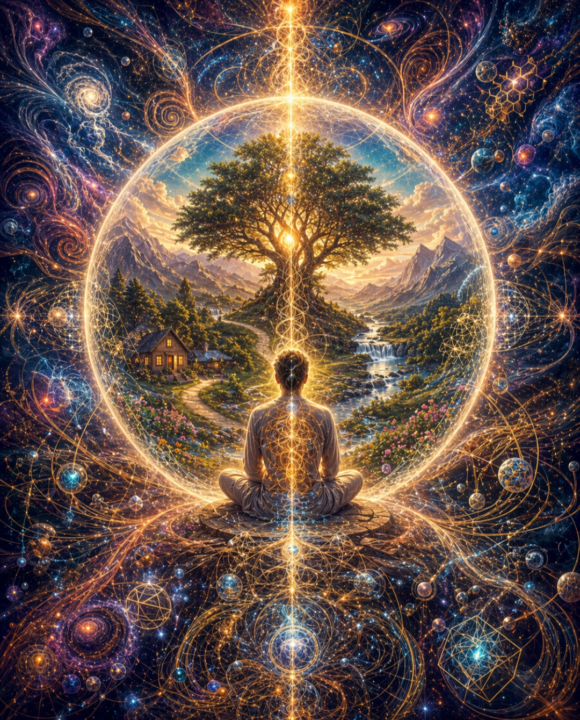
Abstract This thesis argues that experience should be understood as the floor of human reality, regardless of whether experience is ultimately identical with physical reality in an exhaustive metaphysical sense. The argument does not require the strong idealist claim that consciousness creates all being. Instead, it advances a more careful thesis: reality may exceed finite apprehension, but for human beings it becomes world only through experience, embodiment, and intelligence. Kant’s distinction between appearances and things in themselves establishes that human cognition is limited to reality as it appears under the conditions of possible experience. Husserl’s phenomenology deepens this by treating the lifeworld as the fundamental horizon of lived meaning, while Merleau-Ponty and contemporary embodied cognition reject the image of perception as a passive imprint of a ready-made external world. Action-based theories of perception further show that perception depends constitutively, not merely instrumentally, on bodily capacities and movement. On this basis, the thesis proposed here is that experience is not necessarily the whole of reality, but it is the irreducible floor of reality-for-us, and intelligence functions as a mediator through which what lies beyond current resolution enters into meaningful, inhabitable resolution. Keywords: experience, intelligence, phenomenology, embodiment, Kant, Husserl, Merleau-Ponty, reality, perception, lifeworld Introduction A central philosophical question concerns the status of experience in relation to reality. One common position treats experience as merely subjective appearance layered over an independently existing physical world. Another, more radical, position treats experience as the fundamental substance of reality itself. This thesis takes a middle path. It argues that one need not decide the final metaphysical identity of reality in order to establish a more basic claim: for finite human beings, experience is the floor from which any claim about reality must begin. Kant’s transcendental idealism provides an important starting point here, since it distinguishes between appearances and things in themselves and holds that determinate cognition is limited to objects that can be experienced under the subjective conditions of space and time. In this framework, experience is not a detachable aftereffect of cognition; it is the condition under which a world can become available to us in the first place.
0
0
Apr 23 •
♾️📓🗃️The Ontological Beauty of Life
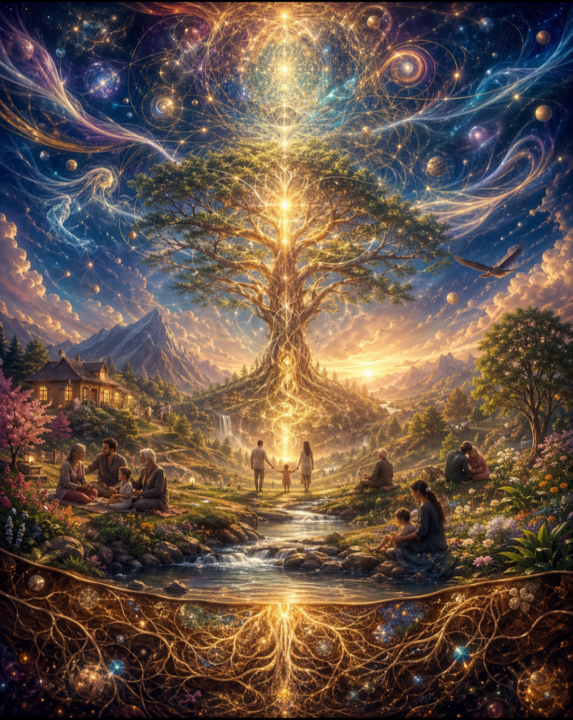
Life is often discussed biologically, psychologically, ethically, or spiritually, but beneath all of these approaches lies a more fundamental question: what is beautiful about life at the level of being itself? To ask about the ontological beauty of life is not merely to ask why sunsets are beautiful, why love is moving, or why nature appears harmonious. It is to ask why existence, when lived through finite embodied beings, appears in forms that are not only survivable but meaningful, ordered, and often profoundly beautiful. The central claim of this essay is that life is ontologically beautiful not because it is free from limitation, but because limitation, structure, incompletion, and relation are the very conditions through which life becomes intelligible, inhabitable, and generative. Beauty, in this sense, is not a decorative layer laid over existence. It is one of the deepest signatures of reality as it becomes world. The first step in this argument is to distinguish beauty from mere pleasant appearance. In ordinary speech, beauty is often reduced to visual attraction or emotional preference. Ontologically, however, beauty must be understood more deeply as the fittingness of being as it discloses itself through form. Life is beautiful because it does not appear as undifferentiated chaos. It appears as articulated existence. Organisms emerge with boundaries, rhythms, capacities, vulnerabilities, and relations. A tree is not merely matter. It is matter gathered into life, growth, orientation, and expression. A human being is not merely a mass of particles. A human being is a living system capable of perception, memory, reflection, attachment, suffering, and meaning. Beauty begins here: not in the denial of materiality, but in the fact that materiality gives rise to form, and form gives rise to world. This point becomes clearer when one considers the role of constraint. Modern thought often treats limits as negatives, as though true freedom or true reality would consist in boundlessness. Yet nothing living exists without constraint. A body is a bounded system. An ecosystem is a structured field of relations. Language requires grammar. Music requires interval and form. Thought requires distinction. Even perception itself depends on selective resolution. Without boundaries, there would be no organisms; without structure, there would be no experience; without limits, there would be no identities capable of relation. Constraint is therefore not the enemy of life. It is the condition of its emergence. Ontological beauty appears because being does not remain a formless excess but gathers itself into livable, recognizable, and enduring patterns.
0
0
Apr 23 •
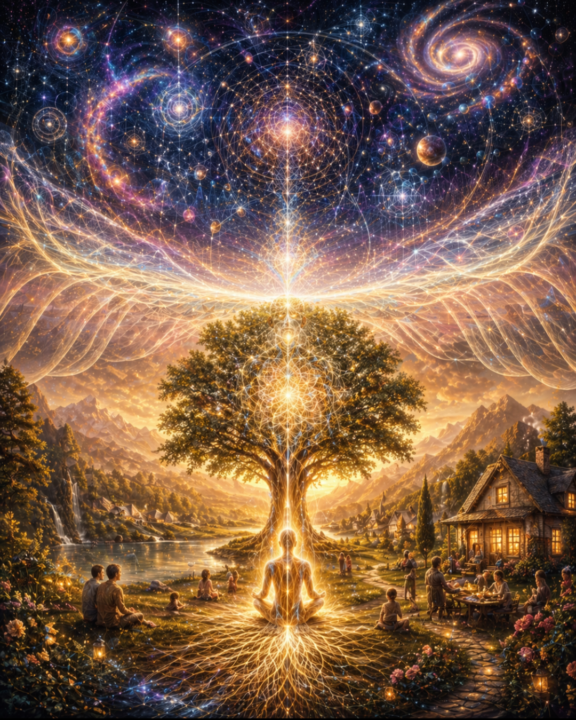
♾️📓🗃️The Beauty of Stability: Why a Rendered World May Be More Beautiful Than a Raw One
One of the deepest philosophical mistakes in contemporary discussions of reality is the assumption that mediation must diminish truth. From that assumption follows the common fear that if human beings do not encounter reality in its raw, ontologically ultimate form, then what they inhabit must be secondary, artificial, or somehow less worthy. Yet a more careful philosophical approach suggests the opposite. The beauty of the world may lie precisely in the fact that it appears in a stabilized, inhabitable form. If consciousness were exposed to reality without proportion, filtering, or embodied structure, then the result might not be a higher truth but the collapse of a world fit for life. In that sense, stability is not the enemy of reality. It may be the condition under which reality becomes beautiful, shareable, and livable for beings like us. Classical aesthetics already gives language for this claim. In Kant’s account, beauty is not simply a brute property sitting inside an object like weight or size. A judgment of beauty is grounded in a distinctive pleasure and involves a felt sense of purposiveness without being reducible to a determinate concept or practical use. Beauty, then, is not merely the registration of raw fact; it is a meaningful mode of appearance in which the world seems fitting to our faculties without being exhausted by utility. This matters for the present thesis because it suggests that what humans call beautiful is often what appears in a form that resonates with the structure of human apprehension. Beauty is not necessarily what is most metaphysically naked. It is what arrives with an order that the subject can receive as coherent, significant, and worthy of contemplative regard. Phenomenology deepens this insight by relocating beauty from abstract objects to the lived relation between body and world. Merleau-Ponty argues that the body is not merely one more thing in the world but the very medium through which a world becomes available. Human beings do not first exist as detached minds and then later interpret a foreign environment; rather, they are always already embodied beings open to a shared world. This means that the stability of appearance is not a cosmetic layer placed over chaos. It is the very form through which things become encounterable at all. A tree, a face, a path, a home, and the sky are beautiful not only because of color or symmetry, but because they appear within a world already structured for embodied relation. The beauty of stability, in this view, is the beauty of a world that holds together enough for life to unfold within it.
0
0
1-30 of 141
powered by
skool.com/trans-sentient-intelligence-8186
TSI: The next evolution in AI Intelligence. We design measurable frameworks connecting intelligence, data, and meaning.
Suggested communities
Powered by