
Jan 2 (edited) • 🏟️ The Main Stage
There is a lot of confusion around “strawman,” the “sovereign citizen,” the “natural man,” or the “living man.”
There is a lot of confusion — and a lot of misinformation — around ideas like the “strawman,” the “sovereign citizen,” the “natural man,” or the “living man.”
Those terms come from old common-law language.
Here’s the problem.
Modern courts are NOT common-law courts in the way most people think they are.
Most court officials believe case law IS common law.
It isn’t. Case law interprets statutes.
It does NOT resurrect common-law capacity arguments that no longer operate in modern statutory jurisdiction.
That’s why sovereign-style arguments almost never work in court. They’re aimed at courts that don’t exist anymore.
So let’s strip the labels away and deal with what the law ACTUALLY says today.
What I’m about to say isn’t opinion.
It’s not conspiracy.
It’s straight out of U.S. law.
First thing you need to understand:
LAW DOES NOT DEAL WITH PEOPLE.
LAW DEALS WITH PERSONS.
That is not my definition.
That comes directly from the United States Code.
Title 26, United States Code, Section 7701 defines a “person” as:
- an individual
- a trust
- an estate
- a partnership
- an association
- a corporation
That’s the system telling you EXACTLY who it governs.
Now here’s where people mess up.
They think the Constitution protects them.
No.
The Constitution restrains the GOVERNMENT.
It does NOT protect you from contracts you voluntarily enter.
That’s why Article I, Section 10 of the Constitution explicitly states that no state may impair the obligation of contracts.
Private contracts are PROTECTED — not restricted.
And the Supreme Court confirmed this in D.H. Overmyer Company v. Frick, where it ruled that constitutional rights may be knowingly and voluntarily waived by contract.
Once you agree — rights are off the table.
That is the foundation of commerce.
Now let’s talk about status.
This is where confusion explodes.
The Constitution also says something most people have never read.
Article I, Section 9, Clause 8 states:
“No Title of Nobility shall be granted by the United States.”
This clause prohibits the government from granting aristocratic or sovereign rank.
Historically, titles of nobility mean:
- Duke
- Earl
- Baron
- Count
- Lord
Titles that convey hereditary privilege or sovereign authority.
In the same sense, one cannot be granted a “slave” title.
This clause does NOT prohibit the government from classifying persons for administrative or commercial purposes.
This is where people misunderstand things like “Mr.” and “Mrs.” Some say those are “slave titles.”
Legally, they are not. But it can FEEL that way — because the state may hold jurisdiction over you.
For example:
- the state grants a marriage license
- the marriage becomes an amalgamation under state jurisdiction
- the state rules over the marriage in divorce
- filing status and commercial operation change
This is a jurisdictional contract couples enter into with the state when they accept a marriage license.
Jurisdiction may be found by:
- the existence of a legal person
- participation in commerce
- statutory capacity
- private contract
The problem is NOT the word “Mr.”
The problem is capacity and presumption.
Now let’s talk about money.
This is where illusions and misconceptions shatter.
Money is NOT backed by gold or silver in Fort Knox.
We are NOT on a gold standard and haven’t been for a long time.
Money is backed by DEBT.
The law tells you this.
Title 31, U.S. Code, Section 5103 states that United States currency is legal tender for debts.
Debt comes first.
Title 12, U.S. Code, Section 411 states that Federal Reserve Notes are obligations of the United States.
An obligation IS debt.
Debt is backed by future performance.
That is why money is debt.
It is produced by your future labor.
Often described as the “full faith and credit of the United States.”
In God We Trust.
The system does not need to own you.
It only needs your participation — giving it the ability to monetize that future labor.
Now watch how identity fits into this.
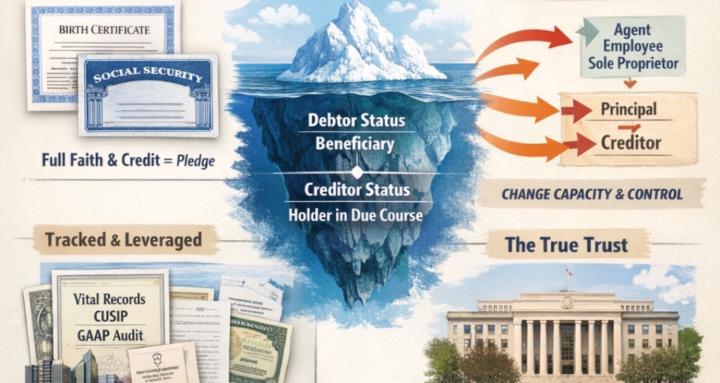
At birth, a record is created.
Not you...
A LEGAL PERSON.
That legal person is used for administration:
- taxation
- benefits
- liability
The Social Security Act makes this explicit.
Title 42, U.S. Code, Section 405(c) explains that the Social Security number exists to track earnings and benefits.
It is an accounting identifier.
You cannot pass a Social Security Number to your children the way you pass on your last name.
Now here’s the part nobody explains.
Most people believe they are acting as themselves.
They’re not.
They are acting as the AGENT for the legal person.
And because they have no estate plan — no structure — no separation — they default into the WORST possible status in commerce:
THE SOLE PROPRIETOR.
Unlimited liability.
No shield.
No separation.
No protection.
Here’s the key principle:
IN LAW, YOU DO NOT CONTROL WHAT YOU DID NOT STRUCTURE (CREATE).
The default sole-proprietor capacity is not something you consciously created.
It is a statutory default applied when no other capacity is defined.
Because of that:
- liability flows to the individual
- contracts attach automatically
- obligations follow the name
Most people enter contracts unknowingly through:
- implied consent
- acquiescence
- estoppel
That’s why sovereign arguments fail in court. They are often hostile and not speaking in a procedural or commercial way the courts can understand. They do not properly rebut the presumptions and assumptions.
That’s why contracts stick.
That’s why debt follows the name.
That’s why courts don’t debate with you.
Courts don’t care about stories.
They enforce capacity and obligation.
Presumptions control until rebutted.
************That is Federal Rule of Evidence 301************
If you don’t define capacity, the system does.
If you don’t structure ownership, administration defaults.
That is why trusts exist.
A trust separates legal title from equitable interest.
That principle is stated in the Restatement of Trusts and recognized throughout U.S. jurisprudence.
This isn’t about hiding.
It isn’t about magic paperwork.
It’s about understanding:
- jurisdiction
- capacity
- structure
Once you understand that: money is accounting, law is capacity, identity is contractual.
You stop being emotional.
And you start operating intentionally.
So the question isn’t philosophical.
It’s practical.
Are you operating as the ASSET…
or as the one controlling the STRUCTURE?
Because in commerce — that distinction changes everything.
One final thought worth sitting with:
The Constitution begins with “We the People.”
NOT “We the Persons.”
The Constitution speaks politically.
Statutes speak administratively.
Understanding the difference between those two layers
is where real mastery begins.
This is why we make our name a business that WE created. Not the State.
This is why we trademark our name, signature, and thumbprint.
This is how we take back consent.
This is how we control our surety.
This is how we control the value we create in the commercial world.
This is why we hold our assets in trust in private domain.
This is why we hold our assets in trust for the benefit of the family not the public or the state.
2:42
4
3 comments
There is a lot of confusion around “strawman,” the “sovereign citizen,” the “natural man,” or the “living man.”
powered by
skool.com/title-8-academy-1862
PRIVATE - FINANCIAL LITERACY AT ITS FINE$T In Layman Terms 🙂
What Are "Dollars" 💰 Anyway?
Ask: “How Do The Rich & Famous Pay Less Taxes Than Me?
Suggested communities
Powered by