
Write something

Apr 8 •
WEDNESDAY LOOPS: MANAGING THE "ECHO CHAMBERS"
High-performance leaders are often surrounded by people who agree with them. This creates a "Static Loop" that prevents the Citadel from evolving. The Kinetic Charge: If everyone in the room is nodding, someone isn't thinking—or they are too afraid to speak. Strategy 1: Appoint a "Devil’s Advocate." In every major strategy session, formally task one person with finding the flaws in the "perfect" plan. Strategy 2: The Diversity of Thought Drill. Explicitly ask the most junior person in the room for their perspective first to avoid "Leader Bias." Strategy 3: Reward the Risk. Publicly thank a team member who disagreed with you and provided a valid alternative. The Kinetic Quote: "A leader who only hears echoes is eventually deafened by their own mistakes." - Cyril N Fomonyuy #CognitiveDiversity #LeadershipBias #CriticalThinking #GrowthCulture #BoldLeadership #managementrevolution #thecore #Vision2026
0
0
Apr 7 •
TUESDAY CHARGE: THE FLOW OF SOCIAL CAPITAL
Trust is the lubricant of high-speed teams. In The Core, "High-Flow" environments allow information to move without the "tax" of suspicion or over-explanation. The Kinetic Charge: Information is only power if it moves; stagnant knowledge is just data waiting to rot. Strategy 1: Radical Transparency. Share the "Why" behind a difficult decision before the rumour mill invents its own version. Strategy 2: The "Over-Communication" Audit. Check if your team is spending more time reporting status than actually doing the work. Simplify the flow. Strategy 3: Micro-Trust Gains. Delegate a small, high-visibility task with zero oversight. Watch how the speed of delivery increases when the "trust tax" is removed. The Kinetic Quote: "When trust is high, communication is instant. When trust is low, every sentence requires a lawyer." - Cyril N Fomonyuy #TrustEquity #TeamFlow #SocialCapital #LeadershipIntegrity #TransparentCulture #managementrevolution #Vision2026
0
0
Apr 6 •
WEEK 3: SOCIAL PHYSICS
In Week 3, we move from the internal speed of the leader to the power of the collective. Social Physics is the study of how ideas and information flow through a group. In the Citadel, we focused on the walls; in Social Physics, we focus on the "currents" between people. High-performance leadership is about creating "intellectual collisions" that spark innovation. MONDAY KICKOFF: THE ARCHITECTURE OF COLLISION Innovation does not happen in isolation; it happens when two different perspectives crash into each other. If your leaders stay in their silos, the Citadel becomes a series of disconnected towers. The Kinetic Charge: Your best ideas are not hidden in your head; they are waiting in the hallway between you and someone you have not spoken to today. Strategy 1: Engineer "Random" Encounters. Break the silo by reaching out to a peer in a completely unrelated department for a 10-minute "no-agenda" sync. Strategy 2: The Cross-Pollination Prompt. Start your team meeting by asking: "What is one thing another department is doing that we could steal and adapt?" Strategy 3: Open the Gates. Physically or virtually move your work to a common area once a week to invite spontaneous dialogue. The Kinetic Quote: "Isolation is the tomb of creativity. True leadership is the art of building bridges where others see only borders." - Cyril N Fomonyuy #SocialPhysics #LeadershipConnections #SiloBusting #InnovationCulture #TheKineticLeader #managementrevolution #thecore #Vision2026
0
0
Apr 4 •
GROWTH IS THE COURAGE TO EVOLVE
There comes a moment in every leader’s journey when yesterday’s best is no longer good enough for today’s reality. What once worked… must now be refined. True leadership is not about always being right, it is about being willing to rise when you learn better. So the question is not: "Did I do my best then?" The real question is: "Am I doing better now that I know more?" Here are three strategies to lead with evolving excellence: 1. Embrace Learning Without Ego Growth begins where defensiveness ends. The strongest leaders do not protect their past decisions,;they improve them. 2. Turn Awareness into Action Knowledge alone changes nothing. When you discover a better way, act on it quickly. Progress lives in application, not intention. 3. Normalise Growth in Your Environment Create a culture where learning, unlearning, and relearning are celebrated, not judged. When people feel safe to improve, performance transforms. Remember, “Your past effort proves your commitment; your present growth proves your leadership.” - Cyril N Fomonyuy In the end, leadership is not about perfection, it is about progression. #Leadership #GrowthMindset #PersonalDevelopment #ContinuousImprovement #managementrevolution #Vision2026
0
0
Apr 2 •
THURSDAY VELOCITY: THE "REDLINE" INDICATOR
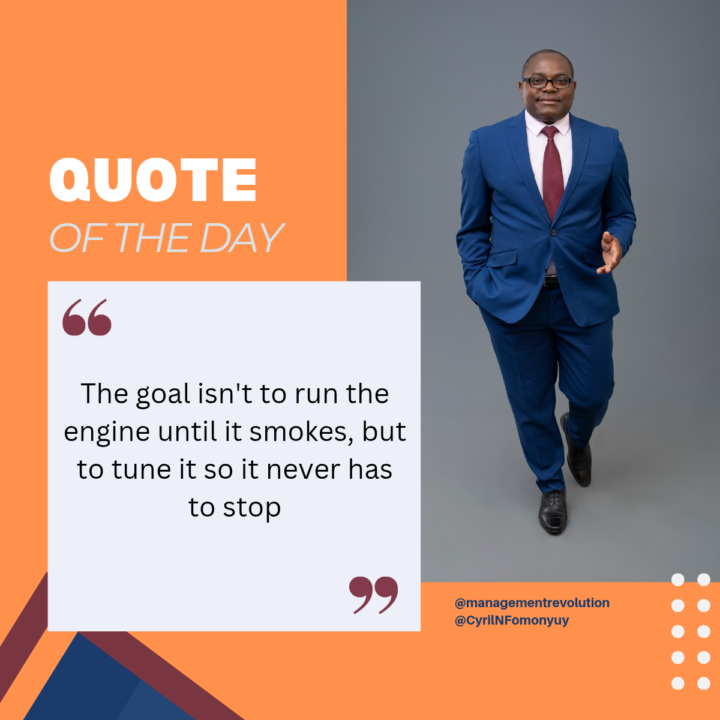
Every engine has a limit. Rotational velocity is about finding the "sweet spot" where you are moving at maximum speed without blowing the gaskets of your team’s morale. The Kinetic Charge: True velocity is sustainable; if your team is breaking, you are not fast, you are just reckless. Strategy 1: The Vibe Check. Once a week, ask: "On a scale of 1-10, is our current pace invigorating or exhausting?" Strategy 2: Strategic Pauses. Every high-speed rotation needs a "cooling period." Schedule 15 minutes of white space between high-intensity sprints. Strategy 3: Resource Re-allocation. If one department is "redlining," move "Citadel guards" from a slower area to support them immediately. The Kinetic Quote: "The goal isn't to run the engine until it smokes, but to tune it so it never has to stop." - Cyril N Fomonyuy #SustainableGrowth #BurnoutPrevention #TeamHealth #PulseCheck #PerformanceTuning #managementrevolution #Vision2026
0
0
1-30 of 68
powered by

skool.com/thrive-now-3974
Training and community for personal growth & daily progress. Build better habits, gain momentum, achieve your goals & start thriving now.
Suggested communities
Powered by