Write something

Sep '25 •
The Architecture of Control - Left-Hemisphere Thinking and the Postwar Re-Engineering of Humanity
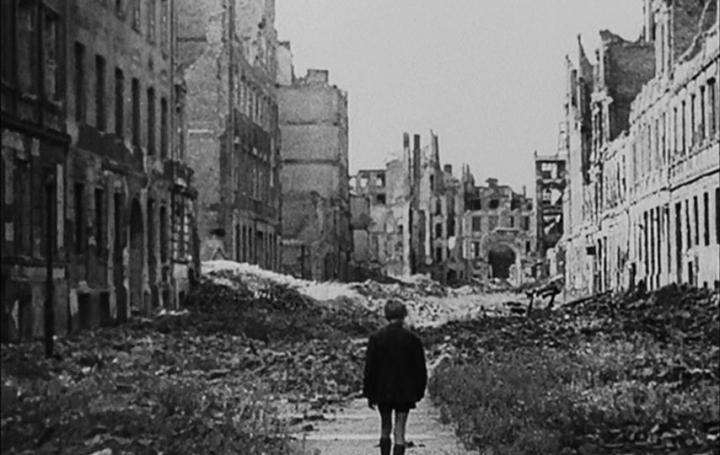
This is the first essay in a series exploring the reconstruction of the Western World after the end of World War 2 - this will be turned into a course in the near future. We are given two modes of reality through which we interpret the world. These come to us in the form of the right hemisphere and the left hemisphere. In short, the right hemisphere engages with the world with breadth, depth, intuition, and a holistic perspective. It seeks to **comprehend** the world. On the other hand, the left hemisphere can be interpreted as a narrow-focused attentional beam. Its purpose is to aid in grasping and manipulating things. Its primary concern is seizing, amassing, and using “things.” In _The Master and His Emissary_, Iain McGilchrist explains in great detail the implications of this divide, both currently and for the future. Neuroscience identifies several differences that characterize the left hemisphere’s worldview: - It has a tendency to classify into groups, often ignoring individual differences. - It possesses a broader linguistic capacity, with subtle and complex syntax. - Most importantly, it extends our **power to map the world and explore complexities of causal relationships between things**. - This capability is of utmost importance, as it has allowed humans to take complete control of their domain, subjecting even nature to the will of man. - It favors the mapped, re-presented world, which is ultimately disconnected from lived reality. Yet this world is self-consistent and self-contained. Iain McGilchrist sums this up: > “If one had to characterise the left hemisphere by reference to one governing principle it would be that of division. Manipulation and use require clarity and fixity, and clarity and fixity require separation and division. What is moving and seamless, a process, becomes static and separate – things. It is the hemisphere of ‘either/or’: clarity yields sharp boundaries.” The traits and tendencies of the left hemisphere, when amplified to a societal and collective scale, leave traces of its influence on institutions, technologies, and power structures. Industrialization intensified humanity’s capacity to remake its surroundings. The increasing drive for territory, resources, and shifting worldviews resulted in the unprecedented devastation and violence of the World Wars. This pushed nations to adopt systems and ideologies that could prevent future catastrophe—ranging from international governance to scientific interventions aimed at understanding and manipulating human behavior.
1
0
Sep '25 •
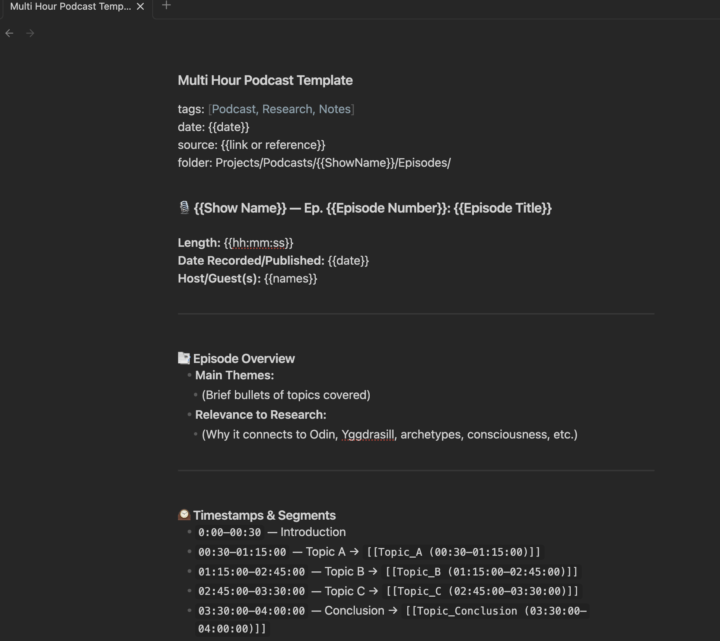
Podcast Summary Prompt Template
Compiling sources, and knitting together ideas for books is incredibly taxing. However this prompt has been incredibly helpful in getting the large picture from podcasts I have already had time to listen to, speeding up my process. Please give it a try and let me know what you think.
1
0
Sep '25 •
✨ Visualization and the Key to Being Who You Want
Every being with a mind makes decisions. These decisions are guided by goals—unique to the individual or group—that reflect perceived needs or ideals. Each goal represents a vision of a better state of being, shaped by the individual’s context: who they are, when they live, and where they come from. For instance: - A businessman seeks promotion to support his family - A warrior enters battle in pursuit of honor - A model seeks beauty and physical perfection for fame and notoriety. Though their paths differ, all are oriented toward a meaningful subjective aim. Through attention and will, they interact with the world in what can be described as **evocation**—drawing forth a reality from shared possibility. 👤 Subjective Worlds in Objective Frames Consider a Canadian man of Western European heritage born in 1996. His genetics, birthplace, and age are fixed. But how he interprets media, makes meaning, and forms goals is subjective. We all live within shared objective layers (local, national, global), but we each filter them through our unique lens. This is the **liminal space** where meaning arises. 🧠 Attention Changes What You Find What if the way we attend to the world **changes** what we find there? This isn’t just poetic—it’s supported by quantum physics, evolutionary biology, and brain science. We may be unaware of two crucial facts: 1. There are **two distinct modes of being** (hemispheres) that want different things 2. The form of attention we bring to the world **changes both the world and ourselves** 📖 From _The Master and His Emissary_ by Iain McGilchrist "There are two fundamentally opposed realities, two different modes of experience... Their difference is rooted in the bihemispheric structure of the brain... I believe they are involved in a sort of power struggle..." — Iain McGilchrist McGilchrist's model isn’t just about neurology—it’s about **culture**, **identity**, and most importantly **how we shape reality**. 🧭 Left vs. Right Hemisphere — Key Overview
0
0
Sep '25 •
Welcome to The Republic
A gathering place for high-signal, inquisitive thinkers. We read difficult books, engage complex ideas, and test them against lived reality. Our aim is not intellectual entertainment, but embodied insight. From neuroscience to mythology, physics to philosophy — we explore timeless and emerging ideas to deepen perception and clarify how to live. We also engage ideas often dismissed as fringe — not to believe or debunk, but to understand. From classified government projects to ancient symbolic systems, nothing is off-limits — so long as it sharpens perception and grounds insight in action. This is philosophy as practice. If this is something that interests you, please feel free to follow and let me know what books you are currently reading!
1
0
1-4 of 4