
Write something

Jan 7 •
Actor Parent Roadmap - DON’T MISS THIS OPPORTUNITY!
Hey Skool fam! Want to level up your acting game (or support your young actor)? 🎭 I have to share this 🔥 opportunity from my friend Amber Bohac — co-owner and coach at Actorsite! Amber’s monthly Intensive of the Month classes are designed to help actors of all ages grow their craft, gain confidence, and get real industry insight — without breaking the bank. ✨ What you get: - Fun, immersive, and focused 1-day training 💥 - Topics change monthly so you’re always learning something fresh. - Real tools actors can use in auditions and on set. - Taught by Amber Bohac — a seasoned coach whose work helps actors shine on camera and in the room. 📍 Great for: ✔ New and experienced actors ✔ Parents who want to confidently support their young actor ✔ Anyone ready to stop feeling stuck and start doing. 💸 Only $39! — an amazing value for expert acting training. 👉 Check out the current Intensive of the Month here: https://www.actorsite.com/intensive-of-the-month Let me know if you want help choosing the best session for you or your kid — these classes fill up quick! 👏
0
0
Jan 5 •
How to do a Standard Slate with a Full Body Shot
When an audition slate requires the standard “frame from the chest up” but also asks for a full body shot, this is how we accomplish both. First we film the slate by holding the phone horizontally and getting that standard wide shot. Then we zoom out (still horizontal), and record a separate video. I like to use an app called InShot to upload both videos to. Then I use the Picture in Picture tool in the InShot app to add the full body shot video to the right of the actor like so.
0
0

Dec '25 •
What Jason Bateman Has Taught Me About Child Actors and Mental Health
Jason Bateman has spent decades speaking candidly about what it means to grow up in the entertainment industry—and more importantly, what it can cost. In interviews, podcasts, and long-form conversations, he’s remarkably consistent in his message: childhood is not something you get back, and no role is worth sacrificing a child’s sense of self. Having been a working child actor himself, Jason often talks about how easily a young performer’s identity can become entangled with approval, performance, and external validation. He’s clear that when a child’s value becomes tied to how well they deliver, how fast they adapt, or how much they please adults, it creates long-term mental health risks. His perspective isn’t anti-acting—it’s pro-boundaries. One of the strongest themes he returns to is normalcy. Children, he argues, need routine, privacy, predictability, and the freedom to fail without an audience. This is why he’s openly shared that he’s chosen not to involve his own children in acting. Not out of fear or bitterness—but out of respect for how formative and fragile those early years are. Children cannot fully understand the psychological tradeoffs of fame or performance; adults must act as gatekeepers. He also speaks often about praise—how intoxicating it can be for a developing nervous system. Constant validation, applause, and being labeled “special” can wire a child to seek worth externally instead of developing internal stability. Success, in his view, isn’t measured by how early a child books work, but by how intact they are when the attention fades. What makes his message especially powerful is that it isn’t theoretical. He’s talked about stepping away from acting as a young adult and how that distance allowed him to rebuild a fuller identity outside of the industry. That pause, he suggests, is something many child actors are never given—and often desperately need. I saw this philosophy embodied firsthand when my ten-year-old daughter had the opportunity to work with him and found herself nervous during a one-on-one improv scene. Rather than rushing her, intimidating her with experience, or “powering through,” he met her with calm presence. He slowed the moment, grounded the interaction, and put her at ease. There was no pressure to perform, no sense that she needed to impress him. He created psychological safety first—and the performance followed naturally.
0
0
Dec '25 •
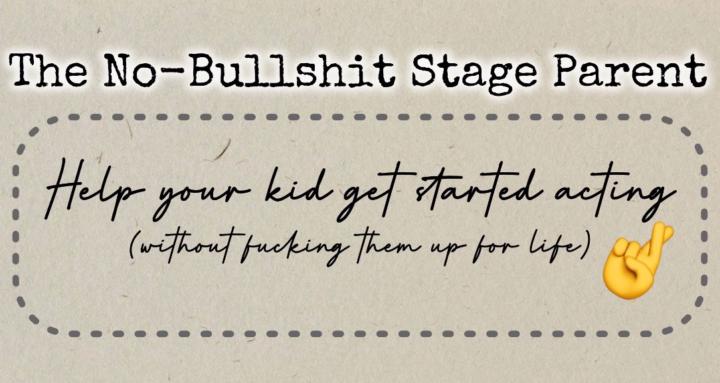
Happy FIRST DAY OF EXISTENCE to The No-Bullshit Stage Parent
Hi, @Kerry Cook ! Thanks for being THE FIRST to join my little community! Let me know if you have any questions. Check out Chapter 1 in the classroom and let me know what you think!
0
0

Dec '25 •
Understanding Your Child’s Desire; The first step is understanding what your child really wants. Sometimes kids are curious, sometimes they’re passionate—and sometimes it’s both! Here are a few questions you can ask:
“What do you like about the idea of acting/being on stage or on camera?” “Would you like to try acting classes?” “Would you like to audition for a play or musical?” -Getting them involved in community theatre or acting classes (in-person or virtual) is a great way to see if they ACTUALLY enjoy being in the spotlight, or if they just liked the IDEA of it. It’s also something they will have to do regularly as part of their acting journey. && if they are too young to talk: “Why are you so dang CUTE?!” Ask yourself… -What about them have you observed that may indicate they may have a natural talent for acting? -Am I prepared to put in many many hours to help them navigate this industry in a SAFE and SANE manner? -Are they in a good spot emotionally/mentally to be on the receiving end of a lot of rejection? If no, how can I help nurture their emotional resiliency so that this doesn’t completely f**k them up??* **Side note: it’s OKAY if you do not know these answers yet or if you’re thinking, “oh man, I don’t even know if I can handle my kid being told, “no” over and over again… Stick with me and I’ll help you learn how to turn failure into a bigger and even better YES. What is your biggest concern for your child possibly becoming an actor?
0
0

1-5 of 5
powered by
skool.com/the-no-bullshit-stage-parent-5448
Went from knowing nothing about acting to guiding my child to an HBO role. Now I help parents start smart—with zero BS.
Suggested communities
Powered by