
Write something
Pinned

Jun '25 •
Welcome to Overtime Rx
Whether you’re here for the training, the sports talk, or a bit of both — you’re in the right place. This community is built for athletes, ex-athletes, fans, and anyone who wants to move better, train smarter, and stay in the game. Inside, you’ll find: - 🏋️♂️ Movement & training modules you can follow at your own pace - 🎙️ Sports talk, injury breakdowns, and athlete insights - 💬 Threads for questions, hot takes, or just talking shop - A few ways to get started: ✅ Introduce yourself below – Where you're from, who you cheer for, and what you're training for ✅ Check out the “Movement Prescription” section to start learning and moving ✅ Drop a hot take in the “Hot Takes & Highlights” thread (keep it spicy 🔥) Appreciate you being here early — let’s build something awesome together.
Jan 26 •
Why That Viral Exercise Isn’t Fixing Your Pain
In today’s world of social media and AI, it’s becoming harder than ever to separate signal from noise when it comes to exercise. Scroll Instagram or TikTok for five minutes and you’ll find countless videos promising that one specific exercise will completely eliminate neck pain, low back pain, shoulder pain—you name it. So what actually works? Before we can answer that, we need to step back and ask a more important question: Why are we doing certain exercises in the first place, and what outcome are we actually trying to achieve? Most of the people I work with are coming from a rehab setting. They’re in pain and looking for a solution. That solution can look very different depending on the person and the situation. Treating someone who can barely walk due to acute low back pain requires a very different plan than working with an athlete who only experiences back pain after long practices or games. This is where the conversation shifts to the difference between rehab and strength training. These are often treated as completely separate worlds, but in reality they’re much closer than most people think. I prefer to think of them as points along a spectrum. On one end, you have basic rehab. On the other, you have full-blown strength training. The key is progression—using the right exercises at the right time to gradually increase capacity. The goal is to build someone’s tolerance to load. As that tolerance improves, certain exercises eventually stop being challenging enough to create further adaptation. At that point, they’re no longer effective—and it’s time to progress to something more demanding. This is exactly why watching a random exercise on social media can be misleading. Those videos don’t account for your starting point. The most important questions to ask are: What is the objective of this exercise? And when does it stop doing its job? A common example is shoulder pain, often labeled as a rotator cuff issue—whether that’s a tear, tendinopathy, or tendinosis. Many people are sent home with a red resistance band and told to keep their elbow pinned to their side while rotating the arm outward for three sets of ten. On the surface, this isn’t a bad exercise. But what does this plan usually lack?
2
0

Jan 6 •
The Least Sexy Core Exercise That Works
In my previous post, I talked about the importance of breathing—specifically diaphragmatic breathing. In this post, I want to show you how to actually practice it on your own and how to integrate it into your at-home workouts. The first goal when working on breathing is to remove as many variables as possible. From a science standpoint, this lets us isolate one thing at a time. From a biomechanics and rehab standpoint, that means starting lying flat on your back. When you’re on your back, your body no longer has to fight gravity to keep you upright, which makes it much easier to feel what’s actually happening with your breath. Once you’re lying down, we shift our focus to the breath itself. Take a slow breath in through your nose, then exhale through your mouth like you’re blowing up a balloon. As you do this, pay attention to what’s moving the most when you inhale and exhale. If you’re using your diaphragm properly, it should move downward as you inhale. This pushes gently against your internal organs and increases pressure around the low back. If the diaphragm isn’t doing its job, the body often compensates by breathing upward into the chest and shoulders—what we call a compensatory breathing pattern. Once you can feel your diaphragm working, the next step is using it to create intra-abdominal pressure (IAP). IAP gives your deep core muscles something solid to brace against, which is what actually creates a strong, stable core. When this system isn’t working well, the body relies on secondary stabilizers instead. Over time, those muscles tend to become tight, overworked, fatigued, and sore. A simple way to know you’re creating good IAP is this: when you inhale, your abdomen should expand 360 degrees—front, sides, and back—not just forward. Now we need to use that pressure to brace the core effectively. Take a deep breath in, then gently engage your core as if someone is about to punch you in the stomach—but not so hard that you risk ripping a fart in a situation you’d rather not. From there, slowly let your breath out. As the diaphragm rises, continue to tighten the core just enough to maintain pressure through the entire exhale.
3
0

Dec '25 •
How your breathing could be secret to pain and performance
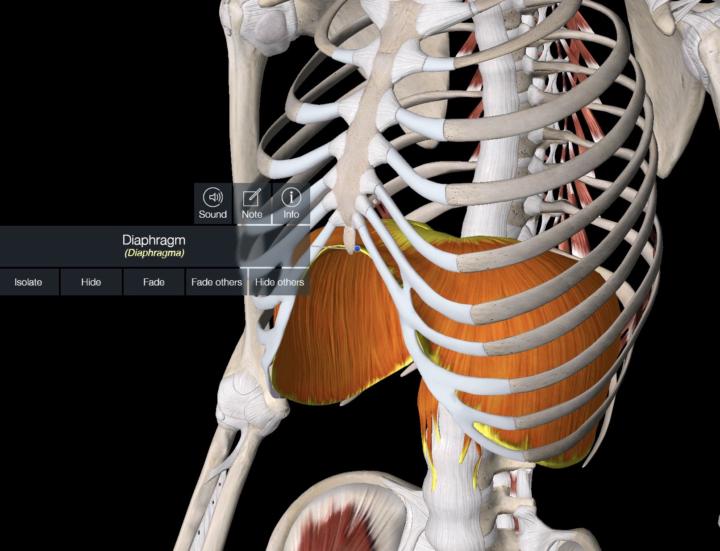
Back pain. Shoulder pain. Neck pain. Rib pain. What do all of these have in common from a rehab standpoint? They almost always start with the same exercise: diaphragmatic breathing (belly breathing). At first glance that sounds odd. Why would we focus on breathing when the pain is so far away from the lungs? Because your breathing pattern alters everything you do. Whether you’re a college athlete or someone who sits at a desk all day, you breathe thousands of times per day. If that breathing pattern is dysfunctional, then every other movement you make is built on compensation. What is the diaphragm, really? The diaphragm is a dome-shaped muscle that sits underneath the lungs. It separates the chest cavity (heart and lungs) from the abdominal cavity (digestive organs and more). It’s unique because it has two critical roles. First, respiration. When the diaphragm contracts, it descends and flattens, expanding the lungs and drawing air in. Second, core stability. The diaphragm forms the top of what we call the core cylinder: - Diaphragm on top - Pelvic floor on the bottom - Core musculature (obliques, rectus abdominis, multifidus) wrapping around As the diaphragm descends, it pushes abdominal contents downward. The pelvic floor resists that pressure (a topic that deserves its own post). This interaction creates intra-abdominal pressure (IAP). IAP acts like an internal weightlifting belt, stiffening and stabilizing the spine against shear and bending forces. This is the foundation of proper core engagement. So, what happens when we don’t use it properly? When the diaphragm doesn’t do its job, people become chest-dominant breathers. Instead of expanding through the abdomen and ribs, the body recruits muscles around the neck and shoulders to pull air in from above. These muscles were never designed to be primary breathing muscles. Over time they fatigue, posture deteriorates, the head drifts forward, the shoulders round, and those same muscles can no longer properly support the neck and shoulders.
Dec '25 •
I’m Back!
After a long hiatus I’m going to start to be more active within this community once again. Originally when I started this community I knew that this was something that I was going to want to use but wasn't exactly sure how. Like many things that I see online there is a lot of start first and figure it out along the way. Unfortunately, when you work full time and are in the middle of planning a wedding, some things fall by the wayside. Now, after a lot of deliberation, I have a more clear idea of what I am going to start to use this community for. The main thing that I want people to get out of this community is for it to be used for education and to talk about topic that I see on a consistent basis within the clinic, gym or even in the sports world and how they relate to health and fitness. I would like this to be an area that people can learn and (hopefully) implement some of the topics into their own lives. So moving forward expect to see more blog style posts explaining different rehab and training principles and even ask whatever questions you’d like with them moving forward. If this is not something your intersted in I totally understand if you decide to leave. But on the flip side if you know of someone who would find this type of thing interesting, feel free to invite anyone you may know. I am not going to promise any frequency but will still continue to monitor the community if there are any topics that would spark your interest.

1-30 of 46
powered by
skool.com/the-movement-prescription-1200
Train smart. Prevent injuries. Overtime Rx helps athletes stay in the game with rehab-informed strength and real sports insight.
Suggested communities
Powered by