
Write something

21d •
The follow-up question that ends most interviews
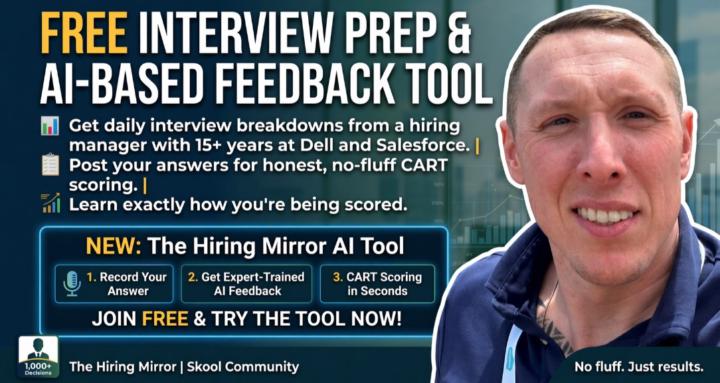
You give a solid answer. The interviewer nods. You think you nailed it. Then they say: "Can you walk me through the specific decision you made there?" And suddenly you're scrambling. Because the story you told was your team's story. Not yours. This is the most common place I've seen candidates fall apart in 15+ years of hiring. The initial answer sounds great. The follow-up exposes that they can't point to a single decision they personally made. Here's what I'm checking when I ask that follow-up: Did you identify the problem, or did someone hand it to you? Did you choose the approach, or did you follow a plan that already existed? Did you make a trade-off, or did everything just "work out"? If you can't answer at least two of those clearly, your answer scores low on Action, one of the four CART dimensions I evaluate every answer on. The fix is simple but uncomfortable: go back through your top 5 interview stories and find the moment where YOU made the call. Not "we decided." Not "the team agreed." The specific point where you chose a direction and owned the risk. If you want to test whether your answers survive the follow-up, run a free mock interview. It asks the same follow-ups I would. 👉 www.thehiringmirror.com Drop your best "leadership" story below and I'll tell you if it would survive my follow-up.
0
0
22d •
The question that trips up senior candidates the most
"Tell me about a time you failed." Junior candidates struggle because they don't want to admit failure. That's expected. Senior candidates struggle for a different reason. They pick a failure that's actually a humble brag. "We launched two weeks late but still hit 120% of our target." That's not a failure. That's a success story with a speed bump. Here's what I'm actually testing with this question. Can you name a real mistake? Do you understand why it happened? Did you change something specific because of it? The best answers I've heard all have one thing in common. The candidate is clearly uncomfortable telling the story. Not because they're unprepared. Because the failure was real and it still stings a little. That's how I know it's true.
0
0
22d •
"Tell me about yourself." Here's how to actually answer it.
This is usually the first question. And most candidates blow it by giving a 3-minute autobiography. Here's the thing. This isn't a life story question. It's a positioning question. The hiring manager is asking: why should I keep paying attention to you for the next 45 minutes? The formula that works: One sentence on your current role and scope. One sentence on the most relevant thing you've done. One sentence on why this role is the logical next step. That's it. 30 to 45 seconds. Tight, specific, forward-looking. What kills you: starting with where you went to college, walking through every job chronologically, or saying "I'm a passionate problem solver who loves working with people." Drop your "tell me about yourself" answer in the comments. I'll tell you what a hiring manager actually hears.
0
0
1-3 of 3
skool.com/the-hiring-mirror-4290
Most interview advice is from people who never hired.
I've hired 1,000s in tech.
Get weekly coaching, live hot seats, and honest scoring.
Powered by