
Write something

Mar 15 •
Cable Gages and Why They’re Important
Power cable gauge (gage) refers to the thickness of the wire conductor, which determines how much electrical current it can safely carry. In North America, this is usually measured using American Wire Gauge (AWG). 1️⃣ How the Gauge System Works 📖 The AWG system is a little counterintuitive: - Lower number = thicker wire = more current capacity - Higher number = thinner wire = less current capacity *Actual ratings depend on insulation type, temperature, and installation method. 2️⃣ Why Thicker Wire Can Carry More Power 💪🏼 Electric current flowing through a wire encounters resistance (a property explained by Ohm's Law). Thin wires have higher resistance, which causes: - More heat - Voltage drop - Energy loss Thicker wires have lower resistance, so they: - Stay cooler - Deliver power more efficiently - Handle higher current safely 3️⃣ What Happens If a Wire Is Too Small ⚠️ Using an undersized cable for the power draw can cause: 1. Overheating = The wire turns electrical energy into heat. 2. Insulation damage = The plastic jacket can melt. 3. Fire risk = Electrical fires often start in overheated wiring. 4. Voltage drop = Devices may run poorly or shut off. 4️⃣ Real Example 🌎 Imagine running a 1500-watt space heater on a 120-volt circuit. Current draw: [I = P / V = 1500W / 120V = approx 12.5A] A 16-gauge extension cord may only be rated for ~10 amps. Result: - Wire overheats - Insulation softens - Potential fire hazard A 14-gauge or 12-gauge cord would be safer. 5️⃣ Why Distance Also Matters 🏔️ Longer cables increase resistance. So even if the amp rating is okay, a long cable may still cause: - voltage drop - overheating That’s why long extension cords should be thicker (lower AWG). 6️⃣ Quick Rule of Thumb 👍 For typical 120V household loads: Current Minimum Safe Wire: - 10A = 16 AWG - 15A =14 AWG - 20A = 12 AWG - 30A = 10 AWG 💡 Simple way to think about it: - Electricity flowing in a wire is like water in a pipe. - Thin pipe → harder flow → pressure & heat build up. - Thick pipe → easier flow → less heat.
0
0
Nov '25 •
The Power Calculation Triangles
The most important thing to know when you’re calculating power is the power calculation triangles. - The first triangle is comprised of 3 iterations of the following formula: Current = Voltage/Resistance (Amps) (Volts) (Ohms) Voltage = Current x Resistance Resistance = Current x Voltage E.g., Voltage = 120 V, Resistance = 8 Ohms, Current = 120/8 =15 Amps - The second triangle is incredibly important for calculating how much power you need for your show, and is comprised of 3 iterations of the following formula: Wattage = Current x Voltage (Watts) (Amps) (Volts) Current = Wattage/Voltage Voltage = Wattage/Current - Once you’ve finalized your gear list, you can check the power rating of each device on the manufacturers website. - Some devices like speakers have multiple power ratings (e.g., continuous, program, and peak). - Continuous or RMS (root mean squared) is the amount of power a speaker can handle continuously over a long period of time without damage or distortion. - Peak is the maximum power that a speaker can handle in short bursts at any given time (most often on startup, so don’t turn everything on at the same time). - Program represents power levels encountered during a typical music performance with dynamic changes. - Program is often 2x the Continuous/RMS rating. - Peak is often 4x the Continuous/RMS rating. - So which one should you go by? Program is generally considered a safe middle ground assuming you don’t push your speakers too hard. But the safest option is peak because you can’t go past that point without damaging your equipment, so they’re not designed to draw more than that. - E.g., let’s say the Program power rating of a speaker is 1200W and we want to know how many amps it will draw from our 100Amp 120V distro. Current = Wattage/Voltage = 1200/120 = 10 Amps - Now we know that it’s drawing approx. 10 amps. - To maintain a margin of safety, we only use 80% of our total Current supply. - So that means we’ve used 10 out of 80Amps available to us and we have 70Amps left. - We repeat this process for all of our gear and that is how we know what the amperage of our distro needs to be. - Disclaimer: I am not an electrician, nor am I the most knowledgeable person when it comes to power. I’ve done a fair amount of research on this and to the best of my knowledge, these statements are accurate. However, if anyone has more knowledge than me, please let me know how I could improve this post!
4
0
Nov '25 •
How to Meter a Distro
It’s always a good idea to test your distro with a meter before use. This ensures it’s safe to use and supplying the power it is rated to supply. How to Meter a Distro: * this is based on North American camlock colours. Always check if you’re unsure. *I am not an electrician. Verify this info. If there is an electrician on site or someone with their LPEC or FE, make sure to shadow them before trying this on your own. You may need your LPEC to do this. Here’s how you can get it: https://www.skool.com/the-av-wizards-club-1325/learning-the-lpec?p=31a66e1e 1) Make sure the meter is in AC not DC 2) Plug the black prong into your ground (green) 3) With the red prong, measure each hot (black, red, blue) They should read close to 120v in a 120v distro 4) Then measure the difference between each hot. This means black prong in one hot, red prong in another. This test should read about 208v between each hot in a 120v/208v distro. 5) Then measure the difference between ground and neutral. This test should read close to zero or 1v max.
2
0
Sep '25 •
Why is it called L21-30?
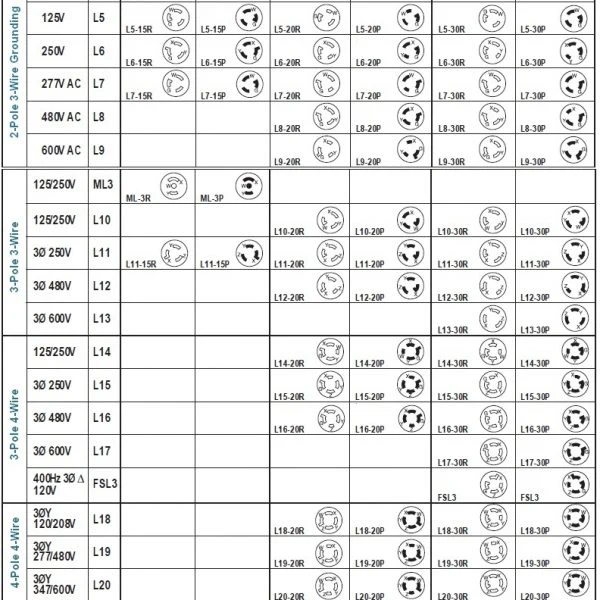
By request from @Rhys Hykawy, we all see L(xy)-(ab) on our twist lock power cables, but do we know what each variable means? The name L21-30 is a standard NEMA (National Electrical Manufacturers Association) designation that follows a specific code to describe its features . The breakdown of the name is as follows: - L: The prefix "L" stands for "locking," which indicates that the connector is a twist-locking type. When a locking plug is inserted into a locking receptacle, it is twisted to secure it in place, preventing accidental disconnection. - 21: This number identifies the specific NEMA series that the connector belongs to. The 21-series connectors are designed for three-phase Y-power configurations. - 30: This number indicates the ampere rating of the connector, which is 30 amps. Therefore, the name L21-30 signifies that it is a Locking connector from the 21-series, rated for 30 amps. The "21-series" indicates it is intended for a 120/208V, 3-phase Y-power system. So, if you see a different designation (e.g., L5-20), you now know the amperage rating of your twist lock cable, and all you have to do to find out what voltage and phase type you need is to look up the NEMA code, which you can do here: (R = Receptacle, P = Prong)
4
0
Sep '25 •
Learning the LPEC
LPEC Certification is something that anyone in the event industry can benefit from, especially those interested in specializing in event power. It is a pre-requisite to higher certifications like FE. Billy, owner of Event Power, created a free online course preparing you for your LPEC test. Check it out here: https://www.power-academy.ca/courses/learning-the-lpec APPLICATION PROCESS 1. Workers must complete at least 800 hours of practical experience to successfully apply to take the exam. 2. Go to Live Performance Electrical Certification page on Actsafe website (actsafe.ca) to purchase the $25 application and exam. 3. After successfully purchasing the application and exam, go to the HOME tab in STAR. Under the ASSIGNED section click on the PDF icon to download the application kit and review the LPEC FAQ. 4. A fully complete application including verification of hours and certification of practical experience form must be submitted to info@actsafe.ca. 5. Application is reviewed by Actsafe and an email with an application updated status is sent to the user within 1-2 weeks. 6. User has 3 attempts to pass the exam (in your STAR profile, in the HOME tab under the ASSIGNED section). 7. Once user has successfully completed the exam, a certificate of completion is available under the COMPLETED section of their STAR profile. Once you’re ready to apply, go here: https://actsafe.ca/courses-workshops/live-performance-electrical-certification/
1
0
1-6 of 6
powered by
skool.com/the-av-wizards-club-1325
THE #1 Community For Learning Audio, Lighting, and Video. Join today to become a Wizard at event technology and content creation! 🧙🏻♂️
Suggested communities
Powered by