
Write something
Jan 13 •
I used to think talent mattered. But...
This "artistic talent" narrative is a really new thing that's blinded society for the last few generations. As the world's become: • more dependent on technology • addicted to convenience and frictionless existence • more willing to hand over their humanity to creating systems for efficiency We've lost something important. I saw a comment recently where someone said, "I don't want to depend on AI to do my thinking. The friction is the point." "The friction is the point." Taking time to *struggle* with your thoughts, write things down, rip them up, try again. Go for a walk come back to it, and KEEP TRYING. That FRICTION is the whole point of making things. Using your body, your hands, your eyes... Learning repetition, *noticing* stuff around you. That's the point. The point is not the END result. The OUTCOME. Nope. That comes naturally as a result of giving your attention to the craft of creating. Do you notice any of this happening, too?

Jan 17 •
FREE LESSON: "Upside-Down Drawing"
This is a free lesson directly from inside the course. It's an exercise called "Upside-Down Drawing" and it's a big unlock for your observational skills. Check it out and comment your experience. It's not about a perfect drawing, it's about opening up your *perception.* Here's the text and video lesson BELOW: _________________________________________ LESSON 1.3 | UPSIDE-DOWN DRAWING (VIDEO DEMO AT THE BOTTOM) Upside-down drawing is a cornerstone exercise that acts as a direct pathway to the visual, perceptual way of seeing. It's a powerful technique because it presents your mind with a task that your left hemisphere finds difficult. So it becomes easy for your right hemisphere to take over! The left hemisphere is concerned with logic, language, and categories. Usually, when you look at an object, the left hemisphere goes "oh I know what that is" and quickly names it and categorizes it based on stored symbols and knowledge. This leads us to draw what we think a chair looks like, rather than what it actually looks like. Your right hemisphere doesn't care these things. It's attuned to the "thing-as-it-is." It doesn't impose pre-determined categories on what you're looking at. So, this exercise will help to escape the conflict. The left hemisphere will disengage, and your natural ability to draw will start to move in. Here's what you'll need: - Sharpened pencil - New page in your sketchbook (or a sheet of computer paper) - The reference image file in Resources Step 1: Position your reference image and your sketchbook so that you can easily draw and glance at the image. Of course, make sure the upside-down man is...upside-down! Step 2: Now, with your pencil, begin slowly copying. Start from the top or the bottom. Patiently work your way through the entire image line by line, curve by curve, mark by mark. Just copy what you see... - Focus purely on lines and curves - Take your time, focus on just one line at a time - Pay attention to exactly how the lines curve, connect, intersect, or overlap - Do not to turn your drawing or the reference right-side-up until you're completely finished

Mar 24 •
Hey, it’s been a minute…
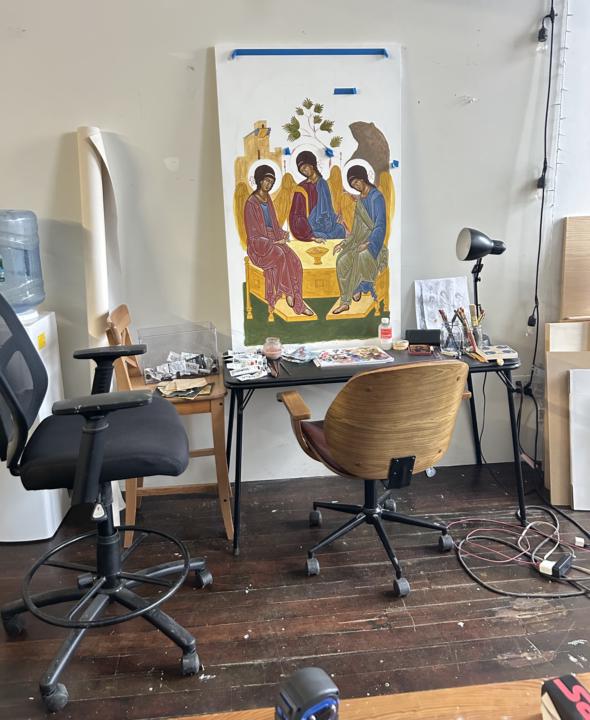
Spring is here! (It snowed this morning in New England lol) It’s been cool to see this group begin to form organically. So I wanted to take the chance to ramble a bit. 💡📲💬 I’m thinking about doing a live call in this group in the near future! There are real humans on the other side of the screen (I think), so we ought to meet each other—even if over a video call haha. Another thing you can hop into (if you’re interested) is this Telegram group not necessarily affiliated with this Skool group. Telegram is great for instant messaging like whatsapp… we can talk more fluidly and regularly in there :) Share your art, chat about current events, etc 💬😊 Telegram group link: https://t.me/+djN_zH7C2VFhMmIx What are you interested to discuss? This can be about anything, honestly. Art, AI, daily struggles, objections you have to being creative, perception, creative blocks, spiritual stuff, podcasts your listening to, how distracted the world is, or whatever else you’ve got hanging out in your mind. I’d love to know what you view as important and meaningful. You can reply to this post, or if you want to email me privately: nickmakiejstudio@gmail.com I’ve been keeping my head down painting lots more orthodox iconography, lately. 🙇🏻♂️ Check out the drawing course (“Classroom” tab inside Skool group) if you wanna learn how to draw anything from observation. Good stuff. But anyways, I really enjoy opportunities to build community, so here we are. Thanks for being here, Nick
1
0
Jan 15 •
Be honest: what excuse keeps stopping you from starting?
There's an invisible force keeping you from sitting down to write, draw, paint, make music. And it’s usually not time, energy, or talent. It’s a story you keep telling yourself. “I’m already behind.” “What if I’m bad at this?” “This doesn’t count unless I do it perfectly.” “I’ll start when things calm down.” Which one of these shows up for you most — or is it a different voice? Right before you stop yourself from creating…what does that voice say? Thank you to each of you for joining the creative fire <3 This weekend is a chance to create before that voice gets a vote. -Nick
Jan 22 •
What do you want help with?
Hey friends. I’m currently looking to get a handle on what people in this space are actually dealing with (creatively or otherwise) and think this group has the potential for helping them with. I think it's best not to assume everyone’s here for the same reasons. If there’s anything you’ve been stuck on lately — or if this just isn’t a focus for you right now — I’d genuinely love to know. Zero pressure to reply here, we can talk in the DMs. Just wanted to ask directly. Have a great weekend! Nick ______________________ P.S. Thinks I imagine *might* be on your mind (i could be TOTALLY off): • "i used to have a creative muscle, but I don't think I do anymore" • "I'd love to get back into _________, but I don't know how or where to start" • "this group seems cool, but it's also confusing because I want to see some direction inside it in order to even know what to do!"
1-9 of 9
powered by
skool.com/the-art-of-seeing-1719
Learn to draw. It’s not a “talent” thing. It’s a SEEING thing.
Suggested communities
Powered by