
Write something
Pinned

8h •
🤝 Your Clients Now Expect AI Speed. Did You Actually Agree to That?
Something has been shifting quietly across most client-facing industries over the past year, and it's worth naming directly because it's rarely discussed as its own phenomenon. Turnaround expectations have been resetting, not because clients are asking for faster service explicitly, but because the fastest available option in any given market becomes the invisible new baseline everyone gets measured against, whether or not they agreed to compete on that basis. The professionals absorbing the most pressure from this shift are often the ones who haven't addressed it directly at all. They're not failing to deliver quality. They're being quietly judged against a speed standard they never negotiated and may not have the workflow to consistently meet. ------------- Context ------------- Client expectations are relative, not absolute. A three-day turnaround felt reasonable when three days was close to the market standard. As AI-assisted competitors compress turnaround times across an industry, three days starts to feel slow, even though nothing about the underlying work or its value has changed. The client isn't necessarily aware they're comparing you to a faster competitor. The comparison happens quietly, in the background of their overall impression, and it shows up as a vague sense that something feels slower than it should, even if they can't articulate exactly why. This dynamic is particularly tricky because it happens without any explicit negotiation. Nobody sits down and renegotiates the terms of a service relationship because a competitor got faster. The expectation just shifts, gradually, and the professional operating at the old pace finds themselves falling short of a standard that was never discussed. A freelance graphic designer noticed this pattern directly when a long-standing client mentioned, almost in passing, that they'd been surprised by how quickly a different vendor had turned around a similar project. The comment wasn't a complaint, and the designer's work quality hadn't changed. But the remark signaled that the client's baseline expectation had shifted, and the designer's usual turnaround, which had been perfectly acceptable for years, was now being measured against a faster standard she hadn't been consulted on.

Pinned
2d •
Fable 5 is Back! Here's the Best Way to Use It...
Anthropic finally brought Fable 5 back and in the same week, they also launched the new Sonnet 5 model. In this video, I break down everything you need to know about these models and explains which one you should be using. Enjoy!
Pinned

6d •
What Success Actually Buys You
Most people think success is about money. It's not. Money is just what buys you options. I've worked hard for decades. Not because I fell in love with the grind, but because I fell in love with what the work could create. Every uncomfortable conversation. Every risk. Every time I wanted to quit but didn't. None of it was just to make more. It was to own my time. To be there for the people I love. To create memories instead of regrets. To have the freedom to say yes to what matters and no to what doesn't. Don't chase success because you want to look successful. Chase it because one day you'll realize time is the only thing you can't earn back. Work hard. Do the uncomfortable things. Become the person capable of creating the life you want. Because real success isn't measured by what you own. It's measured by how fully you get to live. Question for you: If you had complete freedom over your time one year from now, what would you spend more of it doing... and who would you spend it with?

5h •
AI Assistant to maintain neutrality
I do have calls coming in but to remain neutral and unbiased I am limited to what I can discuss. I want my AI assistant to do the AI intake information. This helps me retain objectivity.

⭐
5d •
🤔 WE WANT YOUR HONEST OPINION!
We want to better understand what people are TRULY trying to accomplish when it comes to AI so we can make our products better. We know it’s broad and there are so many different lanes, but if you had to pick one of the 2 options below, which one would you choose?
Poll
1119 members have voted
1-30 of 19,936
skool.com/the-ai-advantage
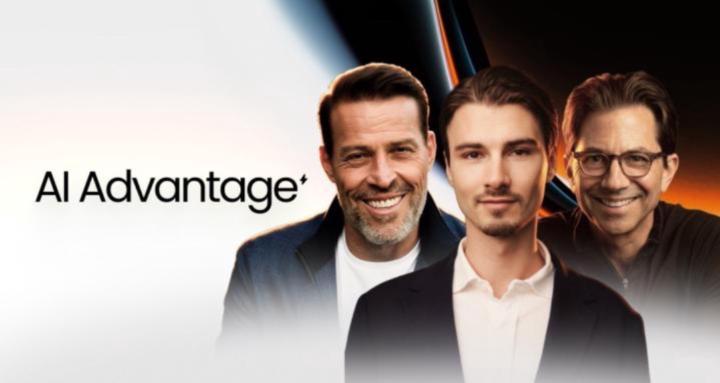
Founded by Tony Robbins, Dean Graziosi & Igor Pogany - AI Advantage is your go-to hub to simplify AI and confidently unlock real & repeatable results
Leaderboard (30-day)
1

+505
2

+353
3

+253
4

+169
5

+135
Powered by