
Write something
Pinned

9h •
🧭 Start With One AI Tool, Because Tool-Hopping Is Stealing Your Time
The fastest path to AI confidence is not trying every tool. It is choosing one useful tool, using it repeatedly, and learning how to make it part of real work. Tool-hopping feels productive because we are exploring. But after a while, exploration without adoption becomes another way to lose time. The goal is not to know every AI tool. The goal is to build one AI habit that gives us time back. ------------- The New Productivity Trap ------------- There is a strange kind of pressure in the AI space right now. Every week, a new tool appears. A new feature launches. A new model gets attention. A new workflow video promises to change everything. A new comparison says one platform is better than another. A new thread tells us we are falling behind if we are not using the latest thing. For people trying to build confidence, this creates a problem. Instead of spending time using AI to improve their work, they spend time deciding which AI tool to use. That decision fatigue is real. Someone may start with one chatbot, then hear about another. They test a writing tool, then a research tool, then a slide tool, then an automation tool, then a note-taking tool. Each one requires a sign-up, a learning curve, a new interface, a few test prompts, and a judgment about whether it is worth keeping. At first, this feels like progress. We are learning the landscape. We are staying current. We are being curious. But after a few weeks, what do we actually have? Often, we have scattered accounts, half-tested workflows, saved demos we never revisit, and no repeatable system that saves time in our actual day. We have consumed information about AI without turning it into leverage. That is the productivity trap. We mistake tool awareness for capability. Awareness can be useful, but capability is what saves time. Capability means we can sit down with a real task, use AI confidently, produce a better first draft, make a faster decision, reduce rework, or protect our focus. That rarely comes from trying everything. It comes from repetition.

Pinned

1d •
Are Your Habits Matching Your Goals?
It’s June 1st, which makes this a good time to step back and ask yourself a hard question: Are you actually doing the things required to build the business or life that you say you want? Not thinking about it. Not planning it. Not consuming more content about it. Actually doing it. Because as entrepreneurs and success seekers, we can convince ourselves we’re “working” while avoiding the handful of things that actually move the needle. The outreach. The follow up. The content. The sales calls. The consistency. The uncomfortable conversations. The discipline to keep showing up when the excitement wears off. Most breakthroughs don’t come from a brand new strategy. They come from recommitting to the fundamentals and staying consistent long enough for the results to compound. So don’t use June to reinvent yourself. Use it to get re-aligned. Review your goals. Get honest about where you’ve been inconsistent. Simplify the plan. And recommit to the habits that actually create momentum. If you stayed consistent for the next 30 days, where could your business or your life look different by July 1st?
Pinned
15d •
🔥 Quick Clarification: Which AI Advantage Community Should You Be In?
We've been getting a few questions in the community and inbox about the difference between our communities, unsure which one you should be in. Here's a quick breakdown to help you find your home base. --------------------------------------------------------------------------------------------------------------------------------------------------- 1. This Skool Community (Free) You're already here. This is our free hub where our team and members share value, ask questions, and grow together. What's inside: - Free trainings and resources in the Classroom - Ongoing community conversations and support - The latest AI news and AIA updates - Practical insights to help you grow with AI Best for: Anyone exploring AI, building community connections, and staying current without a monthly commitment. The Summit may be over, but this group isn't going anywhere. --------------------------------------------------------------------------------------------------------------------------------------------------- 2. AI Advantage Club (Paid Membership) Our premium membership for members ready to go deeper and build their AI skillset consistently. How you may already have access: - VIP members: 30-day trial included - Bootcamp members: 3 months included - VIP + Bootcamp: 4 months free What's inside: - Advanced trainings and step-by-step guides - "Hacks of the Week" you can apply immediately - AI workflows and copy-and-paste prompt libraries - Real business use cases and time-saving systems - Ongoing implementation support - A Technical Support Team for when you hit roadblocks - New resources added regularly Think of it as your AI gym membership: the place to train those AI muscles and really implement AI into your life and business. Best for: Members ready to move past learning and into hands-on implementation with structured support. Where is the AI Advantage Club? Right here: https://app.aiadvantage.com/login

36m •
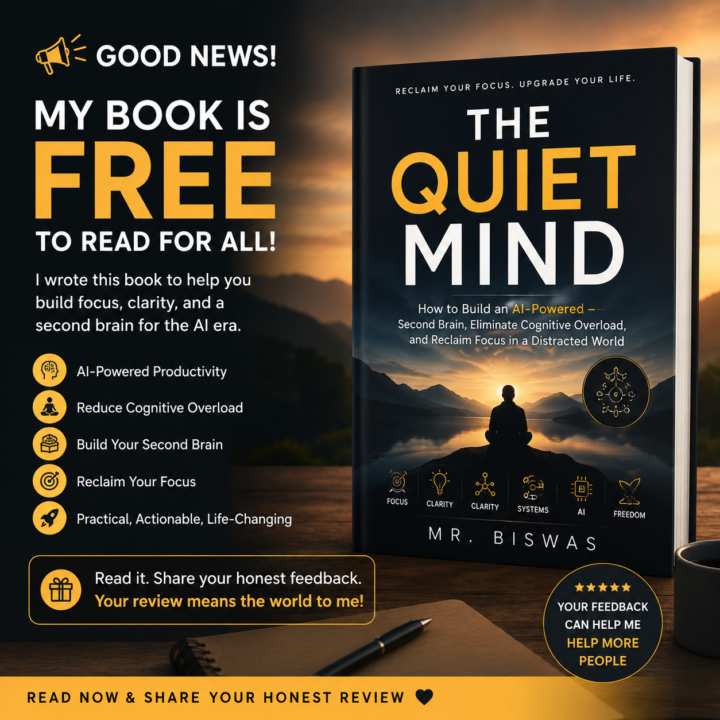
Looking for Honest Feedback – My Book Is Free to Read Right Now
Hey everyone, I have a small favor to ask this amazing community. Over the last few months, I've been deeply exploring the intersection of AI, productivity, knowledge management, and personal focus. That journey led me to write a book called "The Quiet Mind: How to Build an AI-Powered Second Brain, Eliminate Cognitive Overload, and Reclaim Focus in a Distracted World." The book is currently available to read for FREE, and I'd love to get honest feedback from fellow entrepreneurs, creators, AI enthusiasts, and knowledge workers. This isn't a book about working harder. It's about: • Managing information overload • Building a reliable second brain • Using AI as a thinking partner instead of a distraction • Reducing mental clutter and decision fatigue • Creating systems that help you stay focused and organized I wrote this book to solve a problem I personally struggled with: having too many ideas, too many notes, too many tools, and not enough clarity. If you're interested, I'd be incredibly grateful if you could: ✅ Read the book ✅ Share your honest opinion ✅ Tell me what you liked ✅ Tell me what could be improved ✅ Leave a review if you feel it's worth it I'm not looking for praise. I'm looking for real feedback that can help me become a better author and create better books in the future. Book Link: https://www.amazon.com/dp/B0H3K2MSLL After reading, please comment below with: 1. Your biggest takeaway 2. Your favorite chapter or idea 3. One thing you think I should improve Every piece of feedback will be read personally. Thank you for your time and support. I genuinely appreciate it. — Mr. Biswas 📚🤖✨
0
0

12h •
How I automated my LinkedIn outreach with n8n + Puppeteer (11h/week saved)
LinkedIn outreach is one of those tasks that everyone knows they should do, but nobody actually wants to spend time on. I was in the same boat. As a developer, I figured: why not automate the repetitive parts and keep the human touch where it matters? Here's the stack I built: n8n as the workflow engine — fully visual, self-hosted, no black boxes Puppeteer for browser automation — handles the LinkedIn UI safely AI (GPT-4) for message personalization — reads prospect profiles, writes contextual messages that don't sound like templates Supabase for the database — tracks connections, conversations, follow-ups The workflow basically does: ✅ Finds prospects by keyword and sends connection requests ✅ AI writes a personalized message based on their profile ✅ Tracks who replied and auto-follows up after 3 days ✅ Respects LinkedIn daily limits (stays way under the radar) The key insight: don't automate the human part. Automate the clicking, typing, and remembering. The AI handles personalization, but the strategy stays human. Result: 11+ hours freed up every week. And my response rate went up because I was actually consistent. If you're thinking about automating your outreach — n8n + Puppeteer is a solid combo. Happy to share more details about the setup!
1-30 of 19,388

skool.com/the-ai-advantage
Founded by Tony Robbins, Dean Graziosi & Igor Pogany - AI Advantage is your go-to hub to simplify AI and confidently unlock real & repeatable results
Leaderboard (30-day)
1

+610
2

+362
3

+243
4

+182
5

+146
Powered by