
Write something
Pinned

4h •
🔁 Why AI Makes a Bad Second Opinion (And a Great First One)
There's a specific way a lot of people have started using AI that feels reasonable on the surface but tends to produce weaker outcomes than they expect: making a decision first, then asking AI to check it. "Does this plan make sense?" "Is this the right call?" "Can you sanity-check this approach?" These questions feel like due diligence. In practice, they're often asking AI to validate a decision that's already been made, and AI is structurally not very good at that particular job. The distinction that matters here is sequence. AI brought in before a decision is formed and AI brought in after a decision is formed produce genuinely different kinds of value, and most people default into the second pattern without realizing the first would usually serve them better. ------------- Context ------------- When AI is asked to evaluate a decision that's already been presented as the plan, it tends to find reasonable support for that plan, because the framing of the question shapes the response. Ask "does this make sense" about almost any coherent plan, and a capable AI model will generally find a way to say yes, with some caveats, because most reasonably constructed plans do make some sense, and the question as framed is oriented toward confirmation rather than genuine challenge. This isn't a flaw exactly. It's a reflection of how these tools respond to framing. A question asked in a confirmatory posture tends to get a confirmatory answer, unless the plan is genuinely and obviously flawed. The subtler problems, the ones that a good second opinion is actually supposed to catch, are much less likely to surface when the question is framed as "check this" rather than "help me think through this from scratch." Contrast this with AI brought in before a decision has formed, asked to help explore the problem itself: what are the options, what are the tradeoffs, what am I not considering. This framing produces a genuinely different quality of engagement, because there's no existing conclusion for the response to gravitate toward. The AI is helping construct thinking rather than validate a thought that's already complete.

Pinned
4d •
OpenAI Just Rebuilt ChatGPT
OpenAI put out a ton of new stuff this week including the public release of the GPT-5.6 family of models, the new ChatGPT Work app that will be merging Codex and ChatGPT capabilities, a new voice mode, improvements to the speech-to-text dictation, and more! I break it all down for you here, enjoy! Want to save time, get more leverage, and stop figuring this AI stuff out from scratch? I put the clearest map and support inside the AI Advantage Club
Pinned

3d •
Keep Going. You're Building Something Bigger Than You Think.
There's a season where you're doing everything right... You're showing up. You're putting in the work. You're staying consistent. And it still feels like nothing is changing. No momentum. No big breakthrough. No proof that it's working. This is the moment that separates people. Not because the work got harder... but because they mistake a lack of results for a lack of progress. What I've learned after decades in business is this: The invisible season is where everything important gets built. Your discipline. Your resilience. Your standards. Your identity. The results come later. Success rarely announces itself while it's being built. It compounds quietly... until one day everyone calls it an overnight success. If you're in that season right now, don't quit. The work you're doing today is building the life you'll eventually be grateful you didn't give up on.

3h •
🏛️ Introducing Two New Agents Into My Architecture Journey ✨
🏛️ Two Agents, One Collaborative Infrastructure ✨💜 Grand rising, Skool family ✨💜 Today, I’m continuing to introduce my two agents while allowing them to work alongside one another so I can observe, compare, and better understand how each one operates. Although they are being developed for different responsibilities, I want to see how they approach similar prompts, organize information, communicate solutions, and support decision-making within their individual roles. This comparison process is helping me identify each agent’s strengths, limitations, tone, reasoning style, and overall effectiveness. It is also allowing me to determine where their responsibilities should remain separate—and where collaboration could create a stronger result. I’m not simply building two agents. I’m carefully studying how each system performs so I can refine their prompts, strengthen their infrastructure, and give every agent a clear purpose within the larger blueprint. Every comparison provides new insight. Every adjustment strengthens the foundation. And every test brings me closer to creating agents that can work independently while still supporting one another when needed. The architecture journey continues—and now my agents are learning how to build alongside me. ✨🏛️💜 #AIAdvantage #AIAgents #AgentArchitecture #BuildingWithAI #PromptEngineering #DigitalInfrastructure #ArchitectureJourney

6m •
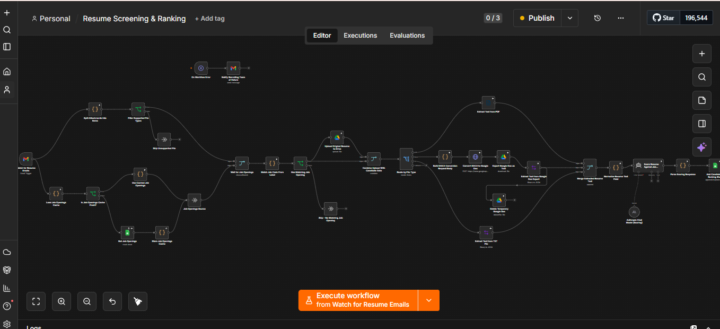
I made these 5 Changes to make my "Resume screening & Ranking Workflow", Production Ready.
These are:- 1. Multiple simultaneous job openings ~Before: The Gmail trigger only watched one specific label, only one role's applications would reach the workflow, others would sit unread, invisible to the whole system. ~After: The trigger has filter (just "unread + has attachment"), applications for any number of concurrent roles get picked up, with correct per-role routing happening downstream based on each email's own label. 2. Candidate scoring was reject/accept ~Before: AI hard filtered out candidates missing "must-have requirements" and marked them "Rejected" with no score. ~After: Every candidate is scored 0-100, no one is filtered out. A weak match just gets a low score with reasoning explaining the gaps. 3. Category field didn't exist ~Before: Only a raw numeric score. ~After: Every candidate gets a High/Medium/Low category, computed automatically from the score band (68+/35-67/0-34). 4. Job Openings sheet reads was wasteful at scale ~Before: Every single poll re-read the entire Job Openings sheet from Google Sheets, regardless of whether anything changed. ~After: A 10-minute cache (via workflow static data) means most polls within 10 Min range skip the Sheets API call only refetches after 10 min. 5. Duplicate candidates wasn't handled ~Before: A candidate resubmitting a resume for the same role created a second row. ~After: Rows are matched on Email + Job Code and updated in place a resubmission overwrites the old row instead of duplicating it. If you are building something not think to build a system production ready from day one. It's not how it works, instead keep testing your workflow, keep building guardrails , make one thing better at one time. Which update you liked the most?
0
0
1-30 of 20,045

skool.com/the-ai-advantage
Founded by Tony Robbins, Dean Graziosi & Igor Pogany - AI Advantage is your go-to hub to simplify AI and confidently unlock real & repeatable results
Leaderboard (30-day)
1

+467
2

+336
3

+269
4
+242
5

+210
Powered by