
Write something
Pinned

2h •
🤐 The Client Who Doesn't Know You Use AI, and Why That's a Choice Worth Examining
A quiet pattern has developed across a lot of professional service work: AI is genuinely integrated into the workflow, meaningfully shaping how deliverables get produced, and clients simply aren't told. Not because of any deliberate deception, but because disclosure never became an explicit decision. It defaulted to silence, and silence has just kept being the path of least resistance. This default is worth examining directly, because it's rarely the product of a considered choice. Most professionals haven't actually weighed the costs and benefits of disclosure versus non-disclosure. They've simply avoided the topic because it feels slightly awkward to raise, and awkward topics tend to get avoided by default rather than addressed deliberately. ------------- Context ------------- The instinct behind non-disclosure usually traces back to a specific worry: that mentioning AI involvement might undermine a client's perception of expertise, making the work feel less personal or less earned than it would if the client believed it was produced entirely through the professional's own unassisted effort. This worry is understandable, but it's rarely been tested directly, and the assumption underneath it, that disclosure necessarily damages perceived value, isn't obviously true once actually examined. Research on client and consumer attitudes toward AI-assisted professional services has found a more nuanced picture than the simple "disclosure damages trust" assumption suggests. Clients often respond more negatively to discovering undisclosed AI use after the fact than they do to transparent disclosure upfront, particularly when the disclosure is framed around how AI assistance allows the professional to deliver better or faster results, rather than framed as an admission of reduced effort. The risk profile of the default silent approach is asymmetric in a way that's easy to miss. If AI use is never discovered, non-disclosure costs nothing. But if it is discovered, whether through a client noticing patterns in the output, through industry conversation, or simply through increasing general awareness of how common AI-assisted work has become, the discovery of undisclosed use tends to feel like a breach of trust specifically because it was hidden, not because AI was used. The hiding is often what damages the relationship, more than the underlying fact would have on its own.

Pinned
5d •
OpenAI Just Rebuilt ChatGPT
OpenAI put out a ton of new stuff this week including the public release of the GPT-5.6 family of models, the new ChatGPT Work app that will be merging Codex and ChatGPT capabilities, a new voice mode, improvements to the speech-to-text dictation, and more! I break it all down for you here, enjoy! Want to save time, get more leverage, and stop figuring this AI stuff out from scratch? I put the clearest map and support inside the AI Advantage Club
Pinned

4d •
Keep Going. You're Building Something Bigger Than You Think.
There's a season where you're doing everything right... You're showing up. You're putting in the work. You're staying consistent. And it still feels like nothing is changing. No momentum. No big breakthrough. No proof that it's working. This is the moment that separates people. Not because the work got harder... but because they mistake a lack of results for a lack of progress. What I've learned after decades in business is this: The invisible season is where everything important gets built. Your discipline. Your resilience. Your standards. Your identity. The results come later. Success rarely announces itself while it's being built. It compounds quietly... until one day everyone calls it an overnight success. If you're in that season right now, don't quit. The work you're doing today is building the life you'll eventually be grateful you didn't give up on.

46m •
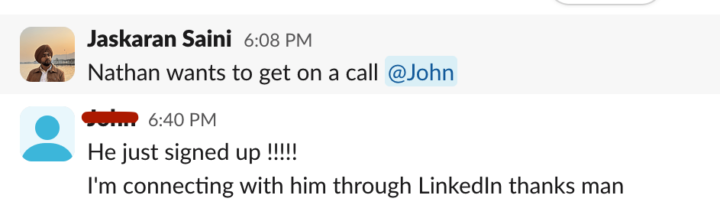
"He just signed up!!!!!"
That was my client's message after 3 days of running our LinkedIn outreach system. No fancy setup. No big team. No ad spend. Just a simple image + sequence we built together. 700 messages sent. 10 bookings landed. 1 client closed. $9,900 in 3 days. This is what happens when you stop guessing and just run a system that actually works. If you're a B2B service provider and your pipeline is dry right now Comment "SYSTEM" below and I'll DM you exactly how we did this.
0
0
4d •
🧩 The Knowledge That Only Lives in Your Head Is Now Your Biggest Liability
AI has compressed the time required for most work that's documented and explainable: work where the process, the standards, and the reasoning can be captured and communicated clearly. What AI hasn't touched, and can't help with, is work that depends entirely on knowledge that exists only in someone's head and has never been written down anywhere. This creates an increasingly stark and underexamined divide inside most businesses. The documented, explainable work is getting dramatically faster. The undocumented, tacit knowledge is becoming, by comparison, a disproportionate bottleneck and a genuine point of fragility, because it's the one category of work that AI adoption does nothing to address until someone takes the separate step of actually capturing it. ------------- Context ------------- Every business accumulates tacit knowledge over time: the specific reasons a particular client relationship requires careful handling, the informal workaround for a recurring operational problem, the judgment calls a founder makes intuitively that have never been articulated as an explicit process, the history behind why something is done a certain way. This knowledge was always somewhat risky to keep undocumented, but for a long time, the risk was manageable because most work moved at a pace where the person holding the knowledge was usually available when it was needed. AI adoption changes the risk calculation significantly, for two connected reasons. First, as documented work gets dramatically faster, the undocumented work becomes a proportionally larger share of total bottleneck time, simply because everything around it has sped up while it hasn't moved at all. Second, and more subtly, businesses that are scaling their output using AI are often taking on more volume, more clients, more complexity, faster than before, which increases the number of situations where tacit knowledge would be needed and decreases the amount of time available to informally transfer it the way it might have been transferred in a slower-moving business.

1-30 of 20,060

skool.com/the-ai-advantage
Founded by Tony Robbins, Dean Graziosi & Igor Pogany - AI Advantage is your go-to hub to simplify AI and confidently unlock real & repeatable results
Leaderboard (30-day)
1

+475
2

+344
3

+307
4

+256
5

+245
Powered by