
Write something
Pinned

42m •
It’s Hard to Feel Grateful and Angry at the Same Time
One thing I’ve learned the hard way: It’s really difficult to feel gratitude and anger at the same time. Not impossible. But difficult. Because whatever emotion you feed tends to shape the lens you see your life through. When you stay stuck in frustration long enough, your brain starts scanning for more proof that things aren’t working. More proof that people are disappointing. More proof that you’re behind. And the scary part is… you’ll find it. But gratitude shifts your focus completely. Not fake positivity. Not pretending hard things aren’t real. I mean intentionally zooming out long enough to remember: • what’s still working • what you’ve already overcome • what opportunities are still in front of you • who’s still in your corner • how far you’ve actually come The people who build great businesses and great lives aren’t the people who never get frustrated. They’re the people who don’t stay there. They know how to reset their perspective before resentment becomes their identity. And honestly, this matters even more as entrepreneurs because this journey will give you endless reasons to focus on what’s broken. The algorithm changed. Sales slowed down. Someone copied your idea. A launch flopped. A partnership fell apart. People unsubscribed. Cool. Welcome to building something meaningful. But if you lose your ability to access gratitude in the middle of the mess, this game gets really heavy really fast. So here’s the question: What’s something in your life right now that you were once praying for… but have slowly started treating as normal?
Pinned

3h •
🔌 Human Middleware Is the New Time Drain: Why Disconnected AI Tools Are Quietly Stealing a Day a Week
For a while, the AI conversation was dominated by capability. Which model is smarter, faster, cheaper, more creative, or more useful. But a new problem is becoming impossible to ignore. Many people are not losing time because AI is weak. They are losing time because AI is disconnected. The tools may be powerful on their own, yet the human still ends up acting as the bridge between them. That is why “human middleware” is such an important phrase. It captures a modern time leak that many teams can feel but have not named clearly enough. People are copying outputs from one tool into another, reconciling conflicting responses, re-entering the same context across multiple systems, and manually stitching together workflows that were supposed to feel easier. The result is a strange kind of productivity theater. AI is everywhere, yet the human is still doing too much glue work to make it all function. ------------- Context ------------- Most AI adoption does not begin with one perfect integrated system. It begins with experimentation. A writing tool here. A note summarizer there. A meeting assistant, a search tool, a design tool, a chatbot, a document analyzer. One by one, the tools enter the workflow because each solves a visible pain point. This is understandable, but it can create a new problem. The work becomes fragmented across too many partially useful systems. Instead of simplifying the day, AI tool sprawl can create more transitions, more duplicate context loading, and more small manual steps that nobody intended to keep forever. That is where the human becomes middleware. The person is no longer only doing the work. They are also doing the integration work. They carry the thread from tool to tool, move information between systems, and keep rebuilding coherence because the workflow itself is not holding together cleanly. This is not just annoying. It is expensive. Every extra transition costs time and attention. Every repeated explanation is hidden rework. Every manual reconciliation step steals focus from the actual task. If this continues unchecked, AI can end up creating its own layer of drag.
2
0

Pinned
8d •
🔥 Quick Clarification: Which AI Advantage Community Should You Be In?
We've been getting a few questions in the community and inbox about the difference between our communities, unsure which one you should be in. Here's a quick breakdown to help you find your home base. --------------------------------------------------------------------------------------------------------------------------------------------------- 1. This Skool Community (Free) You're already here. This is our free hub where our team and members share value, ask questions, and grow together. What's inside: - Free trainings and resources in the Classroom - Ongoing community conversations and support - The latest AI news and AIA updates - Practical insights to help you grow with AI Best for: Anyone exploring AI, building community connections, and staying current without a monthly commitment. The Summit may be over, but this group isn't going anywhere. --------------------------------------------------------------------------------------------------------------------------------------------------- 2. AI Advantage Club (Paid Membership) Our premium membership for members ready to go deeper and build their AI skillset consistently. How you may already have access: - VIP members: 30-day trial included - Bootcamp members: 3 months included - VIP + Bootcamp: 4 months free What's inside: - Advanced trainings and step-by-step guides - "Hacks of the Week" you can apply immediately - AI workflows and copy-and-paste prompt libraries - Real business use cases and time-saving systems - Ongoing implementation support - A Technical Support Team for when you hit roadblocks - New resources added regularly Think of it as your AI gym membership: the place to train those AI muscles and really implement AI into your life and business. Best for: Members ready to move past learning and into hands-on implementation with structured support. Where is the AI Advantage Club? Right here: https://app.aiadvantage.com/login

7m •
Reps Still Beat Shortcuts
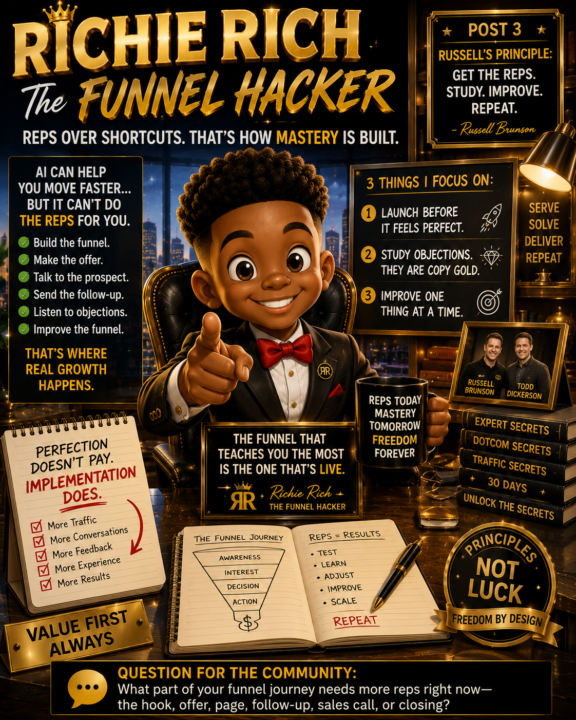
Reps Still Beat Shortcuts Check this out… When I joined the AI Advantage, I thought the hardest part would be building the funnels. But the more I do this, the more I realize the real growth comes from the reps. The discovery calls. The follow-ups. The showposals. The pricing conversations. The objections. The moments where people ghost. The moments where you realize your offer still needs work. AI can help us move faster, but it does not replace the reps. That has been a big lesson for me. Sometimes I want the funnel to be perfect before I share it. But a hidden funnel does not teach you much. A live funnel does. Here are 3 things that I have to remembe…. 1️⃣ Build it and get feedback. Done is better than perfect. - You learn faster when real people see the page. 2️⃣ Track objections The things people say on calls can become your best copy. 3️⃣ Improve one piece at a time Do not rebuild everything. Fix the headline, offer, CTA, or follow-up first. AI gives us speed. But reps give us skill. And I think that matters for everyone working to build & grow their business.: What part of your entrepreneur journey needs more reps right now—creating irresistible offers, building high-converting funnels, follow-up, sales calls, or closing? Renee J #BlackGirlsHackFunnels2 #AIforBusiness
0
0
4d •
You Don’t Need More Content Ideas. You Need a Repurposing System.
Most business owners don’t need more content ideas. They need a better way to reuse the ideas they already have. Because for a lot of entrepreneurs, content creation turns into a treadmill fast. You write one post, publish it, and then immediately feel like you need to come up with the next idea. Then the next one. Then the next one. And if you’re already running the business, serving clients, managing delivery, answering messages, improving offers, and handling everything else, that pace is hard to maintain. The problem usually isn’t that you have nothing useful to say. The problem is that you’re treating every piece of content like it has to start from zero. ---------- THE REAL PROBLEM ---------- Most businesses are sitting on useful content they’ve already created. Old blog posts. Newsletter emails. Webinar transcripts. Podcast notes. Client explanations. Reports. Long LinkedIn posts. Workshop material. Training content. There are probably ideas in there that could become a LinkedIn post, an X thread, a carousel, a short-form video script, or an email. But because there isn’t a simple system for pulling those ideas out and adapting them properly, they just sit there. So instead of building from what already exists, you keep going back to the blank page. That’s where content starts to feel heavier than it needs to. ---------- WHY THIS MATTERS ---------- Because content consistency is not just a marketing preference. It’s how people start to understand what you do, what you believe, how you think, and why they should trust you. When you disappear for weeks because content feels too hard, your audience has fewer chances to hear your message. Fewer chances to remember your offer. Fewer chances to see your expertise in action. And the frustrating part is that you may already have the raw material. You don’t always need a new idea. Sometimes you need to take one strong idea and reshape it for the places your audience already spends time. One idea can become a practical LinkedIn post.The same idea can become a more detailed email.A specific part of it can become a carousel.A sharper angle can become a short video.A step-by-step explanation can become a thread.

1-30 of 19,304

skool.com/the-ai-advantage
Founded by Tony Robbins, Dean Graziosi & Igor Pogany - AI Advantage is your go-to hub to simplify AI and confidently unlock real & repeatable results
Leaderboard (30-day)
1

+815
2

+791
3

+494
4

+412
5

+267
Powered by