
Write something
Pinned

14h •
🐢 The Hidden Cost of Always Choosing the Fastest AI Path
When there are multiple ways to accomplish something with AI, one faster and simpler, another slower but involving more genuine engagement, the faster option almost always wins by default. This makes intuitive sense: the whole point of adopting AI is speed and efficiency, so choosing the fastest available path on any given task feels like a straightforward application of that goal. But there's a cost to always defaulting to the fastest path that only becomes visible over a longer time horizon: the slightly slower approaches often produce learning, durable systems, or quality improvements that the fastest path skips entirely. Optimizing every single task purely for immediate speed can quietly cap how much better someone's overall AI-assisted work gets over time, even as each individual task gets handled efficiently. ------------- Context ------------- The tension here is between two different kinds of time value: the time saved on this specific task right now, and the compounding value that a slightly slower, more deliberate approach might build for every future task of a similar kind. These two values pull in different directions, and defaulting reflexively to the fastest path optimizes entirely for the first at the expense of the second. A simple example illustrates the pattern clearly. Faced with a recurring task, someone can either ask AI to just produce the output directly, which is the fastest path, or they can take a bit more time to understand why a particular approach works well, to build a reusable template or framework from the interaction, or to develop a clearer sense of what good output looks like for that task category. The first path is faster in the moment. The second path takes somewhat longer now but produces a durable asset, whether that's a template, a sharpened judgment, or a piece of genuine skill, that makes every future instance of that task faster and better than the first path alone would have produced. Across many repetitions of a task, the compounding value of the slightly slower path can dramatically exceed the value of the fastest path repeated the same number of times, even though each individual instance of the fastest path was, in isolation, more time-efficient.

Pinned
7d •
OpenAI Just Rebuilt ChatGPT
OpenAI put out a ton of new stuff this week including the public release of the GPT-5.6 family of models, the new ChatGPT Work app that will be merging Codex and ChatGPT capabilities, a new voice mode, improvements to the speech-to-text dictation, and more! I break it all down for you here, enjoy! Want to save time, get more leverage, and stop figuring this AI stuff out from scratch? I put the clearest map and support inside the AI Advantage Club
Pinned

6d •
Keep Going. You're Building Something Bigger Than You Think.
There's a season where you're doing everything right... You're showing up. You're putting in the work. You're staying consistent. And it still feels like nothing is changing. No momentum. No big breakthrough. No proof that it's working. This is the moment that separates people. Not because the work got harder... but because they mistake a lack of results for a lack of progress. What I've learned after decades in business is this: The invisible season is where everything important gets built. Your discipline. Your resilience. Your standards. Your identity. The results come later. Success rarely announces itself while it's being built. It compounds quietly... until one day everyone calls it an overnight success. If you're in that season right now, don't quit. The work you're doing today is building the life you'll eventually be grateful you didn't give up on.

3h •
Incorrect Headshot
After many attempts, AI kept producing the wrong image of me from my uploads (and I upload many different ones). Maybe it will produce better results if I take a few outside in better lighting and let someone else take the photo of me. To be continued..

5d •
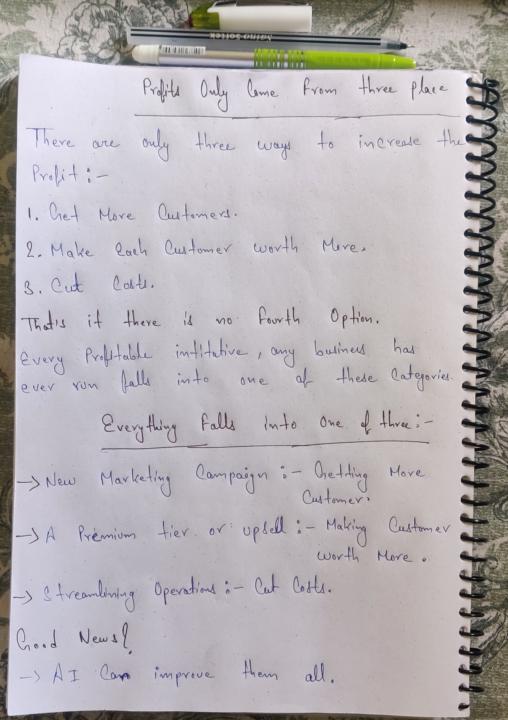
This is the only post you need, to know how AI Actually Creates Profit for any business..
There are only Three Ways AI Creates Profit.. Before that One thing we have to understand , Businesses Don't care About Ai Agents Or Automations They care about profit, Specially Increasing their Profit. AI is just a means to that end. So if you don't know where profit actually comes from, It doesn't Matter how good you are with technology, It will just be a Guessing. So, Here is the catch In Any Business, Profit Only comes from three places:- ~Get more Customers. ~Make each customer worth more. ~Cut costs. That's it there is no fourth option. Everything falls into one of these three categories, Be it- ~A new Marketing Campaign, ~A premium tier or Upsell, ~Streamlining Operations. Etc. whatever you pick. And the Good News? AI can improve all of these.
1-30 of 20,079

skool.com/the-ai-advantage
Founded by Tony Robbins, Dean Graziosi & Igor Pogany - AI Advantage is your go-to hub to simplify AI and confidently unlock real & repeatable results
Leaderboard (30-day)
1

+491
2

+471
3

+410
4

+387
5

+371
Powered by