
Write something
Pinned

17h •
📥 Your Inbox Is Becoming an AI Workflow Hub: Why Email Triage May Be One of the Biggest Time Wins
A lot of people still think of email as a communication tool. In practice, it is often a workflow bottleneck. It is where requests arrive, priorities compete, decisions hide in long threads, and the day begins with a low-grade sense of uncertainty. We open the inbox not just to read, but to figure out what matters, what is urgent, what needs a response, and what can wait. That invisible sorting work consumes more time than most teams realize. This is why AI inbox tools matter so much right now. The real opportunity is not simply writing replies faster. It is turning the inbox into a triage layer that helps people understand, prioritize, and move work without spending the first hour of the day rereading threads and reconstructing context. In time terms, that is a serious gain. It is not just about communication. It is about reclaiming attention from one of the most persistent daily drains in modern work. ------------- Context ------------- Most inboxes are not difficult because the messages themselves are hard to understand. They are difficult because each message competes for attention without carrying enough clarity. One email needs a decision. Another needs a quick answer. A third looks important but is mostly noise. A fourth contains an update buried halfway down the thread that now affects a different project entirely. This creates a hidden tax at the start of the day. Before people can do meaningful work, they first have to interpret the inbox. What changed overnight? What needs action? Which requests are real priorities and which ones are just urgency theater? That sorting effort is mentally expensive, and it often steals the best attention from the earliest part of the day. That is why inbox triage is such a strong AI use case. If AI can summarize threads, surface commitments, identify likely priorities, and reduce the need to manually dig through every message, then the inbox becomes less of a maze and more of a command center. The person is no longer starting with noise. They are starting with a clearer operating picture.

Pinned

1d •
If everything feels important, nothing really moves.
Most people don’t have an effort problem. They have an aim problem. If everything feels important, nothing really moves. When things feel busy but not productive, I always come back to this: What’s the actual goal right now? Not five goals. Not the big vision. Right now. More leads? More sales? More time back? Then get brutally honest about what’s in the way. No leads usually means you’re not getting enough attention. Leads but no sales usually means something isn’t connecting. Sales but you’re overwhelmed usually means your systems aren’t there yet. That’s the work. Not a new strategy every week. Not ten different projects at once. Just fixing the thing that’s slowing everything else down. Where people get stuck is they start doing a little bit of everything. Tweaking the brand. Building something new. Testing another idea. It feels productive. It looks productive. But nothing actually moves. Instead, look at what’s already showing signs of working and build on that. If something is getting attention, do more of it. If something is converting, improve it. If something is taking too much of your time, fix or automate it. That’s where leverage comes from. And yes, tools like AI can help you go faster. But only if you’re pointed in the right direction first. Otherwise you’re just speeding up the wrong things. At the end of the day, this is simpler than people make it. If what you’re doing isn’t helping you get attention, make a sale, or buy your time back, it’s probably not the priority. You don’t need more. You need focus. That’s how momentum actually starts to build. So let me ask you this: What’s the one thing in your business that, if you fixed it right now, would make everything else easier?
Pinned

⭐
8d •
🔥 Quick Clarification: The Difference Between Our 3 AI Advantage Communities
Hey everyone, we’ve received a few questions in the customer service inbox, so we wanted to take a moment to clearly explain the difference between the groups and experiences inside the AI Advantage ecosystem. --------------------------------------------------------------------------------------------------- 1. This Skool Community (Free) This group right here is our free community. It’s where Igor Pogany, our team, and the community continue to share value, insights, resources, conversations, and support. Inside here you can expect: - Free trainings and resources inside the Classroom - Ongoing conversations - Community support - Updates of the latest AI News - Updates and announcements for AIA - Valuable insights to help you grow with AI This group is completely free and we fully encourage you to stay engaged, ask questions, connect, and use everything available here. And just because the Summit is over, doesn’t meant mean this group is going anywhere! --------------------------------------------------------------------------------------------------- 2. AI Advantage Club (Paid Membership) The AI Advantage Club is our premium membership for those who want to go deeper and continue building their AI skillset consistently. Depending on how you joined: - VIP members received a 30-day trial - Bootcamp members receive 3 months included And if you took the VIP upgrade AND joined the Bootcamp, you would have 4 months free inside the Club. Inside the Club, the experience goes deeper with things like: - Advanced trainings - Step-by-step guides and our “Hacks of the Week” - AI workflows - Prompt libraries you can copy - Business use cases - Time-saving systems - Ongoing implementation support - New resources added regularly - A Technical Support Team who can answer questions if you hit roadblocks trying to implement an AI tool Think of this as your AI gym membership. It’s the place where you will train those AI muscles and really focus on implementing AI into your life and business.

1d •
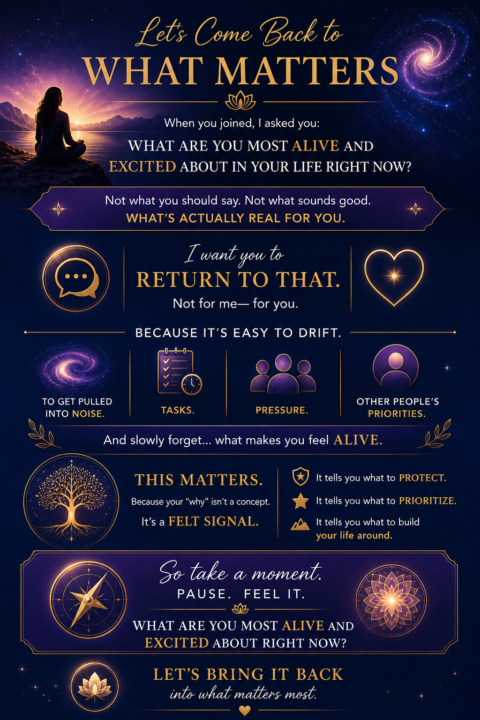
What Truly Matters in Your Life Right Now?
🪷 A More Powerful Question With everything happening in AI right now… tools, prompts, speed, output— I think we need to come back to something deeper. ⟡ When you sit down to use AI… What are you actually building your life around? Not what you should say.Not what sounds smart. What’s real for you. ⟡ Because it’s easy to drift. Into: - more content - more ideas - more output - more noise And slowly lose connection to: what actually matters. ⟡ AI is powerful. But it will amplify whatever you bring into it. So the real question isn’t just:“How do I use AI?” It’s: Why am I using it? What am I moving toward? ⟡ This matters. Because your “why” isn’t a concept. It’s a signal. It tells you: → what to protect → what to prioritize → what to build around ⟡ So pause for a moment. Before the next prompt. Before the next tool. What are you most alive and excited about right now? Drop it below. Let’s bring that back into the room. 🪷
8d •
What an incredible few days
I just wanted to take a moment and sincerely thank you for showing up for the AI Advantage Summit. Thank you for investing your time. Thank you for being open. Thank you for being willing to learn, grow, and prepare for what’s next. In a world full of distractions, noise, and reasons to wait… you made a decision to be here and we don't take that lightly. And as Tony said during the event, your decisions shape your day, your future, and ultimately your reality. That’s why this doesn’t end when the summit ends. Now you get to decide what comes next. Decide to stay plugged in. Decide to keep learning. Decide to take action on what you discovered here. Decide that your future matters enough to keep moving forward. If you are joining us for the Bootcamp, we cannot wait to see you Friday and go even deeper with you. If you grabbed the VIP upgrade and unlocked access to the AI Advantage Club, our team is already pouring insane value into that community every single week and we’re excited to support you there. And if now isn’t the right time for anything more, that’s okay too. This free community is staying open. We’ll keep showing up. We’ll keep adding value. We’ll keep giving you tools, insights, and support to help you grow. No matter where you are in your journey, there is a place for you here. From my heart, thank you for trusting us, for spending these days with us, and for being part of something special. Excited to build alongside you!
1-30 of 18,743

skool.com/the-ai-advantage
Founded by Tony Robbins, Dean Graziosi & Igor Pogany - AI Advantage is your go-to hub to simplify AI and confidently unlock real & repeatable results
Leaderboard (30-day)
1

🔥
+1877
2

+941
3

+775
4
+708
5

+548
Powered by