
Write something
Pinned

5h •
🏁 Frontier Teams Are Pulling Away: The New Competitive Advantage Is How Deeply Work Gets Delegated
For a while, AI advantage looked like access. Which teams had the tools, which leaders supported experimentation, which company moved first. That stage is fading. Access is becoming more common. What matters now is depth. The teams beginning to pull away are not just the ones using AI. They are the ones redesigning work so more of it can be reliably delegated without losing quality. That is a much more meaningful shift than casual adoption. It changes how time moves through the organization. It changes how much work gets trapped in human bottlenecks. It changes how much effort is spent on setup, handoff, and repetitive execution. In other words, the frontier advantage is no longer “we have AI.” It is “we have learned how to hand work off deeply enough that the system itself is getting lighter.” ------------- Context ------------- Most organizations still use AI shallowly. They ask for help on individual tasks. They draft something faster. They summarize a long thread. They generate options. Those are useful gains, but they leave most of the workflow intact. Humans still initiate nearly everything, coordinate most transitions, and carry the responsibility for moving work from stage to stage. Frontier teams are doing something different. They are identifying where work can be delegated more deeply, not only at the output layer, but inside the flow itself. They let AI carry more of the setup, more of the repetitive translation, more of the first-pass execution, and more of the movement between bounded stages. This is important because the real time savings do not appear fully until the workflow changes. A team that drafts faster but still coordinates manually may gain some efficiency. A team that redesigns how work moves can gain real capacity. That is why the competitive gap is widening. The difference is no longer who can generate something clever on demand. The difference is who has learned how to trust AI deeply enough, structure work clearly enough, and review intelligently enough that the delegation actually compounds.

Pinned

1d •
It’s Hard to Feel Grateful and Angry at the Same Time
One thing I’ve learned the hard way: It’s really difficult to feel gratitude and anger at the same time. Not impossible. But difficult. Because whatever emotion you feed tends to shape the lens you see your life through. When you stay stuck in frustration long enough, your brain starts scanning for more proof that things aren’t working. More proof that people are disappointing. More proof that you’re behind. And the scary part is… you’ll find it. But gratitude shifts your focus completely. Not fake positivity. Not pretending hard things aren’t real. I mean intentionally zooming out long enough to remember: • what’s still working • what you’ve already overcome • what opportunities are still in front of you • who’s still in your corner • how far you’ve actually come The people who build great businesses and great lives aren’t the people who never get frustrated. They’re the people who don’t stay there. They know how to reset their perspective before resentment becomes their identity. And honestly, this matters even more as entrepreneurs because this journey will give you endless reasons to focus on what’s broken. The algorithm changed. Sales slowed down. Someone copied your idea. A launch flopped. A partnership fell apart. People unsubscribed. Cool. Welcome to building something meaningful. But if you lose your ability to access gratitude in the middle of the mess, this game gets really heavy really fast. So here’s the question: What’s something in your life right now that you were once praying for… but have slowly started treating as normal?
Pinned
9d •
🔥 Quick Clarification: Which AI Advantage Community Should You Be In?
We've been getting a few questions in the community and inbox about the difference between our communities, unsure which one you should be in. Here's a quick breakdown to help you find your home base. --------------------------------------------------------------------------------------------------------------------------------------------------- 1. This Skool Community (Free) You're already here. This is our free hub where our team and members share value, ask questions, and grow together. What's inside: - Free trainings and resources in the Classroom - Ongoing community conversations and support - The latest AI news and AIA updates - Practical insights to help you grow with AI Best for: Anyone exploring AI, building community connections, and staying current without a monthly commitment. The Summit may be over, but this group isn't going anywhere. --------------------------------------------------------------------------------------------------------------------------------------------------- 2. AI Advantage Club (Paid Membership) Our premium membership for members ready to go deeper and build their AI skillset consistently. How you may already have access: - VIP members: 30-day trial included - Bootcamp members: 3 months included - VIP + Bootcamp: 4 months free What's inside: - Advanced trainings and step-by-step guides - "Hacks of the Week" you can apply immediately - AI workflows and copy-and-paste prompt libraries - Real business use cases and time-saving systems - Ongoing implementation support - A Technical Support Team for when you hit roadblocks - New resources added regularly Think of it as your AI gym membership: the place to train those AI muscles and really implement AI into your life and business. Best for: Members ready to move past learning and into hands-on implementation with structured support. Where is the AI Advantage Club? Right here: https://app.aiadvantage.com/login



3h •
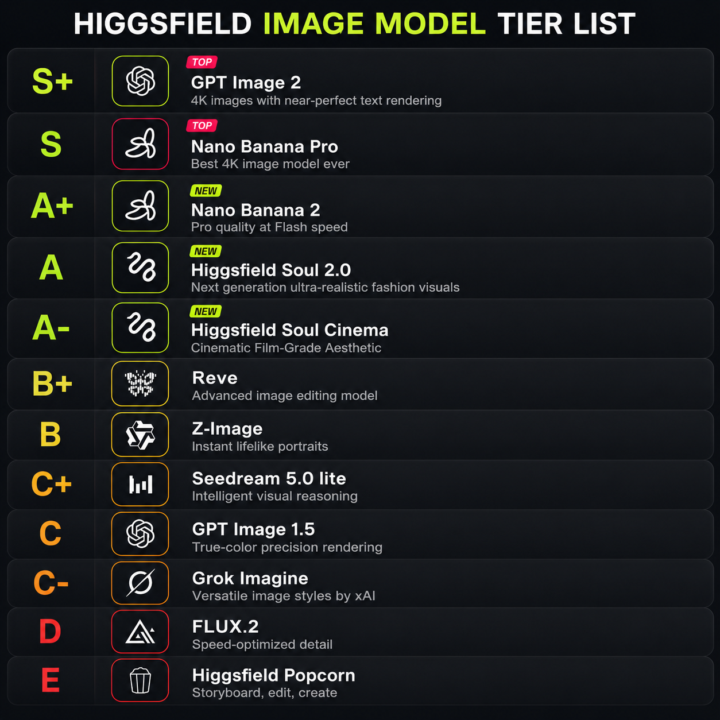
🏆 My HIGGSFIELD Image Model TIER LIST
After testing nearly every image model inside Higgsfield across realism, edits, prompt accuracy, creator visuals, ads, typography, and consistency… This is my current ranking A lot of people rank models based on: “which one looks coolest instantly” But that’s not how professional workflows work The real test is: • realism under inspection • consistency across generations • editing reliability • prompt understanding • usable commercial outputs • lighting/material accuracy • typography + layout quality Here’s the breakdown 👇 S+ — GPT Image 2 Currently the strongest all-round model overall Best at: • prompt understanding • typography • layout accuracy • realistic edits • commercial-ready outputs • consistency This is the most reliable “gets the job done” model right now S — Nano Banana Pro Still one of the best realism/editing models available Best at: • premium ad aesthetics • luxury visuals • cinematic realism • identity consistency • clean material rendering The outputs feel expensive when prompted properly A+ — Nano Banana 2 Fast, creative, sharp, and surprisingly powerful Great for: • ideation • stylized realism • rapid workflows • mood exploration Sometimes looks more impressive at first glance than Pro, but Pro usually holds up better under close inspection A — Higgsfield Soul 2.0 Very strong for creator/fashion aesthetics Best at: • fashion visuals • modern creator branding • social-first imagery • polished editorial feel One of the best “aesthetic taste” models in Higgsfield A- — Higgsfield Soul Cinema Excellent cinematic atmosphere Best at: • film-like compositions • moody lighting • cinematic color grading • storytelling frames Less accurate than GPT Image 2, but visually beautiful B+ — Reve Solid editing-focused model Good for: • image transformations • visual experimentation • iterative edits Underrated in some workflows B — Z-Image Good portrait realism and facial structure Strong for: • headshots • portraits • lifestyle people shots
1-30 of 19,301

skool.com/the-ai-advantage
Founded by Tony Robbins, Dean Graziosi & Igor Pogany - AI Advantage is your go-to hub to simplify AI and confidently unlock real & repeatable results
Leaderboard (30-day)
1

+742
2

+427
3

+388
4

+223
5
+169
Powered by