
Write something

🔥
3d •
Welcome new members!
@Chemikala Reddy @Emmanuel Adeniyi @Madeleiny Mason @Santhu N @Andrew Nguyen-Tran @Jack Robinson @Blue Mojo @Asanti Richard Please introduce yourself in the comments below!

🔥
17d •
Why Testing in Production is the Ultimate Quality Safeguard
1. Introduction: The Reality of Modern Software Delivery In the high-velocity world of modern engineering, the "textbook" approach to software perfection is a myth. We are currently in the era of "vibe coding" - where builders move fast, rely on intuition, and ship to get immediate value into the hands of customers. While high-speed delivery is the goal, it creates a constant tension with technical debt. Project timelines are rarely dictated by engineering ideals; they are driven by management whims, shifting deadlines, and the urgent need to prove a concept. Because resources are finite, we often take shortcuts on unit tests or end-to-end automation to hit a date. The result is technical debt: the "piling on" of minor improvements, cleaner code, and better accessibility that gets deferred for the sake of the launch. We must accept a blunt reality: the system is never 100% perfect at release. The definition of "done" is not a static point in time but an evolving state of quality. Since software is a living entity built under pressure, our testing strategy must extend beyond the safety of sandboxes and into the live environment. 2. Challenging the Taboo: The Philosophy of Production Testing For years, the industry has clung to a dogmatic absolute: "Never test in production." Strictly adhering to this taboo ignores the strategic necessity of validating software where it actually matters. Testing in production is not just a backup plan; it is a valid and critical tool, period. If you deploy a site and immediately visit the URL to see if it’s "up and running," you are testing in production. The difference between a QA environment and production isn't about whether we test, but how we test. We must move from rigid dogma to a nuanced, risk-based perspective. QA Environment Goals - High Information Density: Designed to provide exhaustive feedback on every minor code change. - Experimental Freedom: A playground for high-load, destructive, or complex operations. - Isolated Variables: Focuses on "textbook" scenarios and sandboxed, often stale, data.
1
0
🔥
23d •
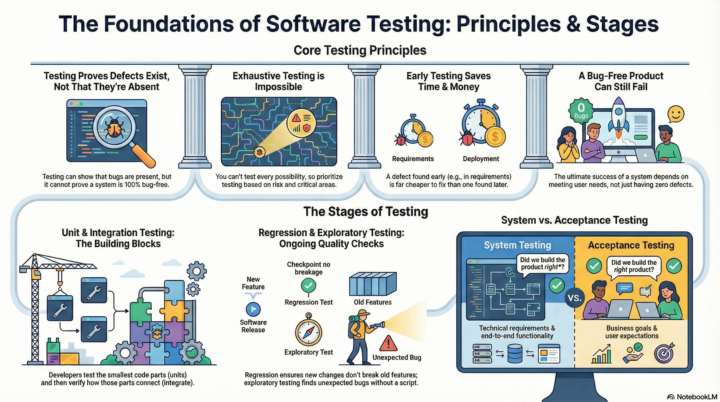
Principles and Stages of Testing
Understanding these fundamentals of software testing will pay dividends in the long run, whether you're a developer, founder, tester, or playing another role associated with software engineering/product development.
1-12 of 12
skool.com/testers
Some theory, but no bullshit. Test real products under the guidance of a 20-year industry veteran. Learn new skills and unlock your testing mindset.
Leaderboard (30-day)
1

+5
2

🔥
+4
3

🔥
+4
Powered by