

Feb '24 •
Sowing > Reaping
An Olympic runner dedicates years to training for a 100-meter sprint that concludes in less than 10 seconds. If victorious, he savors a fleeting moment on the podium with a gold medal. A Professional Athlete can spend a decade chasing an Olympic Gold Medal, or World Cup, or Major Championship. All for a celebration that lasts how long? A week? A day? 5 minutes? The adage “You get out what you put in” isn’t entirely accurate. More precisely, the essence of success lies not in the reaping, but in the sowing. Consider the journey of a man achieving wealth, ranging from millions to billions. His focus isn’t on counting or constantly pondering over his fortune. It exists, serving its purpose, yet it doesn’t define his daily life—much of his reality is similar to someone with significantly less in their bank account. This isn’t about moral preaching or the concept of human equality; it’s about the experience of life on a daily basis. Here’s a thought: If your efforts today are solely for tomorrow’s gains, you’ve wasted both today and tomorrow. Because in this approach, the essence, the Nectar of life, is missing. If you spend your entire life working today, to get somewhere tomorrow, what's the point of arriving there at all? You'll waste your entire life missing today, and even when you finally get to that vision you're so desperately chasing, you'll miss that too. Believe in the work of today for a future reward, and you’re living a fantasy, akin to waiting on the tooth fairy. Unfortunately, this fantasy is a lifelong pursuit for many. What I counsel my clients is straightforward: We do not work today for tomorrow’s benefit. Our actions yield immediate results. Our discussion leads to immediate insight. NOW is where we find divinity. For the professional athlete, the insights provided bring immediate freedom from mind. For the CEO, the sense of clarity and fulfillment is instant. Though these insights will deepen over time, the initial taste, the first experience, is immediate.
0
0
Jan '24 •
Private Discourse: How to Float Through Life
Forget all about the things you have done wrong. Forget about the way you've caused others pain. Forget all your mistakes, failures, shortcomings and regrets. I am giving you permission to give yourself a blank white slate. I am suggestiong you begin again. To treat the remainder of your life as the encore to your existence. Let's get you to a place within yourself that will allow you to Float through the remainder of your life. STARTING TODAY… Begin to see every human interaction through the lens of Freedom. To speak your Heartfelt Truth. To say the things you have always wanted to say. Treat your profession as an expression of your Freedom. Human Beings were meant to be Creators. Not "Workers" It is only the person who is Free, that is the person who can Create. You must look at life as if you own it. But be wary of the trap of possessing. Own your life, and you will carry it in the palm of your hand. Try to Possess it, and it will consume you. Decide Precisely where you want to go. If this is too difficult, decide precisely where you no longer wish to be. Create. Succeed. Earn. Enjoy. But keep it all at arm's length. The ONLY thing to keep in your heart is Freedom. Everything else is negotiable. Freedom is ONLY available Today. And today is the very thing you have ignored for years. You see, sunrise and sunset do not bring closure to one day and give birth to the next. There is only ONE day. It sees sunrise and sunset thousands of times. It is within this day you must take hold of your life. Today is all you ever have. Freedom is not something you 'work toward'. It is something you cannot live without. Freedom is not something you dream of. It is something you live within. Freedom is not something that will one day come. If it does not come today, it will never come. That I can promise you. No matter where you are, no matter what you are doing. When you are with your children, or in a business meeting, or getting ready to run out onto the pitch, or line up on the first tee, or have dinner with your wife, or sipping your morning coffee,
0
0
Jan '24 •
"Trapped" In the Matrix
All it comes down to is what you want, who you want to be, and why. The reason you're "trapped in the matrix" is because you let society tell you what to want and who to be, and the answer will always be a form of MORE. More skills, more knowledge, more experience, more qualifications. More wins, more trophies, more prize money, more records. Better body, better job, better clothes, better watches, better cars, better house, better location, better lifestyle. Better strategy, better business model, better offer, better marketing, better product, better sales tactics. Bigger bank balance, bigger investment portfolio, bigger contract. If you continue looking for answers outside of yourself, the chase will never end. Are you okay with that? The Path is so simple, which is why everyone overlooks it, and no one does it: What do you want? Who do you want to be? and Why? Is it what you want most? or is it what you think you should want? Are your desires yours? or are they society's? or your parents? or your colleagues? or your coaches? or your friends? The only person who can answer these questions is you, and yet you're the only person you're not asking!
0
0

Jan '24 •
The Super-Mario Effect
The "Super Mario Effect" is a term coined by Mark Rober, a former NASA engineer, to describe the phenomenon where completing small, achievable tasks in a video game can increase motivation and engagement in real life. What is the "Super Mario Effect"? The "Super Mario Effect" refers to the psychological impact that video games and virtual reality can have on our motivation and engagement. The effect works by breaking down larger, complex tasks into smaller, achievable ones, much like how levels in video games are broken down into smaller, manageable challenges. This creates a sense of progress and accomplishment, which in turn increases motivation and engagement. Mark Rober is a former NASA engineer who has become well known for his explanation of the "Super Mario Effect." In his TEDx talk, he explains how the experience of playing video games, where tasks are broken down into smaller, achievable levels, can be applied to real life to increase motivation and engagement. He highlights that this approach is particularly effective for complex tasks, as it makes the process of completion more manageable and less overwhelming. Rober also provides real-life examples of the "Super Mario Effect" in action, including weight loss programs and educational settings. In weight loss programs, for example, individuals can set smaller, achievable goals, such as losing 5 pounds a week, rather than trying to lose 50 pounds all at once. This approach makes the task seem less daunting and increases motivation and engagement in the process. Because of an increase in motivation and a focus on a smaller, ‘closer’ goal, the Super Mario Effect leads to greater progress over time, and faster progress toward your ultimate goal, than just focusing on the larger, ‘distant’ goal. The proximity of the goals we pursue can play a crucial role in our motivation and our self-accountability. The further away a goal seems, the less importance we place on what we do today, whereas the closer and more achievable a goal seems, the more likely we are to get on with it and get it out of the way. We know that when we achieve a goal we feel good, so the closer a goal seems, the more likely we are to chase that dopamine rush. The magic of the Super Mario Effect comes down to the proximity of our goals - making sure they are close enough in sight that we are motivated to chase them down as soon as possible and get that dopamine reward.
0
0
Jan '24 •
3 Things Between You & Anything You Want.
There are only 3 things between you and what you want. But this isn’t a 3-step plan. There’s nothing to do. So don’t worry. This is simply what stands between where you are right now and whatever you want. What you do is up to you. Getting what you want has nothing to do with discipline, or ‘massive’ action, or habits, or ‘experience’, or anything else society will tell you. The only 3 things standing between you and what you want is Clarity, A Sufficient Level of Desire, and Understanding. If you are not where you want to be, it is either because you don’t know what you want, you don’t really want it, or there are things you simply do not understand about the way things work. Let’s look deeper. Clarity Clarity is knowing EXACTLY what you want, who you want to be, and what works for you to be at your best. 99.9% of the population has no clarity whatsoever. They have never given themselves the time & space to figure out what they truly want, and settle for goals given to them by society. Our goals, our beliefs, our habits, our standards, our methods, are all given to us by society. By our parents, teachers, friends, online guru’s and social media influencers. We’re told to get X degree. We’re told to go into X industry. We’re told to want the latest iPhone. We’re told to try the latest side hustle. We’re told to want to live a certain lifestyle. We’re told to meditate for 20 minutes a day. Come on. If any of this really worked, the self-help industry wouldn’t exist! But it does. Because 99.9% of people don’t ask themselves ‘what do I actually want?’ and wait more than 7 seconds before answering. What is it that you actually want? Who do you want to be? What kind of life do you want to lead? And why? What works for you to be your best? To be your most productive? To be your most effective? Have you ever asked yourself these questions? Most people don’t achieve anything, and settle for a life of mediocrity, because they are constantly chasing things they don’t really want.
0
0
1-6 of 6
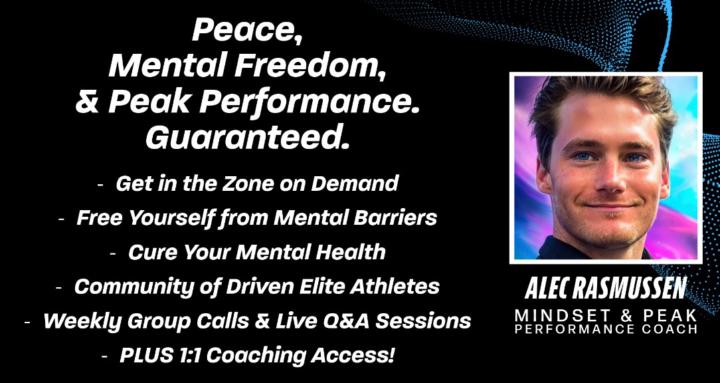
skool.com/successlab-sports-academy-9729
In Elite Level Sport, Your Team is Your Greatest Asset. Join a Team of Aspiring Elite Athletes Pushing to Perform and Succeed at the Highest Level.
Powered by