
Write something
Pinned

Feb 22 •
👉 Start Here - Revenue Stage Brands Only
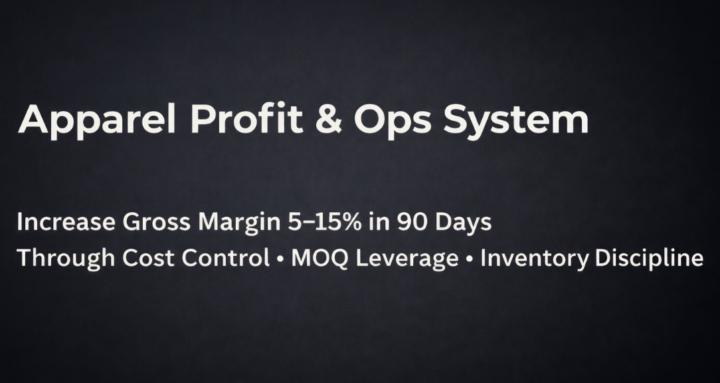
Welcome to the Apparel Profit & Ops System. This is an apparel group built for revenue-stage brands that are already selling and want stronger control over margins and operations. If you’re generating revenue but dealing with margin pressure, MOQ constraints, vendor challenges, or inventory inefficiencies — you’re in the right place. We focus on four core areas: • Cost Visibility — understanding your true landed cost & SKU contribution • Commercial Clarity — protecting margin through structured pricing • Vendor Leverage — smarter MOQ strategy & production discipline • Inventory Control — better reorder logic & cash flow alignment The goal is simple: Improve gross margin by 5–15% by identifying and fixing structural leaks while strengthening operational foundations. If you’re already selling, introduce yourself below and share: 1️⃣ Your monthly revenue band 2️⃣ Your current gross margin % 3️⃣ Your biggest operational bottleneck Looking forward to understanding where your brand stands and how we can tighten the numbers. — Prem
Jan 28 •
👋 Start Here
Welcome to Startup to Scale-Up (Apparel). This community is for founders and aspiring entrepreneurs who want to build a profitable apparel brand — without wasting time or money. Whether you’re at the idea stage or already planning your first launch, you’re in the right place. 🎯 What This Community Helps You Do Inside this community, you’ll learn how to: - Choose the right category and customer - Decide what products to launch first - Avoid expensive beginner mistakes - Build a clear, repeatable apparel business - Move from idea → product → first sale → scale This is practical guidance, not theory. 🧭 How to Use This Community Step 1: Start with the Classroom Go to Classroom → Foundations: Start Your Apparel Brand Complete: - Module 1: Niche, Customer & Positioning - Module 2: Product Selection & Development Do not skip these. They form the base for everything else. Step 2: Do the Action Steps Each lesson ends with a simple action. Post your answers in the comments. That’s how you’ll get feedback and clarity. Progress comes from doing, not watching. Step 3: Join the Weekly Live Calls This is where most value happens. - Ask questions - Get feedback on your ideas - Learn from others’ mistakes and wins Details will be posted inside the community. ⚠️ Important Guidelines - This is a no-fluff space - Keep questions specific - Respect others’ journeys - Focus on progress, not perfection Everyone here is building. 🚀 What to Do Right Now 1️⃣ Go to Classroom → Foundations 2️⃣ Complete Module 1 3️⃣ Post your answers in the lesson comments Once you’re done, move to Module 2. Glad to have you here. Let’s build something real. — Prem
Feb 19 •
Never Ask a Factory "How Much?" 🛑
Asking for a price first gives the factory all the leverage. You lose the negotiation before it starts. To get a fair price, use Reverse Costing. Here is your 3-step cheat sheet: 1️⃣ Know Your Target Cost: If your retail price is $100 and you need a 40% margin after shipping/marketing, your production limit is $30. If the factory says $45, don't just ask for a discount—ask which fabric or construction changes will get you to $30. 📉 2️⃣ The MOQ Staircase: Never get one quote. Always ask for prices at 50, 200, and 500 units. It shows you have a scaling plan, and factories take you more seriously. 🪜 3️⃣ Speak Technical: Stop saying "high quality." Use GSM, Fabric Composition, and Finish. When you speak the language, the "beginner tax" disappears. 🗣️ The Homework: Go to Module 2.3 and grab the Tech Pack Template. Using this can drop your quotes by 15% because it proves you aren't a hobbyist. Got a quote that feels off? Post the garment type, GSM, and MOQ below. I can try to give you a ‘Sanity Check’ on the pricing. 👇
Feb 19 •
Why Your "Dream Product" is Killing Your Cash Flow 💸
Most founders design a product, get a sample and then ask, "How much should I sell this for?" That is the fastest way to go broke. In 15 years of supply chain ops, I’ve seen brands launch beautiful garments that cost ₹600 to make, only to realize that after marketing, shipping, and returns, they need to sell it for ₹2,500 just to break even. But the market only wants to pay ₹1,499. The result? Every sale you make actually loses you money. The Fix: Reverse Costing. You start with the Retail Price the market will pay, subtract your Profit Margin, and then tell your factory what the cost must be. If the fabric or construction is too expensive to fit that cost, you change the design—NOT the price. Quick Poll for the group: When you think about your next (or first) product launch, which of these is your biggest headache? 1️⃣ Finding a fabric that fits the budget. 2️⃣ Knowing what a "fair" factory price actually is. 3️⃣ Calculating the hidden costs (shipping/packaging/marketing). Drop a 1, 2, or 3 in the comments and I’ll give you a tip on how to solve it.
Oct '25 •
🧵 Welcome to Startup to Scale-Up (Apparel)
Hey everyone — I’m Prem Kalyani, and I’ve spent the last 15+ years building, running, and scaling apparel businesses — from factories and export units to lifestyle brands and D2C startups. I created this community to help founders, operators, and creators in the apparel space bridge the gap between creativity and execution — so your ideas don’t just look good, they scale profitably. Here, you’ll learn how to: 👕 Build strong sourcing and production systems 📊 Price your products right and manage cash flow ⚙️ Streamline supply chains and operations 🚀 Plan growth — from startup to ₹10 Cr+ This is a space to learn, share, and grow together — not theory, but what actually works on the ground. 👉 Introduce yourself below: - What’s your brand or role? - What’s one challenge you’re facing right now? Welcome to the journey from Startup → Scale-Up. Let’s build smarter.
1-7 of 7
powered by
skool.com/startup-to-scale-up-apparel-1289
Helping apparel brands increase gross margins 5–15% using structured costing, sourcing & inventory systems.
Suggested communities
Powered by