

18d •
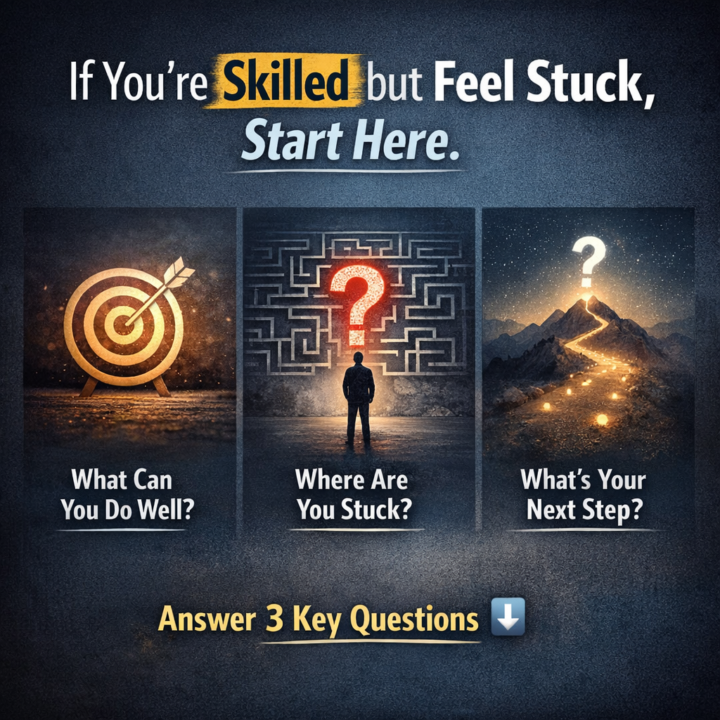
Be Honest for 2 Minutes — This Changes Your Direction
Answer these three questions — short and concrete: 1️⃣ What can you actually do well? Not what your job title says. What do people come to you for because you do it better, faster, or clearer than most? 2️⃣ Where are you currently stuck? What keeps looping in your head? What costs you energy or creates doubt about your next move? 3️⃣ What is the next step you want to understand better? Not “what do you want to become,” but: what do you need clarity on to move forward? (Responsibility, communication, positioning, role choice, growth path, etc.) 👇 Important - Keep it real. - 1–3 sentences per question is enough. - No polished story needed. I’ll read along and ask sharp follow‑up questions where it helps — not to “coach,” but to create clarity and direction. reply to one other post you relate to. You’ll often recognize your own block faster in someone else’s words.
0
0
20d •
Help That Makes People Stronger
The best help you can give someone is teaching them they do not need you. When someone is struggling, the instinct is to step in and fix it. Give them what they need. Solve the problem. Move on. And sometimes that is exactly what is needed. But if you stop there, you have not really helped them. You have just delayed the same problem from showing up again. Real help is not about making someone rely on you. It is about making them capable without you. It is teaching them the skill, opening the door, showing them the path so they can walk it themselves. I have seen leaders who solve every problem for their team. They step in, fix it, and their team never learns. They stay dependent. They wait for someone else to save them instead of figuring it out on their own. The strongest leaders do not create dependency. They create capability. They teach. They guide. They give people the tools and the confidence to solve their own problems. And when those people succeed without needing you anymore, that is when you know you actually helped. If you want to make a real impact, do not just hand someone the solution. Show them how to build it themselves. That is what actually changes their life.
0
0
26d •
Why Smart Leaders End Up Shrinking Their Team
Many leaders struggle with delegating. Not because they can’t do it. But because they are too good at solving problems. - They pull work toward themselves. - Fix issues. - Put out fires. Often, these are the very people who were once praised for their commitment, reliability, and strong sense of responsibility. But something strange happens here: 👉 The harder the leader works, 👉 the less the team starts to do. Not out of laziness. But because initiative is quietly, unintentionally discouraged. - Diminishers use their own intelligence. - Multipliers multiply the intelligence of their team. Diminishers (often unconsciously) want to be the smartest person in the room. Multipliers create a room where others become smarter. The key insight? Delegation ≠ letting go. Good delegation means: - making it clear why something matters - defining the desired outcome - outlining the boundaries - and then: getting out of the way The how belongs to your employee. That feels uncomfortable. And yes — your team won’t applaud immediately. They’ve grown used to you stepping in and fixing things. But real leadership growth starts here: “I only do the things that only I can do.” Everything else? That’s an opportunity to make someone else bigger. An often-overlooked leadership skill: 👉 sensing signals This took me years to learn. - Someone comes to you with a question. - They say it’s become too much. - They can’t handle it anymore. - They can’t get it done. As a manager — in big brother mode — I used to respond with: “I get it. Give it to me. I’ll take it over completely.” In my mind, I was helping. In reality, I was taking the work out of their hands. What they actually wanted wasn’t a solution. - They wanted to vent. - They wanted recognition that it had become too much. - They wanted to be seen. Not rescued. Leadership maturity is learning to feel that difference: - Is this a request for ownership transfer? - Or a signal of overload, asking for acknowledgment?
0
0
29d •
📌 Ownership as a System
Stop Asking for Ownership --> Start Designing It. Everyone says they want people to “take ownership.” - So they push harder. - Assign more responsibility. - Add KPIs. - Check in more often. And then they’re surprised people: - Wait - Do the minimum. - Look up for decisions. Here’s the truth: Ownership is not a character trait --> it’s a system outcome. Responsibility vs Ownership (big difference) 📌Responsibility gets assigned: “this is your task.” 📌Ownership gets taken: “this is mine.” Ownership doesn’t grow under pressure! It grows under the right conditions: - clarity - mandate - psychological safety. The hidden ownership killer: - overfunctioning at the top - When a leader jumps in “to help” the moment it gets hard, the system learns:“Someone else will take it.” So people stop taking initiative. Not because they’re lazy. Because the system trained them. Work & Life Performance: This is not just business. If you avoid discomfort, you steal ownership from others. - At work: you become the bottleneck. - At home: you become the fixer 👉 In both: you get tired, and others get passive. Ownership requires the ability to hold tension without rescuing. 3-minute Ownership Reset: Pick one situation where you feel you’re “pulling” people. Then answer these 3 questions: 1. What is unclear? (role / expectation / decision) 2. Where is responsibility without mandate? 3. Where am I taking over too fast? Fix one of those — and ownership starts moving. Where have you experienced ownership being taken away by leadership or the system? A moment where you thought: “This was mine… until it wasn’t.” Share one real example.That’s where understanding begins. - Less pulling. - More building.
Mar 2 •
What skill of yours should earn you MORE money? 💰
Most people are underpaid.Not because they’re not good……but because nobody ever taught them how to make their skills worth more. So let’s start with this 👇 👉 What skill do YOU have today that should earn you more money? - Something you’re good at - Something people rely on - Something you rarely get credit (or pay) for Share it here. One sentence is enough. I’ll reply and show you exactly how that skill can become more valuable,so you can earn more — faster. Let’s make your work worth more.Let’s get you Skilled & Paid. 💪💰
1-8 of 8
powered by
skool.com/skilled-paid-9712
You're capable You work hard
But you're no longer sure where to focus — or what's still yours to carry
Clarity. Direction. Action. At work and in life
Suggested communities
Powered by