
Write something

Apr '24 •
Wanna Know How to Consistently Do Hard Things?
You have to make it easy to. Or put another way, you have to make it difficult to do the easy thing instead. That could mean putting your kindle next to your toilet, so every time you need to go to the bathroom, you’re spending time reading something educational instead of scrolling on twitter. That could mean making the one-time decision to delete YouTube from your phone, so you can’t use it as a crutch to fill the 5 minute gaps of boredom between meetings. That could mean choosing a business partner who’s smarter than you, so you’re constantly playing catchup to learn as much as them. That could mean taking 5 minutes at the end of your day to write down a prioritized to-do list you can attack the next morning. That could mean removing the TV from your bedroom, so you aren’t tempted to sacrifice crucial sleep for instant gratification. That could mean batching all your shallow work tasks (replying to emails, creating new sprint tickets, etc.) into a single time slot so they don’t interrupt your flow state. That could mean ANYTHING which makes it as easy as possible to work as hard as possible. Instead of wondering why you don’t feel motivated to do something difficult, ask yourself what's motivating you not to. Then remove those things.
0
0

Apr '24 •
What's 1 Piece of Valuable Advice You've Received in Your Career?
Let's use this thread to crowd-source high-level insights for our new members, so they can immediately start getting value from this community. I'll start! 👇

Apr '24 •
How I Survived 3 Layoffs in 3 Years, and How You Can Too
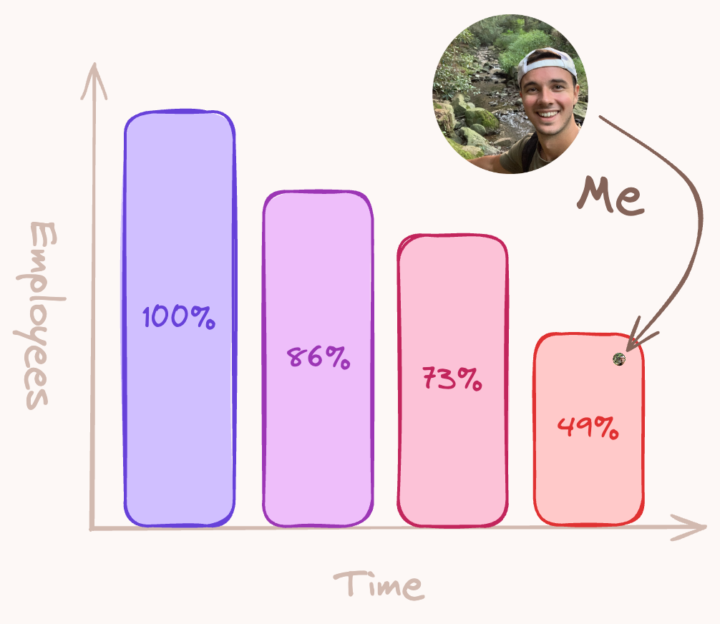
Charlie Munger famously said, "The first rule of compounding: Never interrupt it unnecessarily." If investing your time into growing within an organization is like accruing compound interest across your knowledge, skills, network and reputation, then being laid off is like being forced to sell some of those intangible assets. Oof, there go your long-term returns. What can we do to avoid this growth hindering outcome? At Wayfair, we've gone through 3 company-wide layoffs in the past 3 years, but I've been fortunate to survive all of them. After each reduction in force (RIF), I reflected on the tragedy of losing beloved coworkers, the fear that another one might be around the corner, and the feeling of being an utterly replaceable cog in the machine. If you're part of this community, you've no doubt seen or experienced a layoff at your company in recent years. For that, you have my empathy. And if you're anything like me, you want to know exactly what you should do to avoid such calamities in the future. Here's what I've learned so far from each of the 3 layoffs I've witnessed: 1. Become an indispensable linchpin. In the first RIF, Wayfair targeted the bottom 10-15% of employees based on their recent performance. But rather than aiming to "not be bad" at your job, you're much better off aiming to be indispensable – to be what Seth Godin calls a "linchpin." Linchpins are the engineers that entire teams get built around, because they are able to deliver business impact in ways others can't. Their specific knowledge and unique skill stack enable them to perform work that only THEY can do. No one is completely irreplaceable in a big tech company, but if you develop a reputation for being a linchpin, the cost of firing you is obvious. Without even crunching the numbers, everyone can agree that you're worth more than your salary. Your name never enters the conversation for termination, because it's always at the top of the list for promotion.
Apr '24 •
Why Job Hopping is a SWE Career Killer
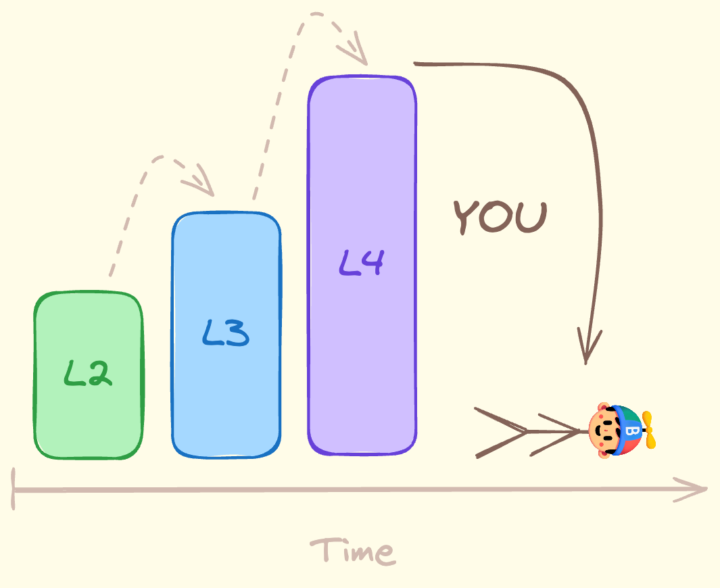
The greatest returns in life come from the power of compound interest. This is true no matter the resource you're investing: money in the market, time spent mastering a skill, energy put into a relationship – you name it. Yet many SWEs choose to interrupt the positive compounding forces in their career for a slightly better salary. They clearly haven't heard of the 5 buckets of success. 😉 "You can get a 20% raise every time you switch jobs," they think. And in a bull market, that might be true. But what are the hidden costs of constantly starting over with a new role, a new team, and a new company? The answer lies in all the benefits you would accrue by consistently investing in a single job: 1. Specific knowledge and applicable skills. The first 3-6 months of any job are largely consumed by onboarding. For more senior positions, this number only increases. It takes time to understand how you can make an impact within a company, and even more time to bring those ambitions to fruition. If you're constantly switching jobs every year, you're forfeiting these valuable learning opportunities in exchange for a modest pay raise. That's short-term thinking, not long-term thinking. You may earn more money with this strategy over the next 2 years, but how will it hamstring your earning potential over the next decade? You'll also be spending a disproportionate amount of energy on interviewing for SWE positions. Especially at big tech companies, the skills required to be an effective interviewee are fairly different from the skills required to be an effective engineer. Which do you want to become? 2. Mentorships and a strong professional network. The #1 hack to becoming an expert in any domain is to find a great mentor. Someone who has been in your shoes and climbed to greater heights can help you chart a path to your goals in half the time it would've taken you alone.
Mar '24 •
How to Become the Top SWE at Your Company: 1 Simple Formula
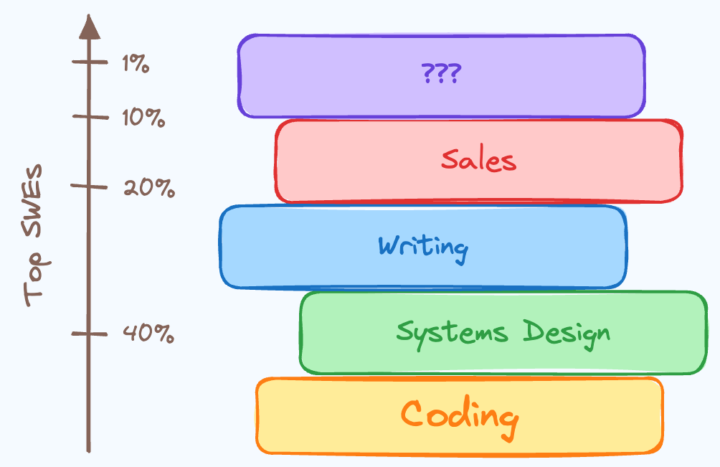
Most people believe you have to be more technically capable than any other engineer to be considered "the best," but they’re mistaken. Doing so is highly unlikely, because in the world of software engineers, you'll be competing against a LOT of brilliant, analytical minds. And for the most part, they're all focused on improving at the same technical skills, like writing code and designing distributed systems. But thankfully, there's a different path you can follow. To see it, we must first understand the concept of "skill stacking," coined by Scott Adams and popularized by Naval Ravikant. Consider this example: If you want to be the best coder amongst 1000 engineers at your company, you have to be in the top 0.1%. That's a tall order. You might dedicate your life to that task and still never get there. But if you want to be the best coder who can also design distributed systems AND lead teams to implement them, you need only be in the top 10% of each skill. Mathematically, 1000 x 0.1^3 = 1000 x 0.001 = 1 Or, a higher proficiency in one skill might compensate for lower proficiency in another. E.g. 1000 x 0.2 x 0.1 x 0.05 = 1 You get the idea. The more things you're good at, the easier it is to be considered "the best" at that unique combination of talents. Thankfully, being a great software engineer isn't confined to a single skill stack. Chances are, all SWEs will overlap on some stereotypical capabilities, like the ones bolded on your resume. But some of us will be better writers, persuasive speakers, or UX designers than others. What's the key insight? Look for complimentary skills that others in your shoes are unlikely to possess. Become proficient in these, and you'll set yourself apart in a league of your own. But we can take this one step further. If you truly want to become the #1 SWE at your company, you won't be able to do it alone. You'll be leading teams of engineers, which means your ability to ensure their success will be part of your own skill stack.
1-5 of 5
skool.com/self-taught-web-developers-5417
A community of friendly software devs working at big tech companies.
Constantly sharing learnings to help each other earn that next promotion.
Powered by