
Write something

Oct '25 •
🧠 The Psychology of “Yes”: 3 Hidden Triggers Behind Every High-Converting Sale
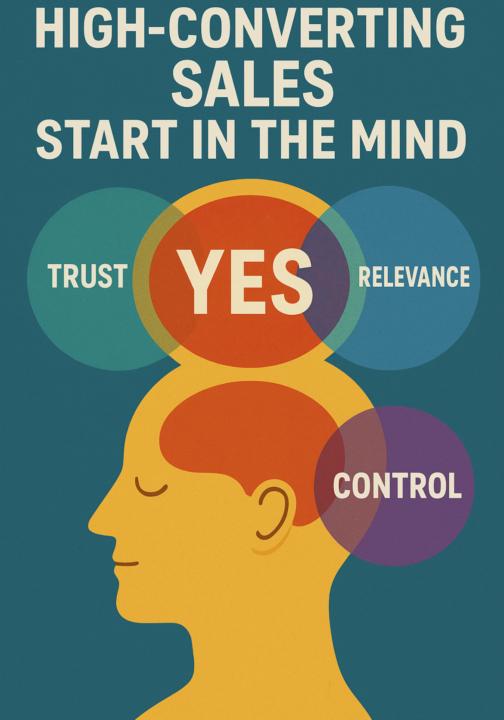
You’ve learned the tactics — now let’s talk psychology. Because the truth is, people don’t buy the best offer… they buy the offer that feels right. Here are the 3 psychological triggers that quietly drive every “yes” (and how to use them ethically 👇): 1️⃣ The Trust Trigger – “Do I Believe You?” Before anyone buys, they subconsciously scan for credibility cues. They’re not looking for perfection — they’re looking for proof. ✅ Use micro-trust signals early: - Real screenshots, testimonials, or social proof - Confident, specific language (“Clients see results in 7 days” > “We get results fast”) - Consistency across your messaging and visuals 💬 Perception = reality. Clarity + proof = trust. 2️⃣ The Relevance Trigger – “Is This for Me?” If your message feels generic, the brain tunes out. The fastest way to win attention is to make your audience feel seen. ✅ Speak to identity, not just pain points: - “For busy entrepreneurs who want to sell more without burnout.” - “For local brands ready to turn visibility into consistent revenue.” 💬 The tighter the targeting, the stronger the response. 3️⃣ The Control Trigger – “Can I See Myself Winning?” People hesitate to buy when they fear losing control. Your job is to show them a clear, safe path to success. ✅ Use predictability to calm their uncertainty: - “Here’s exactly what happens after you join…” - “In the first 7 days, we’ll focus on ____.” - “You’ll know you’re on track when ____.” 💬 Control reduces risk — and risk kills conversions. ⚡️ Your Quick Win: Audit your offer page, funnel, or next sales call. Ask yourself: “Where am I missing trust, relevance, or control?” Plug those gaps and you’ll watch resistance disappear. 🎯 Comment Challenge: Drop ONE line from your current sales script or page below 👇 I’ll help you tweak it using these psychological triggers to make it convert higher.
0
0
Oct '25 •
💡 Is Your Sales Funnel Actually Converting—or Just Collecting Clicks?
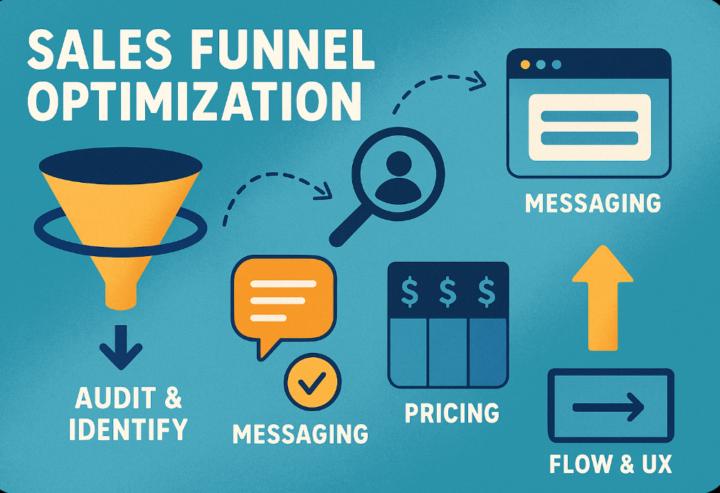
1️⃣ Funnel Audit: Finding the Leaks - Track every step: Use tools like Google Analytics, Hotjar, or Funnel.io to see exactly where users drop off. - Segment traffic: Look at behavior by source (ads, email, organic) to see which audiences convert best. - Analyze user experience: Check for confusing navigation, slow load times, or distracting elements that disrupt flow. Pro Tip: Focus on the top 3 drop-off points first—they usually account for 70–80% of lost conversions. 2️⃣ Messaging Optimization: Speak to Their Head and Heart - Clarify the value: Ensure every page answers, “Why should I care?” immediately. - Align with the prospect’s journey: Headlines, copy, and CTAs should match their awareness stage. - Use social proof wisely: Testimonials, case studies, and numbers that highlight real results can significantly reduce friction. Pro Tip: A/B test variations of headlines, CTAs, and hero copy for 1–2 weeks before making permanent changes. 3️⃣ Pricing & Offer Structure - Anchor pricing: Introduce 3 tiers to guide prospects toward the “best value.” - Bundle strategically: Package complementary services or products for higher perceived value. - Show the cost of waiting: Limited-time bonuses or scarcity tied to real benefits can increase urgency. Pro Tip: Track conversions by tier to fine-tune your offer hierarchy and pricing psychology. 4️⃣ Funnel Flow & UX - Simplify forms: Only ask for information you truly need. Long forms kill conversions. - Remove friction points: Eliminate unnecessary clicks, confusing buttons, or unclear CTAs. - Mobile-first: Most users now browse on mobile—optimize buttons, text, and visuals accordingly. Pro Tip: Use session recordings or heatmaps to see exactly how users interact with your funnel and spot bottlenecks. 5️⃣ Testing & Continuous Optimization - Run small experiments: Test one element at a time (headline, CTA color, bonus offer). - Measure impact: Track conversion rate, cost per lead, and revenue per visitor. - Iterate quickly: Funnels aren’t “set it and forget it.” Small tweaks compound over time.
0
0
Oct '25 •
💥 Unlock the Psychology Behind High-Converting Sales 💥
Discover 3 simple strategies that make your offers irresistible, prompt action, and position you as the go-to expert—plus a quick win you can test this week.
0
0
Oct '25 •
🚀 Welcome to High-Converting Sales Psychology
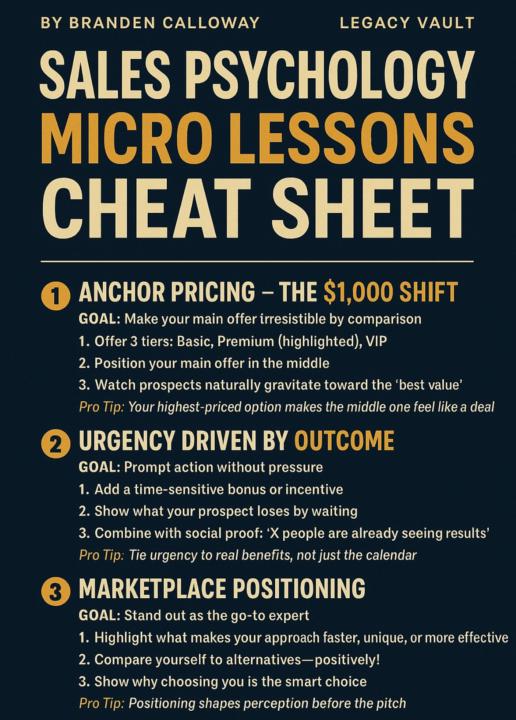
Hey everyone! 👋I’m Branden Calloway, founder of Legacy Vault and Play Golf Rentals. I’ve spent years mastering sales strategies that turn conversations into conversions—without feeling pushy. I help entrepreneurs, business owners, and creatives position their offers, create urgency, and price for maximum value. Now, let’s dive into some of the high-converting sales psychology principles you can use immediately: Sales isn’t just about pitching your product—it’s about understanding human psychology, positioning yourself in the marketplace, and creating irresistible offers. Here’s what we’ll cover today: 1️⃣ Pricing Strategies That Convert Your price isn’t just a number—it’s a signal of value. - Anchor your price against a higher value option to make your core offer feel irresistible. - Use tiered pricing to give prospects a “best choice” option that guides them to the high-value package. - Scarcity and exclusivity work best when tied to a real benefit, not just a gimmick. 💡 Example: Instead of saying, “I have 3 spots left,” frame it as, “Only 3 spots available to guarantee personal attention and fast results.” 2️⃣ Urgency-Driven Sales Humans are wired to act fast when there’s a clear cost of delay. - Limited-time bonuses or early-bird incentives increase conversions. - Show the real impact of waiting—what your customer loses by not acting now. - Tie urgency to outcome, not just the calendar. 💡 Pro Tip: Combine urgency with social proof—“X people have already joined this month and are seeing results.” 3️⃣ Marketplace Positioning Your offer isn’t just about features—it’s about perceived value in the marketplace. - Position yourself as the expert, not just another option. - Highlight what makes your approach unique, faster, or more effective. - Make your audience feel like joining you is the smart choice—they’ll sell themselves on the value. 💡 Quick Win: Compare your solution to the alternatives in your market—not in a negative way, but to show why yours is superior.
0
0
1-4 of 4