
Write something

Sep '24 •
A brief background.
Hello and good morning everyone! My name is Elijah and I am s devoted Catholic. I was baptized as Christian and recently was baptized as Catholic. I joined this community in hopes that it helps me stay close to God, Mary, and Jesus in the difficult moments I am experiencing in life. Something I do everyday is read the Bible or listen to readings with my Exodus app and have Holy Hour every night. And overtime I would hope to gain some insight and help with the difficult experiences I am going through and I am more than happy to help anyone who is in need of help!

Aug '24 •
New Members 🎖️
STEP 1: DOWNLOAD THE SKOOL APP Android version & turn on notifications! STEP 2: Comment below on this post and introduce yourself. - What’s your name & where are you from? - What are your current interest ? - What are you hoping to learn from this community? STEP 3: We want to hear your testimonials! We believe hearing others testimonials brings us closer as a family under God! STEP 4: Invite A Friend! Grow a stronger friendship by spending time together understanding God!


Sep '24 •
A little about me
Hi Everyone! I'm Nicholle and I just joined Saintralize. I've joined this group to learn a little more about my faith. One thing I've started to implement in my daily routine is praying the rosary!

Sep '24 •
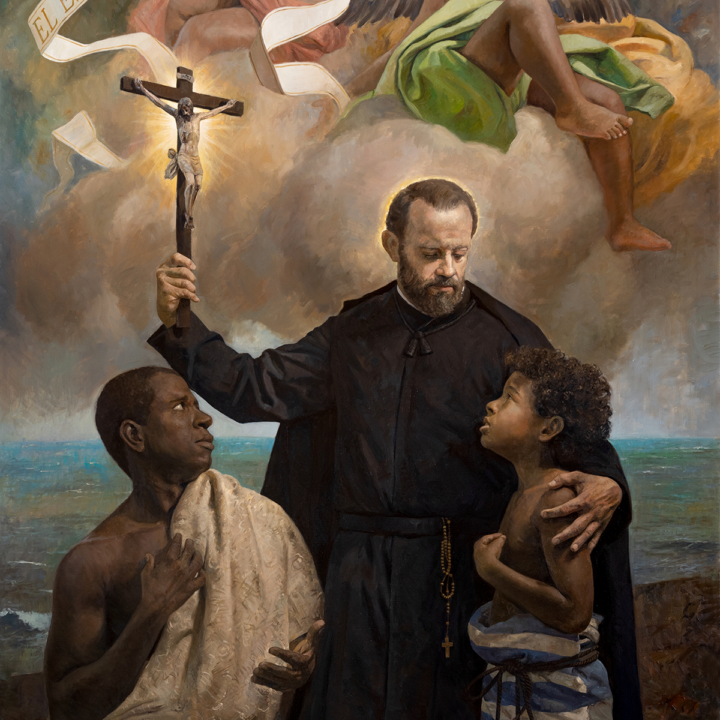
St. peter claver Pray For Us!
------------------------- An unlikely friendship ------------------------- At the University of Barcelona, Peter Claver studied and prayed. The young man, born in 1580 in the Catalan region of Spain, came to understand: “I must dedicate myself to the service of God until death.” He felt a call. Its clearer contours were still hidden from him, but he knew that he had to follow it. So at 20, Peter joined the Society of Jesus. His superiors sent him to study philosophy in Mallorca, where he made an unlikely friend: Alphonsus Rodriguez, the elderly, uneducated lay brother who was the porter at the Jesuit college. Alphonsus may not have had much book-learning, but a life of suffering had taught him to listen to God. Peter noticed his holiness. “How can I love the Lord?” he asked the old man. “He gives me a great desire to follow him, but I don’t know how.” Alphonsus prayed, and the answer came to him: this young man with a great heart was destined for a suffering people far away. At Alphonsus’ urging, Peter told his superiors of his desire to go to the missions. In 1610, he left for Cartagena in present-day Colombia, a center of the Spanish slave trade, where ships sailing from West Africa brought 10,000 new slaves yearly. --------------------------- “Slave of the slaves” ---------------------- Peter finished seminary in Cartagena, learning from the Jesuit missionary Alonso de Sandoval, who had ministered to the slaves. He was horrified by what he learned about their plight. When Peter, ordained in 1616, made his final profession as a Jesuit in 1622, he signed his vows, “Peter Claver, the slave of the Africans forever.” He had found his calling. Before the slave ships entered port, Fr. Peter begged for bread, medicine, anything he could bring with him into those ships packed tightly with captives chained for so long that a third of the “cargo” died. He assembled a team of interpreters. As soon as a ship docked, this “slave of the slaves” descended into the dark holds. He brought food, but more importantly, he brought kindness to men and women driven mad with terror and suffering. He looked at them as if they were human beings, tended their wounds and lent his cloak to the shivering. “We must speak with our hands,” he said, “before we speak to them with our lips.” His hands spoke, and so when he assured these people that God loved them despite the cruelty that men had inflicted on them, they listened. Using simple pictures, he taught them the Christian faith. In small groups, he baptized them – which not only made them members of Christ’s body, but enabled Peter to call upon the slave masters to treat their fellow Christians more humanely.
3
0
1-8 of 8
skool.com/saintralize
A group of Catholics who take their faith seriously.
Powered by