
Write something

Jan 15 •
How to Tell If a 1688 Supplier Is a Real Factory
One of the quickest ways to judge a supplier on 1688 is by looking at the company name. In general, names give strong clues about what kind of entity you are dealing with: - Names that include “Factory (厂)”, “Manufacturing (制造)”, or “Co., Ltd. (有限公司)” are more likely to be closer to actual production. - Names such as “Trading Co. (贸易有限公司)”, “E-commerce Company (电子商务公司)”, or “General Merchandise Store (百货商行)” usually indicate intermediaries rather than factories. - Personal names or small “shops” are often resellers or individual operators. This doesn’t mean every company with “有限公司” is a factory, or that every factory uses the word “factory” in its name.But understanding these naming patterns helps you quickly filter suppliers and move closer to the source. The goal is not perfection, it’s knowing where you are in the supply chain, and how close you are to first-hand production.
2
0
Jan 11 •
The 4 Basic Steps to Sourcing from China’s Domestic Platform 1688
Sourcing directly from China’s domestic platform 1688 is actually simple at a high level: 1. Purchase the products you want on 1688 2. Ship the goods to a trusted local freight forwarder in China 3. The freight forwarder ships the goods to your country 4. Clear customs and pay duties/taxes in your destination country The steps are straightforward. With the right understanding at each stage, small shops can source more confidently and achieve better cost control on their own.
0
0
Jan 1 •
Why the Same Product Costs More on Alibaba
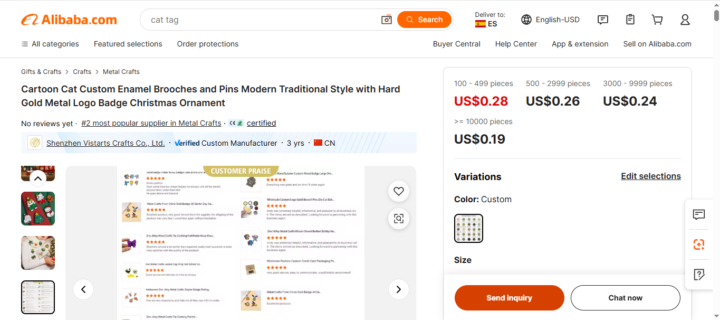
Happy New Year 2026. Today, we look at a simple but very clear comparison. Using the same product type—Christmas brooch—the price gap between Alibaba and 1688 is obvious. On Alibaba, similar brooches are priced around USD 0.28, with fewer design options available.On 1688, comparable products are priced as low as USD 0.068, with a much wider range of designs—many of which never appear on Alibaba at all. This difference is not just about price. It reflects where you are sourcing from. For small shops outside China, relying only on Alibaba makes it difficult to differentiate or maintain healthy margins.If you want more design options, better cost control, and real room for branding, you already know where to look.
0
0
Dec '25 •
Alibaba vs 1688: Two Platforms, Two Very Different Layers
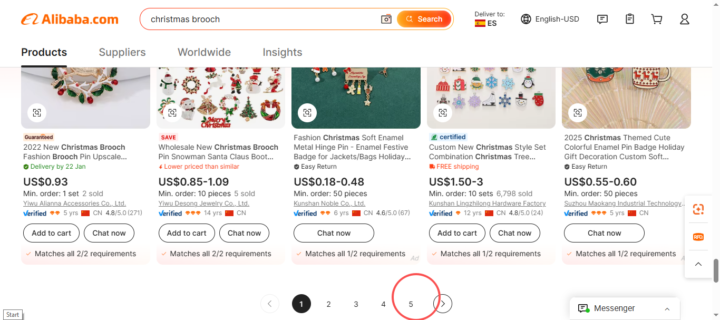
Hope you all had a Merry Christmas yesterday. Today, I want to compare two platforms that are often confused: Alibaba and 1688. Alibaba is designed for international buyers and shows a limited export-facing layer of suppliers.1688 is a domestic Chinese platform, where a much broader range of factories and suppliers operate. To access its full scope, searches need to be done in Chinese. This difference becomes very clear in search results.Using the same keyword, “Christmas brooch”, Alibaba shows around 5 pages of results, mostly from trading companies. On 1688, the same search shows over 30 pages, with far more product variations and supplier options. The screenshots below show how differently these two platforms surface the market.
1
0
Dec '25 •
Why Alibaba Is Not the Factory Layer
What you see on Alibaba is often limited: styles are repetitive, prices are higher than they should be, and quality can vary widely. Most competitive factories are found on China’s domestic platforms, not on international-facing marketplaces. If you’re interested in unique products or want to build your own brand, the best approach is to work directly with Chinese factories, then arrange shipping through a reliable freight forwarder to your destination country. This gives you more control over design, quality, pricing, and branding.
1-5 of 5
powered by
skool.com/safe-sourcing-from-china-4134
An independent group for small shops to discuss China factory sourcing, pricing logic, and risks.
No agents. No products sold.
Suggested communities
Powered by