
Write something

14d •
The #14 Trap That Fails Strong Electricians on Paper
You're at the panel. #14 copper, 75°C terminations. What's the biggest breaker you can legally land on it? On the truck, you'd grab a 15 without thinking. Under the clock on exam day, with Table 2 sitting in front of you, a lot of solid electricians answer 20 — and lose the mark. Here's why it gets you: The table says 20. Table 2, #14 copper, 75°C column — ampacity is 20A. That's a real number. If you stop there, you're wrong. The rule says 15. Rule 14-104(2) is the small-conductor rule, and it overrides the table for #14, #12, and #10. No exceptions on a standard branch circuit: - #14 Cu → 15A max - #12 Cu → 20A max - #10 Cu → 30A max - #12 Al → 15A max - #10 Al → 25A max Table 2 even flags this for you — there's a § footnote on those three rows that says "See Rule 14-104(2)." The code is pointing you off the table. Miss that footnote, you fail the question with more information, not less. The part that catches the people who know code well: Table 13 lets you round up to the next standard breaker size — and the "16-20A" band says 20A is fine. So now two tables in the book are both whispering "20." The opening line of 14-104(2) — "Except as provided for by Subrule 1)(c)" — is the tie-breaker. That exception is for motors, transformers, heaters, single-luminaire runs under 30-412. A general branch circuit isn't one of them. The hard cap wins. 15A. The 30-second method, every time you see an ampacity question: 1. Cu or Al, and which termination column (4-006) 2. Base ampacity off Table 2/4 3. #14, #12, #10? Stop. Go to 14-104(2) first. That cap governs, not the table. 4. Derating if bundled/hot ambient — Table 5A/5C off the 90°C column, then check against termination rating, take the lowest 5. Breaker size: small conductor = the hard cap. Bigger conductor with no exact match = Table 13 next-size-up This isn't a knowledge gap. You know this in the field with your eyes closed. It's a paper-navigation gap — and that's the entire difference between "good electrician" and "Red Seal electrician" on exam day.
0
0


Aug '25 •
NJ exam agents RE
Hey guys does anyone have advice on how to pass the Nj agents exam ? Having a hard time
Dec '25 •
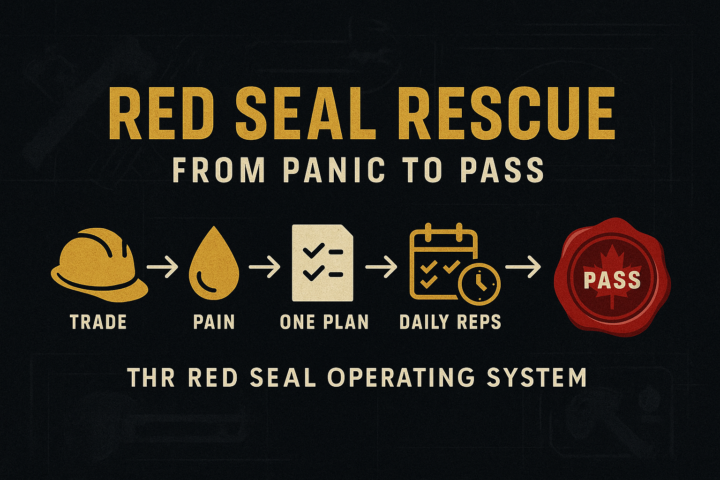
Red Seal Rescue: Your Red Seal. Your Timeline. Your Terms.
If you’ve got years in the trade but no Red Seal yet, you already know the pain: 30–40% lower wages than the certified guy doing the same work Limited mobility (interprovincial = headaches) Career ceiling (foreman/supervisor/contractor doors stay locked) Wasted time studying the wrong stuff, failing, and losing months of income Here’s the truth: the exam isn’t the problem. Most prep systems are built by people who haven’t worn the boots. What Red Seal Rescue is A certification coaching system built by an active Red Seal Journeyman (passed May 2017, still in the field) who coaches tradespeople through the process with a plan that actually works. What you get Week 1 — Diagnostic Skill audit across the exam domains Gap analysis (what you think you know vs. what the exam tests) A custom timeline based on your schedule (not some generic 12-week fantasy) Weeks 2–8 — Targeted Study Modules Trade-specific prep (Electrical, Plumbing, HVAC, Millwright, etc.) Focus on high-frequency exam topics Real-world examples + exam-style practice questions Weekly Accountability 30-min check-ins to keep you moving Bring confusion, leave with clarity “Ready” calibration so you don’t over-study or panic Week 9 — Exam Strategy Session Red Seal test tactics Time management under pressure Anxiety regulation (calm mind = clean marks) Post-Exam Support Pass: wage negotiation coaching (get paid like you earned it) Fail: gap-adjusted retest plan (most pass on attempt #2 with proper correction) Conservative wage bump: +$10–$15/hr Annual gain: $16,000–$25,000+ Payback: 2–3 months 10-year impact: $160,000–$250,000+ This isn’t an “expense.” It’s wage arbitrage. Who this is for 5+ years in the field — you know the work, need the paper Apprentices close to journeyman — want to pass first try Career-changers from adjacent trades — need focused prep Not for years experience or anyone hunting shortcuts. You still have to work — just smarter. Next steps Option 1: 30-min discovery call
0
0

Aug '25 •
421A Heavy Duty Equipment Technician
I’m currently preparing for the 421A Heavy Duty Equipment Technician Red Seal exam, scheduled for August 15th, and I’m seeking guidance and assistance to help me get fully ready for the test.

1-9 of 9
Powered by