
Write something
Pinned
6d •
Free Download — 4 Mental Health Prompt Cards
Print them, carry them, and see if they earn their place next to the clinical set. Most of us have had the shift where the clinical bit was easy and the conversation wasn't. You can run an arrest. You've been trained for that. Then someone sits on a kerb and tells you they don't want to be here any more, and there's no algorithm for the next sentence. That's what these are for. One topic per card, written to be read in seconds rather than studied. Four of them are attached to this post, free, for everyone here. What you're getting 02 · Starting the Conversation — where and how to open it. The moment, the place, and the two questions that get past "I'm fine". Most people are waiting to be asked. 03 · Asking About Suicide — the exact words. Asking directly does not plant the idea; it is very often the first relief they've had. This card is the one I'd want in your pocket if you only took one. 21 · Meltdown, Shutdown or Panic? — they look alike and need opposite things, and getting it wrong makes it worse. Panic wants company. Overload wants quiet. 16 · Getting Help — UK Routes — England, Scotland, Wales and Northern Ireland. This one's in here because card 03 should never travel on its own. If you're going to ask the question, you need to know where you're sending them before you ask it. Both A5 and A6 are attached. A5 for the wall or the folder, A6 for your pocket. Print single-sided at 100% — don't let your printer "fit to page". 250gsm and a laminating pouch if you want them to survive a wet shift. 📋 There are 46 cards in the full set Recognising and responding · conditions · neurodiversity · crisis and conversation · law, ages and groups · grief and the responder. Three of them are pure crib sheet — actual sentences to say, for opening a conversation, keeping it going, and ending it safely. Not "listen and be supportive". The words. ADHD and autism are in there as neurodevelopmental differences, not illnesses, because we meet these people constantly and get it wrong. Capacity and detention law is set out plainly — England and Wales section by section, Scotland and Northern Ireland by statute.
0
0
Pinned
Jul 19 •
Clinical Prompt Cards Free Sample
Free Download — 3 Clinical Prompt Cards Print them, carry them, and see if they earn their place in your pocket. I've been building a set of clinical prompt cards — one topic per card, designed to be used on shift rather than read once and forgotten. Three of them are attached to this post, free, for everyone here. What you're getting 42 · Cardiac Arrest Checklist — the full run sheet. First minutes through to ALS arriving, including who does what and when the drugs go in. 24 · AED Pad Placement — adult male, adult female, child front and back. Including where pad 2 actually goes on a female patient, which is the bit most people get wrong. 34 · Reading an ECG — the nine-step sequence. Same order, every time, so you stop missing things. Both A5 and A6 are attached. A5 for the wall or the folder, A6 for your pocket. Print single-sided at 100% — don't let your printer "fit to page". 250gsm and a laminating pouch if you want them to survive a wet shift. 📋 There are 46 cards in the full set Assessment & handover · trauma & emergencies · resuscitation · drugs & devices · ECG & cardiology · cardiac arrest. All aligned to Resuscitation Council UK Guidelines 2025. The ECG section alone runs to 11 cards and 17 rhythm strips — lead placement, rhythm recognition, heart blocks and conduction. The newest addition is a Stepwise Airway Management card — an airway escalation ladder that keeps every step inside FREC scope. If you already bought the pack on Etsy, re-download and it's yours; Premium members, it's in the classroom. ⭐ Two ways to get all 46 Premium members already have it. The complete pack is in the classroom now, alongside every course and your CPD certificates. If you're on Premium, go and download it — that's yours. Not on Premium? You can buy the pack on its own for £18, or upgrade to Premium ($29/month — about £22) and get the pack plus every course, all future content, and downloadable CPD certificates. The annual option is $249, which works out at over three months free.
Pinned
May 16 •
Unlock All Training & CPD — Join Premium
Welcome to RapidMed Training. This community is for responders who want to stay sharp, stay confident, and stay ready — and Premium is where the actual training lives. ⭐ What Premium gets you 🎓 Documented CPD you can evidence. Downloadable certificates for every course you complete — ready for your portfolio, appraisal or employer. 📚 Every course, now and in future. Ten Second Triage & METHANE, scenario-based modules, and everything released from here on. New content lands in Premium first. 🃏 The Clinical Prompt Cards pack — included. All 46 cards, A5 and A6, aligned to Resuscitation Council UK Guidelines 2025. Sold on its own at £18. Yours free as a member. 🧠 Scenario-driven learning. Case studies and premium-only posts built around what actually goes wrong on shift — not textbook ideals. 💬 Ask questions and get answers. Direct access to discussion with people doing the same job. Everything is written against NHS, JESIP, JRCALC and Resuscitation Council UK principles. 💷 Two ways to join Monthly — $29 (about £22) Full access, cancel any time. Annual — $249 (about £185) Save $99 — that's over three months free. Skool bills in US dollars. The pound figures are approximate and will shift slightly with the exchange rate. 🎯 Why it's worth it Responders don't rise to the occasion — they rise to the level of their training. One shift where you knew exactly what to do pays this back. That's the whole point. 🔓 Ready? Hit Upgrade at the top of the page for instant access to everything — courses, CPD certificates, and the full Prompt Cards pack. If you're serious about developing your skills, Premium is where the real learning happens.
0
0
22h •
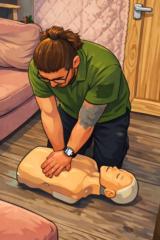
AED pads on a woman — the hesitation that costs lives
Same stigma as bystander CPR, same cost. The bra comes off, or gets cut. Pads must go on bare skin. A wire or padding under a pad is a burn risk and a poor contact. Pad placement doesn't change: below the right collarbone, and the left side below the armpit. Under breast tissue, not on it. Remove piercings and jewellery from the pad area. Wipe the chest dry. Nobody has ever been prosecuted for exposing a chest to save a life. People have died while bystanders debated it. Cover this in every session you teach. It changes what people do.
1
0

10d •
Scene safety isn't a box you tick on arrival
Danger is the first step of the primary survey and the one most people treat as a single check at the door. It isn't. It's continuous. Conditions change — a crowd builds, a vehicle moves, someone who was calm isn't any more, weather turns, a second casualty appears. The scene you assessed ninety seconds ago is not the scene you're standing in now. Four priorities, on repeat: identify hazards · reduce risks · protect yourself with PPE · decide whether it's still safe to be there. And the uncomfortable one — if it isn't safe, you don't go in. Waiting for police or fire isn't hesitation. You cannot help anyone if you become the second casualty.
1
0

1-9 of 9
powered by

skool.com/rapidmed-training-2831
UK‑based medical training built on national guidelines. Save lives through skill, speed, and knowledge.
Suggested communities
Powered by