
Write something
Pinned
Feb 21 •
From Classroom to Clinic: Mastering the Boards as One.
Our mission is to bridge the gap between heavy textbooks and clinical confidence. If you are prepping for your final board exams or a mid-semester musculoskeletal practical like me, this page is designed to provide: • High-Yield Reviews: Simplified breakdowns of complex anatomy, neuro, and cardio-resp topics. - Question discussion: Question discussion and challenges to refine problem solving skills • Community Support: A space to connect with fellow students who are in the same trenches. How to Participate: 1. Post Your Question: Whether it’s from a textbook, a practice exam, or a clinical placement. 2. Tag it #CommunityCase: Use the tag so everyone can find it. 3. The Brain Trust: We’ll open it up to the group for discussion. 4. The Final Breakdown: Once we’ve all had a go, we’ll summarise the evidence-based answer and the clinical reasoning behind it.
1
0

Feb 25 •
The Scapula — The Silent Architect of Shoulder Power
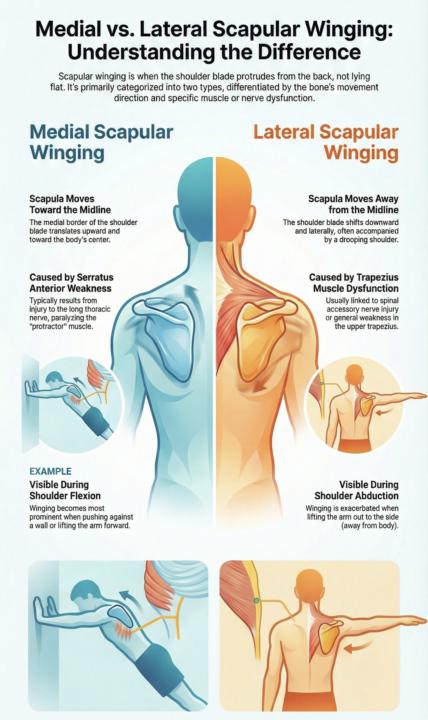
The scapula is far more than a flat triangular bone resting on the back of the rib cage. It is the dynamic foundation of shoulder function — a floating platform that links the arm to the trunk and orchestrates movement with remarkable precision. Unlike most bones, the scapula does not attach directly to the rib cage by a true joint. Instead, it glides along the thoracic wall through the scapulothoracic articulation, relying on finely tuned muscular coordination. This unique design allows extraordinary mobility while maintaining stability. Scapular winging occurs when the medial border of the scapula protrudes posteriorly, lifting away from the thoracic wall like a wing. It is not merely a cosmetic issue — it reflects muscular or neurological dysfunction. Most Common Cause - Weakness or paralysis of the serratus anterior - Often due to injury of the long thoracic nerve When the serratus anterior fails, the scapula loses its ability to stay anchored against the rib cage, especially during pushing movements or forward elevation. Other Causes - Trapezius weakness (spinal accessory nerve injury) - Rhomboid weakness (dorsal scapular nerve injury) - Muscular imbalance or poor motor control
0
0
Feb 24 •
WRIST
A therapist identifies weakness in the flexor digitorum superficialis (FDS). To isolate this muscle during manual muscle testing, the therapist should assess the patient's ability to flex which joint while the other fingers are held in extension? #PHYSIO PREP # CPTE # NPTE #PCE #REHAB #PHYSIOTHERAPY
Poll
Cast your vote
0
0
Feb 23 •
ELBOW JOINT
A physical therapist is applying a joint mobilization to the 1st carpometacarpal (CMC) joint to improve the patient's ability to reach for large objects (Abduction). Based on the concave-convex rules for a saddle joint, which glide is required? #PHYSIO PREP # NPTE # CPTE #SKILL
Poll
Cast your vote
0
0
Feb 23 •
ELBOW JOINT
A patient with a history of a cervical cord injury and a Grade 0 strength in the triceps is observed extending the elbow by purposely horizontally adducting the arm while the distal segment is fixed. This is an example of: #Physiotherapy. #CPTE # NPTE #LEARN
Poll
Cast your vote
0
0
1-15 of 15
powered by

skool.com/physio-prep-2060
Welcome to Physio Prep, the destination for physiotherapy students gearing up for their exams and the Clinician who want to polish their knowledge
Suggested communities
Powered by