
Write something
Pinned

3d •
GLP-1 PLATEAUS: WHEN THE SCALE DECIDES TO TAKE A VACATION!
You’ve been doing everything right. You’re taking your GLP-1, eating better, losing weight, and then BAM! The scale stops moving. Two weeks go by. Then three. Now you’re wondering if your medication stopped working. Before you start increasing doses, stacking compounds, or throwing your scale out the window, let’s talk SCIENCE! WHY DO GLP-1 PLATEAUS HAPPEN? Your body is incredibly good at adapting. Unfortunately, that includes adapting to weight loss. 1. Your Metabolism Has Adjusted As you lose weight, your body requires fewer calories to function. A calorie deficit that worked 30 pounds ago may now be your maintenance level. 2. You’re Losing Muscle Along With Fat Without adequate protein and resistance training, some of your weight loss may come from muscle. Less muscle can mean lower energy expenditure. 3. Your Calorie Intake Has Changed Those little bites, snacks, fancy coffees, and extra portions add up. Even healthy foods have calories. 4. You’re Not Eating Enough to Support Your Activity GLP-1 medications can suppress appetite so effectively that some people struggle to meet basic nutritional needs. Chronic under-fueling can contribute to fatigue, muscle loss, and reduced activity. And no, starvation mode doesn’t magically stop fat loss. But inadequate nutrition can make sustainable weight loss much harder. 5. Water Retention Is Hiding Fat Loss Stress, poor sleep, sodium, hormonal fluctuations, constipation, and increased exercise can temporarily mask fat loss on the scale. 6. Your Body Is Defending Its New Weight Weight loss triggers biological adaptations, including changes in hunger hormones, energy expenditure, and appetite regulation. Your body isn’t necessarily fighting YOU. It’s responding to changes in energy balance. HOW DO YOU BREAK THROUGH A PLATEAU? 1. FIRST, MAKE SURE IT’S ACTUALLY A PLATEAU! A week or two without movement isn’t necessarily a true plateau. Look for a sustained stall of approximately 4–6 weeks while monitoring your weight trend, waist measurements, and consistency.

Pinned
Oct 14 •
FLASH SALE! 10% OFF Hormonal, Anabolic and Performance-Related Compounds — Product Reference Guide
‼️FLASH SALE‼️ 10% OFF FOR ONE DAY ONLY‼️ MESSAGE ME FOR DETAILS

Jun 10 •
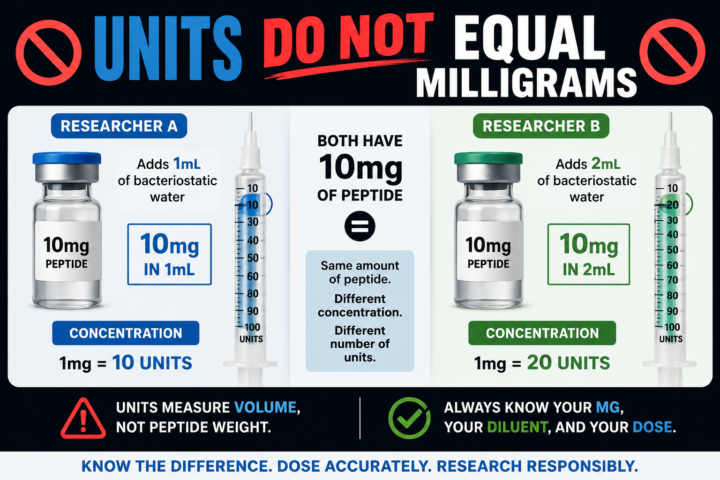
Units ≠ Milligrams: One of the Most Important Concepts in Peptide Research
If there is one thing I wish every new peptide researcher understood, it's this: Units do NOT equal milligrams. Let me say that again for the people in the back: Units are not a measurement of how much peptide is in the vial. They are simply a measurement of volume based on how much liquid you added to reconstitute the peptide. This is where many dosing mistakes happen. Example: Let's say you have a vial that contains 10mg of peptide. Researcher A adds 1mL of bacteriostatic water. Researcher B adds 2mL of bacteriostatic water. Both researchers still have exactly 10mg of peptide. The amount of peptide didn't magically change. What changed is the concentration. Researcher A - 10mg in 1mL - 1mg = 10 units - Researcher B - 10mg in 2mL - 1mg = 20 units - Same peptide. Same milligram amount. Different number of units. This is why asking: "How many units should I take?" is impossible to answer without knowing: - How many milligrams are in the vial - How much diluent was added - What dose is being targeted Why This Matters: Imagine two different vendors selling the same peptide. Vendor A's laboratory testing shows the vial contains 9.2mg. Vendor B's laboratory testing shows the vial contains 11.1mg. Both may be labeled as "10mg." If you are dosing based solely on units and not the actual laboratory-tested content, your dosing could be significantly different than intended. This is why I constantly emphasize: ☑️Review the CoA ☑️Verify the actual tested amount ☑️Use a peptide calculator ☑️Understand your concentration ☑️Never assume units equal milligrams The Takeaway: Milligrams tell you how much peptide you have. Units tell you how much liquid you're drawing into the syringe. They are not interchangeable. The researchers who take the time to understand this concept make fewer dosing errors, get more consistent results, and become far more confident in their research. If you're new to peptides, learning concentration calculations and dosing calculators is one of the most valuable skills you can develop.
5h •
🚨 GROUP RULES REMINDER — ZERO TOLERANCE 🚨
Let's make something VERY clear about promoting, soliciting, and sending unsolicited private messages to members of this group. This community was created for education, research, sharing knowledge, and helping one another. It was NOT created to give people access to a ready-made audience for their own personal promotions. Effective immediately, the following will result in a PERMANENT BAN: 🚫 Unsolicited Private Messages: Messaging members to promote products, vendors, websites, services, other groups, or anything you're trying to sell is STRICTLY PROHIBITED. This also includes, "Hi @so-in-so. How are you?" I've been seeing this a lot. If this is you....STOP now or get banned. It's that simple. 🚫 Self-Promotion: Posting advertisements, affiliate links, referral codes, or promoting your own business without prior admin approval is NOT allowed. 🚫 Recruiting Members: Attempting to pull members into another community, private group, or platform is grounds for removal. 🚫 DISCORD LINKS: Let me be crystal clear on this one. NO DISCORD LINKS. PERIOD. Not in posts, not in comments, and not in unsolicited private messages to our members. There are NO exceptions. ⚠️ NO WARNINGS. NO SECOND CHANCES. If you're caught using this community to solicit members, advertise without permission, or distribute Discord invitations, you WILL be permanently banned. And yes, that includes privately messaging members because you think the admins won't find out. ‼️Newsflash: Members send me screenshots. If someone contacts you privately with unsolicited promotions, vendor recommendations, or invitations to other groups, please screenshot the conversation and report it to me immediately. I have worked hard to build this community and provide valuable educational resources. I'm not going to allow people to use our membership as their personal marketing list. Respect the community. Respect the members. Respect the rules. It's really that simple. — Kristina Marie
2
0

1d •
JADE NEXUS NEW PRODUCT RELEASE — KLOW 80 MG IS FINALLY HERE!
YOU ASKED. WE LISTENED. JADE NEXUS DELIVERED! http://jadenexus.net/?ref=KRISTINA For a long time, our research community has been asking Jade Nexus to carry KLOW 80 mg, and we've heard your requests loud and clear! At Jade Nexus, we value our customers' feedback. We pay attention to what our research community wants, and we're always looking for ways to expand our product selection. We're excited to officially announce that KLOW 80 mg is now available at Jade Nexus! WHAT IS KLOW 80 MG? KLOW is a four-peptide research blend containing compounds being studied for tissue repair, cellular regeneration, inflammatory signaling, and skin health. Each vial contains: - GHK-Cu — 50 mg - BPC-157 — 10 mg - TB-500 — 10 mg - KPV — 10 mg Total: 80 mg per vial UNDERSTANDING THE FOUR COMPOUNDS: 1️⃣ GHK-Cu — Skin and Collagen Research GHK-Cu is studied for its involvement in collagen production, tissue remodeling, antioxidant pathways, and skin regeneration. 2️⃣ BPC-157 — Tissue Repair Research BPC-157 has been investigated primarily in animal and laboratory studies involving tendon, ligament, muscle, and gastrointestinal tissue repair. 3️⃣ TB-500 — Recovery and Cellular Research TB-500 is associated with research into cellular migration, actin regulation, wound healing, and tissue remodeling. 4️⃣ KPV — Inflammation and Gut Research KPV is a tripeptide investigated for its potential effects on inflammatory signaling, intestinal inflammation, and skin-related inflammatory pathways. KLOW RESEARCH PROTOCOL: There is currently no clinically validated human dosing or administration schedule for the KLOW four-compound formulation. Research protocols involving individual peptides do not establish the safety or effectiveness of their combined use. Reconstitution calculations describe concentration, not recommended administration doses. WHY HAS OUR COMMUNITY BEEN ASKING FOR KLOW? KLOW brings together four different research compounds in one formulation.
1-30 of 405

skool.com/peptidejunkies24
Advance your peptide research with precise, science-driven guidance, expert community talk, and access to vetted suppliers, promotions, and giveaways.
Leaderboard (30-day)
1

+6
2

+3
3

+3
4

+2
5

+2
Powered by