
Write something
Pinned

7d •
GLP-1 PLATEAUS: WHEN THE SCALE DECIDES TO TAKE A VACATION!
You’ve been doing everything right. You’re taking your GLP-1, eating better, losing weight, and then BAM! The scale stops moving. Two weeks go by. Then three. Now you’re wondering if your medication stopped working. Before you start increasing doses, stacking compounds, or throwing your scale out the window, let’s talk SCIENCE! WHY DO GLP-1 PLATEAUS HAPPEN? Your body is incredibly good at adapting. Unfortunately, that includes adapting to weight loss. 1. Your Metabolism Has Adjusted As you lose weight, your body requires fewer calories to function. A calorie deficit that worked 30 pounds ago may now be your maintenance level. 2. You’re Losing Muscle Along With Fat Without adequate protein and resistance training, some of your weight loss may come from muscle. Less muscle can mean lower energy expenditure. 3. Your Calorie Intake Has Changed Those little bites, snacks, fancy coffees, and extra portions add up. Even healthy foods have calories. 4. You’re Not Eating Enough to Support Your Activity GLP-1 medications can suppress appetite so effectively that some people struggle to meet basic nutritional needs. Chronic under-fueling can contribute to fatigue, muscle loss, and reduced activity. And no, starvation mode doesn’t magically stop fat loss. But inadequate nutrition can make sustainable weight loss much harder. 5. Water Retention Is Hiding Fat Loss Stress, poor sleep, sodium, hormonal fluctuations, constipation, and increased exercise can temporarily mask fat loss on the scale. 6. Your Body Is Defending Its New Weight Weight loss triggers biological adaptations, including changes in hunger hormones, energy expenditure, and appetite regulation. Your body isn’t necessarily fighting YOU. It’s responding to changes in energy balance. HOW DO YOU BREAK THROUGH A PLATEAU? 1. FIRST, MAKE SURE IT’S ACTUALLY A PLATEAU! A week or two without movement isn’t necessarily a true plateau. Look for a sustained stall of approximately 4–6 weeks while monitoring your weight trend, waist measurements, and consistency.


7h •
Reta
I've been taking 2mg (8 units) for 6 weeks. I want to increase the dose but not sure how I should do this.... This came from the dosing site. 4mg (16 units) seems like a big jump. GLP3-R, 60MG MIX WITH 2.5ML (250 UNITS) OF BACTERIOSTATIC WATER 2mg= 8 units 4mg= 16 units 6mg= 25 units 8mg= 33 units 10mg= 41 units 12mg= 50 units
8d •
🚨 NEW PRODUCTS JUST DROPPED AT PEPTIDE JUNKIES 24! 🚨
Three new skincare ingredients, a FULL RESTOCK, and a Black Friday Sale on the horizon! I've been busy adding some exciting new ingredients to the Peptide Junkies 24 Topical Peptide Store! If you're into DIY skincare, anti-aging ingredients, and understanding the science behind what you're putting on your face, you're going to love these additions! https://peptidejunkies24.shop MEET THE NEWEST ADDITIONS! ✨OLIGOPEPTIDE-68 — THE COMPLEXION BRIGHTENER Looking for a more even-looking complexion? This cosmetic peptide is designed to target the appearance of uneven pigmentation. Potential Benefits: - Helps reduce the appearance of dark spots and discoloration - Supports a brighter, more even-looking skin tone - Targets pathways involved in melanin production - Great for formulating targeted brightening serums - The Science: Oligopeptide-68 is designed to influence melanogenesis, the process responsible for producing skin pigment. ✨ RESVERATROL — THE ANTIOXIDANT POWERHOUSE Resveratrol is a plant-derived polyphenol known for its antioxidant properties. Think environmental protection and healthy-looking skin! Potential Benefits: - Helps defend against oxidative stress caused by environmental exposure - Supports the appearance of healthier, more youthful skin - May help improve the appearance of dullness and uneven tone - Provides antioxidant support in anti-aging formulations - The Science: Resveratrol helps neutralize free radicals and is being studied for its effects on cellular pathways associated with skin aging. ✨NAD+ — THE CELLULAR SKINCARE INGREDIENT NAD+ (Nicotinamide Adenine Dinucleotide) is a coenzyme naturally present in our cells and essential for cellular energy metabolism. Potential Benefits Being Investigated: - Supports cellular energy processes - Plays a role in normal cellular maintenance and repair pathways - Has emerging research interest in skin aging and cellular function - Offers an exciting ingredient for experimental cosmetic formulations -

5d •
JADE NEXUS NEW PRODUCT RELEASE — KLOW 80 MG IS FINALLY HERE!
YOU ASKED. WE LISTENED. JADE NEXUS DELIVERED! http://jadenexus.net/?ref=KRISTINA For a long time, our research community has been asking Jade Nexus to carry KLOW 80 mg, and we've heard your requests loud and clear! At Jade Nexus, we value our customers' feedback. We pay attention to what our research community wants, and we're always looking for ways to expand our product selection. We're excited to officially announce that KLOW 80 mg is now available at Jade Nexus! WHAT IS KLOW 80 MG? KLOW is a four-peptide research blend containing compounds being studied for tissue repair, cellular regeneration, inflammatory signaling, and skin health. Each vial contains: - GHK-Cu — 50 mg - BPC-157 — 10 mg - TB-500 — 10 mg - KPV — 10 mg Total: 80 mg per vial UNDERSTANDING THE FOUR COMPOUNDS: 1️⃣ GHK-Cu — Skin and Collagen Research GHK-Cu is studied for its involvement in collagen production, tissue remodeling, antioxidant pathways, and skin regeneration. 2️⃣ BPC-157 — Tissue Repair Research BPC-157 has been investigated primarily in animal and laboratory studies involving tendon, ligament, muscle, and gastrointestinal tissue repair. 3️⃣ TB-500 — Recovery and Cellular Research TB-500 is associated with research into cellular migration, actin regulation, wound healing, and tissue remodeling. 4️⃣ KPV — Inflammation and Gut Research KPV is a tripeptide investigated for its potential effects on inflammatory signaling, intestinal inflammation, and skin-related inflammatory pathways. KLOW RESEARCH PROTOCOL: There is currently no clinically validated human dosing or administration schedule for the KLOW four-compound formulation. Research protocols involving individual peptides do not establish the safety or effectiveness of their combined use. Reconstitution calculations describe concentration, not recommended administration doses. WHY HAS OUR COMMUNITY BEEN ASKING FOR KLOW? KLOW brings together four different research compounds in one formulation.
Jun 10 •
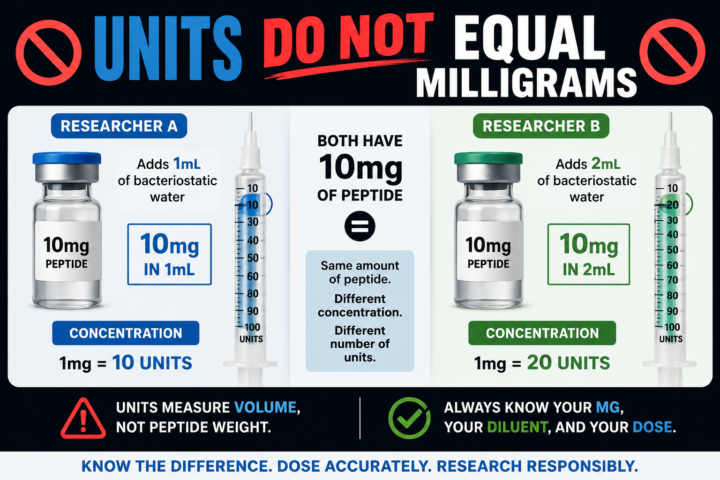
Units ≠ Milligrams: One of the Most Important Concepts in Peptide Research
If there is one thing I wish every new peptide researcher understood, it's this: Units do NOT equal milligrams. Let me say that again for the people in the back: Units are not a measurement of how much peptide is in the vial. They are simply a measurement of volume based on how much liquid you added to reconstitute the peptide. This is where many dosing mistakes happen. Example: Let's say you have a vial that contains 10mg of peptide. Researcher A adds 1mL of bacteriostatic water. Researcher B adds 2mL of bacteriostatic water. Both researchers still have exactly 10mg of peptide. The amount of peptide didn't magically change. What changed is the concentration. Researcher A - 10mg in 1mL - 1mg = 10 units - Researcher B - 10mg in 2mL - 1mg = 20 units - Same peptide. Same milligram amount. Different number of units. This is why asking: "How many units should I take?" is impossible to answer without knowing: - How many milligrams are in the vial - How much diluent was added - What dose is being targeted Why This Matters: Imagine two different vendors selling the same peptide. Vendor A's laboratory testing shows the vial contains 9.2mg. Vendor B's laboratory testing shows the vial contains 11.1mg. Both may be labeled as "10mg." If you are dosing based solely on units and not the actual laboratory-tested content, your dosing could be significantly different than intended. This is why I constantly emphasize: ☑️Review the CoA ☑️Verify the actual tested amount ☑️Use a peptide calculator ☑️Understand your concentration ☑️Never assume units equal milligrams The Takeaway: Milligrams tell you how much peptide you have. Units tell you how much liquid you're drawing into the syringe. They are not interchangeable. The researchers who take the time to understand this concept make fewer dosing errors, get more consistent results, and become far more confident in their research. If you're new to peptides, learning concentration calculations and dosing calculators is one of the most valuable skills you can develop.
1-30 of 404

skool.com/peptidejunkies24
Advance your peptide research with precise, science-driven guidance, expert community talk, and access to vetted suppliers, promotions, and giveaways.
Leaderboard (30-day)
1

+6
2

+3
3
+2
4

+2
5

+2
Powered by