Write something


Feb 18 •
Welcome everyone!
I've noticed we've had some new members join lately! So nice to have you all here. If you have any questions, feel free to drop them below for discussion :)
Feb 12 •
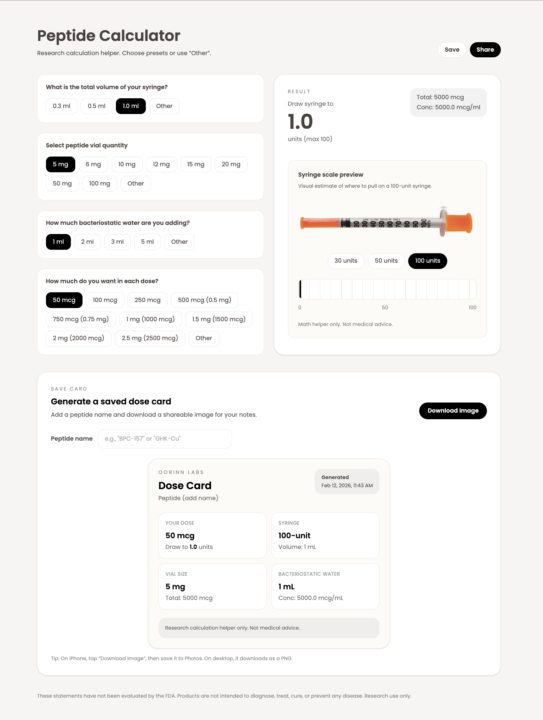
Our Peptide Dosage Calculator!
If you are confused how many "units" to pull to, how much water to reconstitute with, or anything in between, use this free peptide calculator to calculate how to get your desired dosage! https://oorinn.com/about/peptide-calculator
0
0
Feb 12 •
FAQ #2 - Different Kinds of Injections
Different Injection Methods for Peptides Spotlight on Peptide Injection Methods 💉🧠 Hey everyone! 👋 We're back with FAQ #2 in our peptide education series — this time diving into one of the most asked-about topics: injection methods. New researchers often wonder, "Where do I inject? What angle? SubQ or IM?" Today we're breaking down the main types of injections used in peptide studies, how they differ, common sites, needle tips, and which peptides typically align with each method (with examples like BPC-157's flexibility). Let's make it clear and beginner-friendly! 📚 What Are the Main Injection Types for Peptides? 🔍 In peptide research (typically in vitro or animal models), administration route affects absorption speed, bioavailability, and localized vs systemic effects. The most common are: 1. Subcutaneous (SubQ or SC) 🩹 - Injected into the fatty tissue layer just under the skin. - Slow, steady release — ideal for peptides needing sustained systemic effects. - Most common method for the majority of research peptides. - Angle: 45° if pinching skin (thinner individuals or areas), or 90° straight in with no pinch (more fat). - Needle: 29–32 gauge, ½-inch (insulin syringes work great — thin and short for minimal discomfort). 2. Intramuscular (IM) 💪 - Injected directly into muscle tissue. - Faster absorption than SubQ due to richer blood supply. - Used for peptides where quicker onset or higher bioavailability is desired in studies. - Angle: Always 90° straight in. - Needle: 25–27 gauge, 1–1½ inch (longer to reach muscle). 3. Local / Site-Specific Injection (Near Injury) 🎯 - Injected SubQ or shallow IM directly near the area of interest (e.g., joint, tendon, or muscle being studied). - Maximizes localized effects while minimizing systemic spread. - Often used with healing peptides in preclinical injury models. - Angle & needle: Usually SubQ technique (45–90°, fine/short needle). 4. Other Routes (Less Common for Peptides) - Intravenous (IV): Rare for peptides — very fast but requires advanced technique and higher risk.
0
0
Feb 12 •
The Basics of Reconstitution
Spotlight on Peptide Reconstitution 💉🔬 Hey everyone! 👋 We're shifting gears in our peptide series to tackle one of the most common beginner hurdles: reconstitution. If you're new to peptide research, this step can feel intimidating, but it's straightforward once you know the basics. Today, we're breaking it down into a full beginner's guide — what it is, why it's needed, supplies, step-by-step process, needle tips, and more. Let's make it simple and safe! 📚 What is Peptide Reconstitution? 🧪 Reconstitution is the process of dissolving lyophilized (freeze-dried) peptide powder into a liquid solution for research use. - Peptides often arrive as a dry powder in a vial to maintain stability and shelf life during shipping and storage. - You "reconstitute" it by adding a sterile solvent (like bacteriostatic water, or BAC water) to create a usable solution. - This allows precise dosing and administration in lab settings, such as for in vitro experiments or animal models. - Without reconstitution, the peptide remains inactive and hard to handle — think of it like mixing instant coffee with water to make it drinkable! It's a crucial first step for most peptides, ensuring they stay potent and contamination-free. Essential Supplies You'll Need 🛒 Gather these before starting — quality matters for purity and safety in research: - Lyophilized peptide vial: Your starting point, usually 1–10mg of powder in a sealed glass vial. - Bacteriostatic water (BAC water): The go-to solvent. It's sterile water with 0.9% benzyl alcohol to prevent bacterial growth. Avoid plain sterile water unless short-term use (it doesn't inhibit microbes as well). - Alcohol wipes or isopropyl alcohol swabs: For sterilizing vial tops, needles, and surfaces to minimize contamination risk. - Syringes: - 3ml syringes for drawing BAC water into the vial (larger volume for easy handling). - 1ml insulin syringes (with fixed needles) for precise dosing later. - Needles: Separate if not fixed to syringes.
0
0
1-8 of 8