
Write something

Dec '25 •
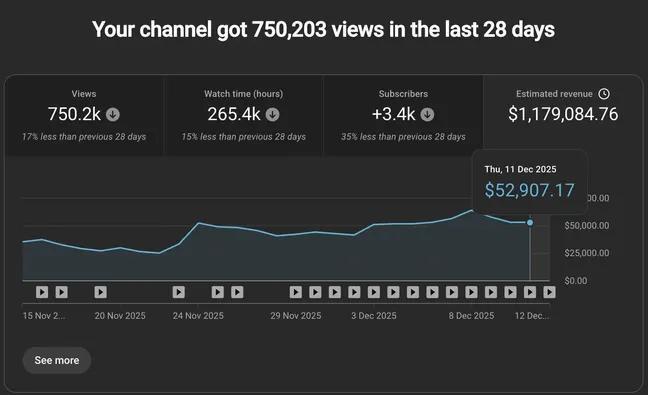
Just sharing this as a reminder of what consistency + systems can do.
In the last 28 days, this channel pulled: • 750,203 views • 265K+ watch hours • 3,400+ new subscribers • $1,179,084+ estimated revenue • One single day peaked at $52,907 This is from a faceless YouTube channel, powered by AI tools, good niche selection, and steady execution — not hype, not shortcuts. Some days are higher, some days are lower. What matters is building something that compounds over time. If you’re still learning, stay patient. If you’ve started already, don’t stop. And if you haven’t started yet, let this be proof that the opportunity is real — when done the right way. I share lessons, updates, and behind-the-scenes insights inside my Telegram community for anyone who wants to grow quietly and consistently. Telegram community: 👉 https://t.me/ytsuccessnetwork0 Telegram DM (open for questions): 👉 @Ytsuccessnetwork No pressure. Just progress.

Jul '25 •
Overcoming Resistance: Strategies for Quick Wins
When you’re leading change, especially around AI adoption, resistance is part of the process it's not personal. It’s human nature. People don’t resist change as much as they resist uncertainty and loss of control. That’s why one of the fastest ways we help teams shift from hesitation to momentum is by focusing on quick wins. Quick wins create immediate, tangible proof that change is worth it. They lower defenses, build confidence, and open the door for bigger conversations. When we teach teams how to integrate AI into their daily workflows, we don’t start with the most complex strategies. We start with something small but valuable, like saving 15 minutes on a repetitive task or building your first custom GPT. Once people experience that first win, something clicks. They see the ROI, not just in theory, but in real time, and that creates a snowball effect. The more small wins they stack, the faster the momentum builds. Curiosity turns into capability. Capability turns into confidence, and confidence makes resistance fade. Start small. Win fast. Build from there.


Jul '25 •
Awesome quick read
This article from Forbes outlines five practical shifts that can help bridge that gap and drive meaningful results. https://www.forbes.com/sites/nadyazhexembayeva/2025/06/27/ai-isnt-paying-off-yet-5-fast-fixes-to-finally-see-results/
Jun '25 •
Adopting AI is about more than just tools — it’s about mindset.
I had the opportunity to attend the EO One Canada conference this past week and saw an incredible talk by Zack Kass, Former Head of Go To Market at OpenAI. He shared a simple but powerful lens for what’s needed to thrive in the age of AI: ✨ Adaptability✨ Curiosity✨ Empathy✨ Courage✨ Wisdom These resonated deeply with me because AI is moving so fast, and success isn’t just about knowing which tools to use. It’s about how you approach change on a human level. I’d also add a few more qualities that feel essential on this journey: ✨ Flexibility — things will keep evolving; stay open and fluid. ✨ Discernment — not all AI applications will serve your mission; choose wisely. ✨ Playfulness — experimentation leads to learning; don’t be afraid to play. ✨ Collaboration — AI is not a solo sport; share, learn, and build together. The leaders and teams who cultivate these qualities will navigate this wave with far more ease (and joy). Curious — what would you add to this list? What qualities have served you as you explore AI in your work and life?
May '25 •
Creating Safe Spaces for Experimentation
One thing I’ve learned again and again, especially in the age of AI—is that innovation doesn’t happen without safety. If your team doesn’t feel safe to try, test, mess up, and learn, they’ll wait for permission instead of taking initiative. And here’s the thing: most people aren’t resisting AI because they’re lazy or behind—they’re afraid. Afraid of getting it wrong. Of looking unqualified. Of wasting time. That’s where we, as leaders, have to shift the culture. Here’s how I’ve approached creating safe spaces for experimentation on our team: 🔹 Celebrate process, not just outcomes. When someone tries something new, even if it flops—we talk about what they learned. Not every AI test will be a win. But every attempt is a step toward clarity, insight, or progress. Make that visible. 🔹 Model imperfection. I try to regularly share something I’m experimenting with—especially the messy parts. Whether it's a prompt that completely missed the mark or a tool I still don’t fully understand, naming my own learning curve helps others feel more comfortable in theirs. 🔹 Create structure for low-risk testing. We carve out space for low-stakes trial and error. Maybe it’s 20 minutes on a Friday where a teammate shares something they tested with ChatGPT, or a simple "Experiment of the Week" highlight in Slack. The goal is to normalize the trying, not just the winning. 🔹 Acknowledge courage. Trying something new takes guts. I make a point to thank people for stepping up and being curious. That kind of effort needs to be seen, especially early on, when momentum is still building. A few questions to bring to your team this week: - What’s one thing you’d love to try—even if you’re not sure it’ll work? - Where do you feel pressure to “get it right” instead of just starting? - How can we create more room for trial, error, and shared learning? Safe spaces aren’t soft, they’re strong. They’re what allow teams to stretch, explore, and grow together. Let’s build that kind of culture one small experiment at a time.
1-10 of 10

skool.com/myzoneai
Where entrepreneurs and AI enthusiasts learn, share and transform into AI-first organizations—together in a friendly peer community. No-solicitations!
Leaderboard (30-day)
1

+1
Powered by