
Write something

22d •
Who’s in Your Corner? 🤝
This morning, I turned nearly five years of weight entries into a chart. There were pounds, dates, occasional victories, and enough food emojis to open a restaurant. 😂 Around 200 pounds has acted like support, 220 like resistance, and 210 like the center of my personal trading range. Apparently, even my bathroom scale has a market outlook. My latest weight is 213.7. My goal is about 185 (based on sub-15% body fat), with guardrails to stay in the 180s. Some perspective: my all-time high was 252.5. My average over these past several years has been about 210.4—roughly 42 pounds below that high. Progress worth acknowledging. Work still worth doing. My strongest stretch came in 2024, when I went from roughly 219 to 181 in five months. I had weekly weigh-ins at a weight-loss clinic and friends alongside me. I had people in my corner. The gaps in my recording were revealing, too. Often, when I resumed, my weight was higher. Discouragement had interrupted my routine—and my feedback. I see parallels with money. The unopened statement. The account balance we haven’t checked. The savings contribution we paused and never restarted. The investment review we keep postponing because we’d rather wait until things look better. Sometimes, discouragement costs us twice: first through the setback, then through the delay in responding. Going it alone can add volatility to both the journey and our emotions. It can also make the learning curve harder: we discover through trial and error what someone beside us might already know. With saving and investing, a trusted person can help us notice spending drift, restore regular contributions, question an impulsive decision, and keep a difficult market in perspective. Research supports the value of regular feedback and accountability. In one savings experiment, feedback texts helped almost as much as group meetings. Consistent contact mattered. (povertyactionlab.org) Over time, I think togetherness has its own compounding effect. We share lessons, catch problems earlier, and build confidence through repeated follow-through. That doesn’t guarantee investment returns or uninterrupted progress. It gives good habits more opportunities to endure.
2
0

May 15 •
⏱️ millionaireME Minute: Future-Proof Yourself Today…How to Calculate and Build Your Cash Reserve Account 🤓
There’s something powerful about knowing your life can absorb a hit without falling apart. A job loss. A medical bill. A transmission. A season of uncertainty. That’s what cash reserves are for. One of the simplest frameworks I’ve seen is the 50/30/20 budget: 50% → Needs 30% → Lifestyle 20% → Future You That “20” is where future-proofing begins. Start by calculating your essential monthly expenses: ✅ Housing ✅ Groceries ✅ Transportation ✅ Utilities ✅ Insurance ✅ Minimum debt payments ✅ Childcare The basics required to keep life moving. Then multiply that number by: • 3 months if you’re young and flexible • 6 months if you have a mortgage or dependents • 9 months if your income is specialized or harder to replace • 12 months if multiple people depend on you If your essentials are $5,000/month: $5,000 times 6 = $30,000 That’s a $30,000 Freedom Fund target. Not because fear wins. But because margin matters. Open a high-interest savings account — something like Betterment Cash Reserve or another reputable HYSA — automate contributions, and begin building resilience one transfer at a time. The goal isn’t perfection. It’s becoming directionally correct and harder to shake. Do the math. Open the account. Fund the future. Begin future-proofing yourself today. #millionaireME #FutureProof #WealthBuilding #FinancialFreedom #ForTheGoodLife

Apr 26 •
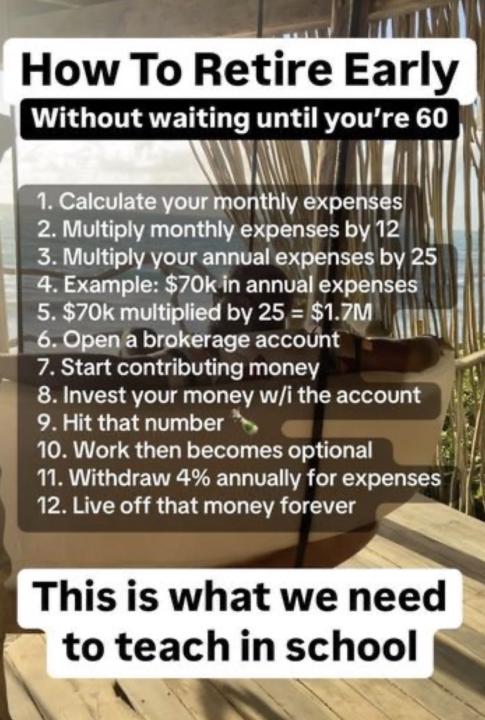
⏱️ millionaireME Minute | Retirement Is a Number, Not an Age
Most people think retirement starts at 65. It doesn’t. Retirement starts when work becomes optional. The simple math is this: Know your annual expenses. Multiply that number by 25. That gives you a rough target for financial independence. If you need $70,000 per year to live, your target is about $1.75 million. Why? Because the 4% rule suggests that withdrawing roughly 4% annually from a properly invested portfolio may allow your money to last for decades. That means retirement is less about age and more about ownership. The goal is not to stop working. The goal is to stop needing to work. This is why spending matters so much. Every dollar you don’t need lowers the number. Every dollar you invest helps close the gap. Own more. Owe less. Create margin. That’s freedom. Your two-part challenge today: First, run the math.What does your number look like? Second, ask yourself honestly: What expenses could I cut? What actions could I take to earn more? What habits would help me save and invest more consistently? Because financial independence rarely arrives through one giant move. It shows up through small, repeated decisions made on purpose. Give it a try. You may find your version of “early retirement” is a lot closer than you think.
Apr 9 •
⏱️ millionaireME Minute | The Wealth Path or Broke Path? (Choose wisely.)
There are really only two financial playbooks in life. Not 100. Not complicated. Just two. 📈 The Wealth Path - Spend less than you earn - Invest early and consistently - Build multiple income streams - Learn about money constantly - Set a budget and stick to it - Think long-term - Surround yourself with growth-minded people 📉 The Broke Path - Spend first, save never - Wait for the “perfect time” - Rely on one paycheck - Avoid learning about money - Wing it with no plan - Chase trends - Compete on lifestyle 🧠 Here’s the truth most people don’t want to hear: Nobody accidentally builds wealth. But plenty of people accidentally stay broke. And it’s rarely about income. It’s about sequence. - Do you save before you spend? - Do you invest before you upgrade your lifestyle? - Do you think years instead of weekends? 💡 The millionaireME lens This isn’t about perfection. It’s about being directionally correct. Small decisions. Repeated daily. Stacked weekly. Compounding monthly. Transformational annually. 👉 That’s how identity changes. 🎯 One simple challenge: Pick ONE habit from the wealth side…and implement it this week. Not all seven. Just one. Because momentum > intensity. Follow millionaireME for more ways to turn income into lasting wealth. 🐷🚀 #UnleashYourInnerTBA

Apr 10 •
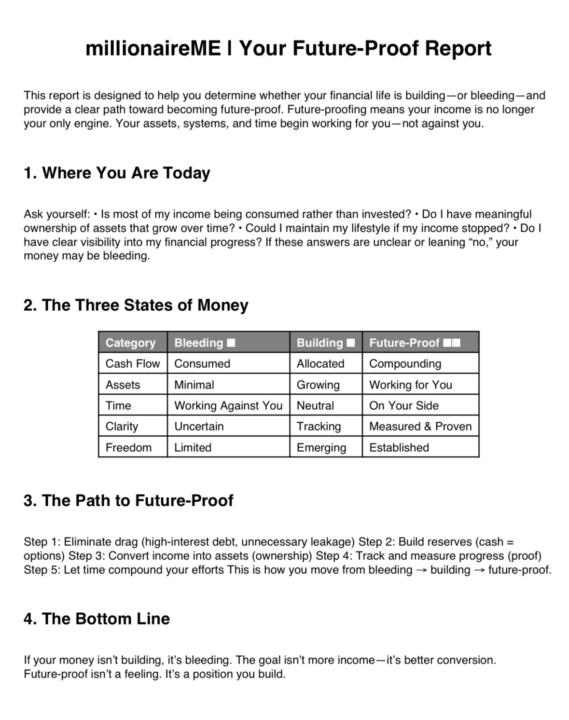
⏱️ millionaireME Minute | Building…or Bleeding?
You’re making good money—$250K+ household income. On paper, you’re winning. But here’s the uncomfortable truth: you might still be bleeding. 🩸 Not all at once. Quietly. A little more lifestyle, a little more convenience, a little more “we deserve this.” And over time, the bleed compounds. No alarm bells. Just years of effort with less ownership than you expected. That’s the trap: high income, low conversion. Motion without real progress. You’re not alone—and you’re not the problem. We live in a consumption-driven culture fueled by easy credit, BNPL, and normalized overspending. The system is designed for you to bleed slowly and invisibly. That’s why we created the Future-Proof Report—a simple framework to help you move from bleeding to building to future-proof. We help you convert income into ownership, build reserves, and grow assets—without feeling like you’re depriving yourself at every turn. Because here’s what’s at stake: Ignore it, and the bleeding continues. Time never gets a chance to work for you. You stay successful… but dependent. Address it, and your money starts building. Your balance sheet proves it. Your options expand. That’s the shift—proof. You stop guessing because now you can see your money is building, not bleeding. And that’s how you become future-proof: assets growing, time compounding, family protected, options increasing. If your income isn’t turning into ownership, it’s time to find out if you’re building—or bleeding. Start with the Future-Proof Report. If your money isn’t building, it’s bleeding.
1-30 of 368

skool.com/millionaireme-marchforward
Encouraging and Celebrating One Another’s Success Journeys Toward Wealth and Wellness via Community, Coursework, and Collaborative Technology
Powered by